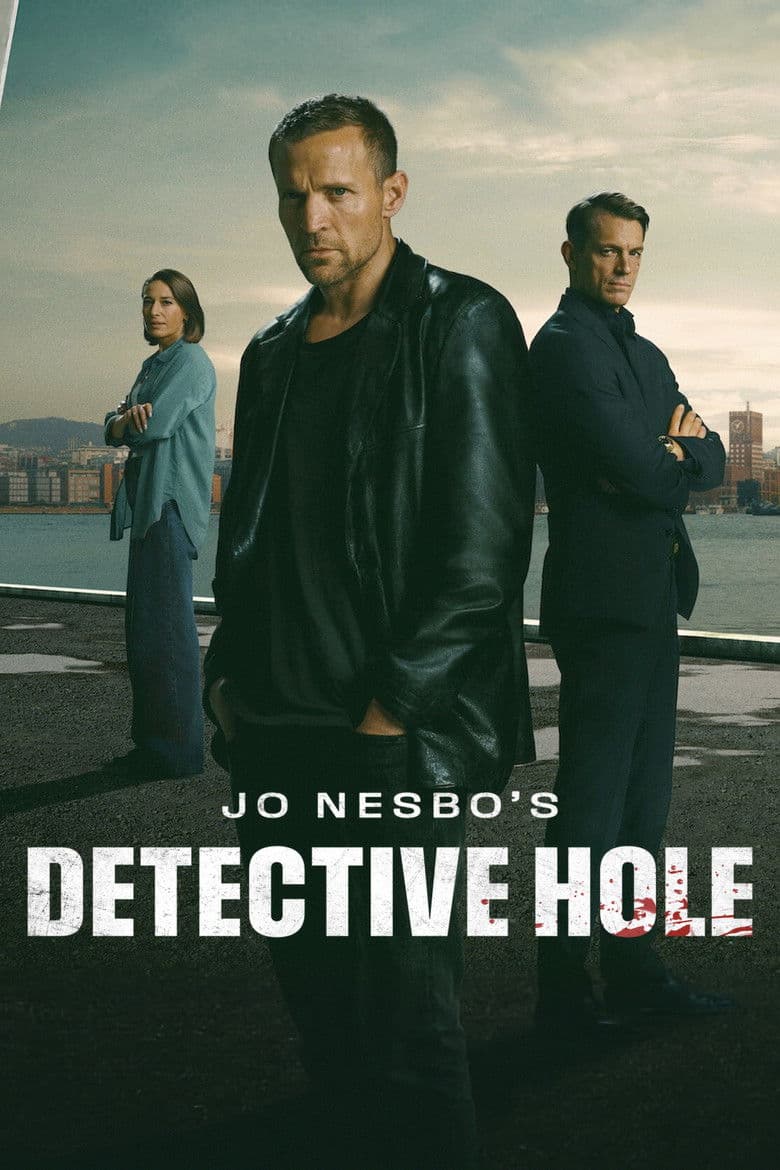
Started March 26, 2026 · Returning Series · Based on 1 season, 9 episodes through March 26, 2026 · TV-MA · Norwegian
Detective Hole follows Harry Hole, a brilliant Oslo police detective who is trying to stay sober after a crash killed his partner. When women are murdered in a pattern involving missing fingers, red star-shaped stones, and a bike courier, Harry studies the clues while his corrupt colleague Tom Waaler controls the case. Harry also tries to prove that Tom killed Ellen, a fellow officer, and is selling weapons through a criminal network. The season is a grim and violent crime story about guilt, addiction, revenge, police corruption, and the cost of chasing justice.
The clearest woke elements come from identity changes in the book adaptation. Tom has a past relationship with a man and seeks a male sex worker, and the encounter becomes a brutal killing. The police discuss whether the crime targets the gay community. One senior official also favors Tom over Ellen because he wants a male successor. These points matter to a major side plot, but the main story still centers on murder, corruption, dark religious symbols, alcoholism, and revenge rather than a broad activist message.
Community feedback
Was our 48% Woke rating accurate?
Breakdown
These are the editorial factors and ratings behind our score for Detective Hole.
Woke representation / casting
Not present. The main cast is mostly Norwegian or Swedish, which fits the Oslo setting and source material. The show does not frame its casting as a diversity or identity campaign.
0%
Woke political dialogue
A senior police official insists on a male candidate even though Ellen is praised as a strong leader. Vibeke says that a woman’s active sex life is healthy, while Anders judges murdered women for their sexual behavior. These brief exchanges touch gender roles and sexual double standards, but the season has no recurring activist speeches.
25%
Identity-driven story themes
Tom Waaler has a past relationship with a man, and his private sexuality is tied to the death of Harry’s police partner, Lars. Tom then approaches a male sex worker, and the encounter ends in a brutal killing. Police discuss whether the crime targets the gay community. This gives a major rival a queer-centered backstory, but it remains a side plot within a nine-episode murder story.
45%
Western institutional / cultural critique
A senior police official favors Tom over Ellen because he wants a male successor, even though the chief calls Ellen an excellent leader. The scene presents old gender bias inside the police. The season’s larger criticism targets bribery, weapon dealing, and police corruption, not family life, religion, or wider Western culture.
18%
Woke character or canon changes
The TV version gives established villain Tom Waaler a hidden relationship with a man that is not part of the source novel’s main setup. The change makes same-sex desire, secrecy, and shame part of his rivalry with Harry. The season also adds other same-sex relationships around the police world and changes backstory details from The Devil’s Star and earlier Harry Hole books. These identity changes shape a major rival’s arc across the season.
70%
Anti-woke backlash and complaints
Not present. The reported complaints focus on gore, pacing, plot clarity, dubbing, accents, and book changes. No meaningful anti-woke, DEI, or identity-politics backlash was found by the review cutoff.
0%
Creator track record context
Jo Nesbø has a mild general social and political signal but no sustained DEI or identity campaign. Øystein Karlsen and Anna Zackrisson have no documented activist or representation-first public record. The listed producers also have low or zero signals and no clear activist platform.
15%
Production
TV Show · 2022
Lucy wakes every night at exactly 3:33am. Nothing in her life has made sense for a long time. But the answers are out there, somewhere, at the end of a trail of brutal murders.
TV Show · 2018
After his daughter goes missing, a widower begins uncovering the dark secrets of the people closest to him.

TV Show · 2020
Zoe Walker leaves her quiet life behind to investigate her brother's disappearance in Ibiza, where she quickly heads down a decadent and dangerous path.
TV Show · 2025
A brash but brilliant cop becomes head of a new police department, where he leads an unlikely team of misfits in solving Edinburgh's cold cases.
TV Show · 2024
When ex-soldier Maya sees her murdered husband on a secret nanny cam, she uncovers a deadly conspiracy that stretches deep into the past.
TV Show · 2026
Ben Reilly, an aging and down on his luck private investigator in 1930s New York, is forced to grapple with his past life as the city's one and only superhero.
TV Show · 2020
When an insidious supernatural force edges its way into a seemingly straightforward investigation into the gruesome murder of a young boy, it leads a seasoned cop and an…
TV Show · 2020
A family's lives are irreparably disrupted when the 14-year-old son is accused of murdering a fellow classmate.
