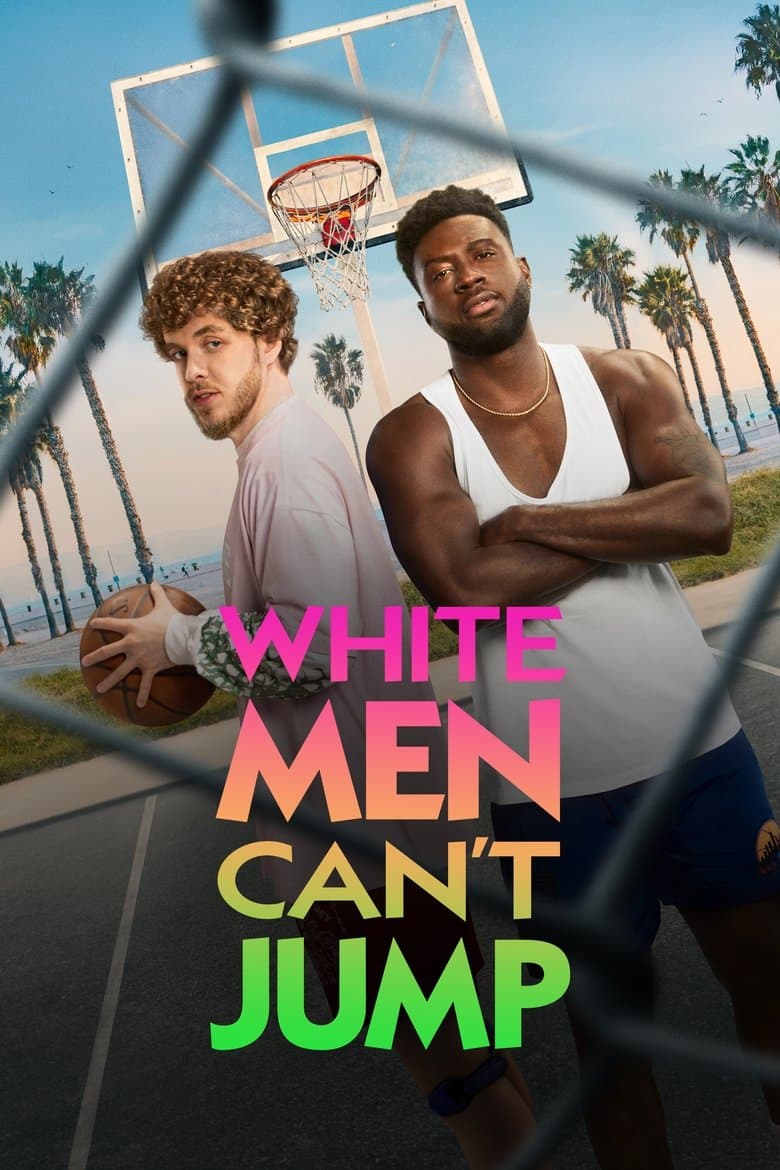
White Men Can’t Jump follows Kamal Allen, a former high school star who lost his path to pro basketball after a violent mistake and now works as a delivery driver. He supports his wife Imani and their son while caring for his sick father and struggling with anger and fear of failure. Jeremy is a white former college player whose bad knees and painkiller habit have left him broke and stuck. The two men hustle pickup games across Los Angeles so they can enter a major streetball tournament. The film mixes loud jokes, racial banter, family drama, and hopeful sports scenes.
Race is visible in nearly every part of the friendship because Kamal is black and Jeremy is white, and players repeatedly joke about stereotypes, gentrification, reparations, and who belongs on a basketball court. Jeremy also performs a fake caring, socially aware style that other Black players read as another kind of racism. The story gives real weight to black male anger, mental health, fatherhood, and learning to accept help, while Imani and Tatiana push the men toward better choices. The film presents these ideas through jokes and personal problems instead of speeches, and the message is that people can cross racial lines through trust and shared work.
Community feedback
Was our 56% Woke rating accurate?
Breakdown
These are the editorial factors and ratings behind our score for White Men Can't Jump.
Woke representation / casting
Not present. The main Black and white players and mostly black supporting cast fit a Los Angeles streetball story. Interviews mention a diverse cast, but the film does not show a clear one-of-each design or a diversity-first message tied to the casting.
0%
Woke political dialogue
The characters repeatedly talk about race in the streetball scenes. The jokes mention reparations, gentrification, interracial marriage, Black love, and white support for the black community. Jeremy’s race-aware language often shows his awkwardness rather than offering a perfect lesson. The film returns to this banter throughout the story, but it does not give a long activist speech.
42%
Identity-driven story themes
Kamal’s story centers on black male anger, mental health, family pressure, and learning to accept help. The friendship with white Jeremy grows through repeated arguments about race and racial stereotypes. Imani and Tatiana push the men toward better choices and emotional honesty. The film treats these ideas as personal problems in a sports comedy instead of presenting a broad activist campaign.
45%
Western institutional / cultural critique
The film briefly jokes about gentrification when a character complains that the players are hurting his changed neighborhood. The film also shows Jeremy losing a job after a fight is clipped and sent to corporate, which touches on social-media pressure and workplace judgment. Neither event grows into a repeated attack on Western institutions, capitalism, religion, or traditional family life.
18%
Woke character or canon changes
The original film’s Latina girlfriend Gloria is replaced by Tatiana, who is played by black actor Laura Harrier. This changes the race of a visible supporting character in the lead couple’s story. The two male leads keep the original white and Black setup, so the identity change is limited.
28%
Anti-woke backlash and complaints
Small X accounts called the remake woke and attacked what they saw as anti-white racial insults. A few Reddit users called it a watered-down remake tied to a woke agenda. Other small right-leaning X users said it was not especially woke and liked the racial banter. No large account, boycott, review-bomb campaign, or sustained news controversy appeared.
24%
Creator track record context
Calmatic has a representation-conscious career and has spoken about creating chances for black and brown filmmakers. Kenya Barris is known for black-ish, which often uses race and social issues as story subjects. Ron Shelton and Doug Hall show weaker or mixed signals, and the producers mostly have neutral public records. The group gives the film a moderate creator track record context, not a strong shared record of activist campaigning.
48%
Production
Movie · 2017
When dictator Joseph Stalin dies, his parasitic cronies square off in a frantic power struggle to become the next Soviet leader.
Movie · 2025
1984; Michael Larson, an unemployed ice-cream truck driver from Ohio, steps onto the game show "Press Your Luck" harboring a secret: the key to endless amounts of money.

Movie · 2019
A young Scottish singer, Rose-Lynn Harlan, dreams of making it as a country artist in Nashville after being released from prison.
Movie · 2022
After discovering a once-in-a-lifetime player with a rocky past abroad, a down on his luck basketball scout takes it upon himself to bring the phenom to the States without his…
Movie · 2016
An improv group deals with several crises, including the loss of their lease and one member hitting the big time.
Movie · 2019
The story of Rudy Ray Moore, who created the iconic big screen pimp character Dolemite in the 1970s.
Movie · 2024
In 2008, during the last month of summer before high school begins, an impressionable 13-year-old Taiwanese American boy learns what his family can't teach him: how to skate, how…

Movie · 2019
An unlikely friendship between two neighbors becomes an unexpectedly emotional journey when the younger man is diagnosed with terminal cancer.
