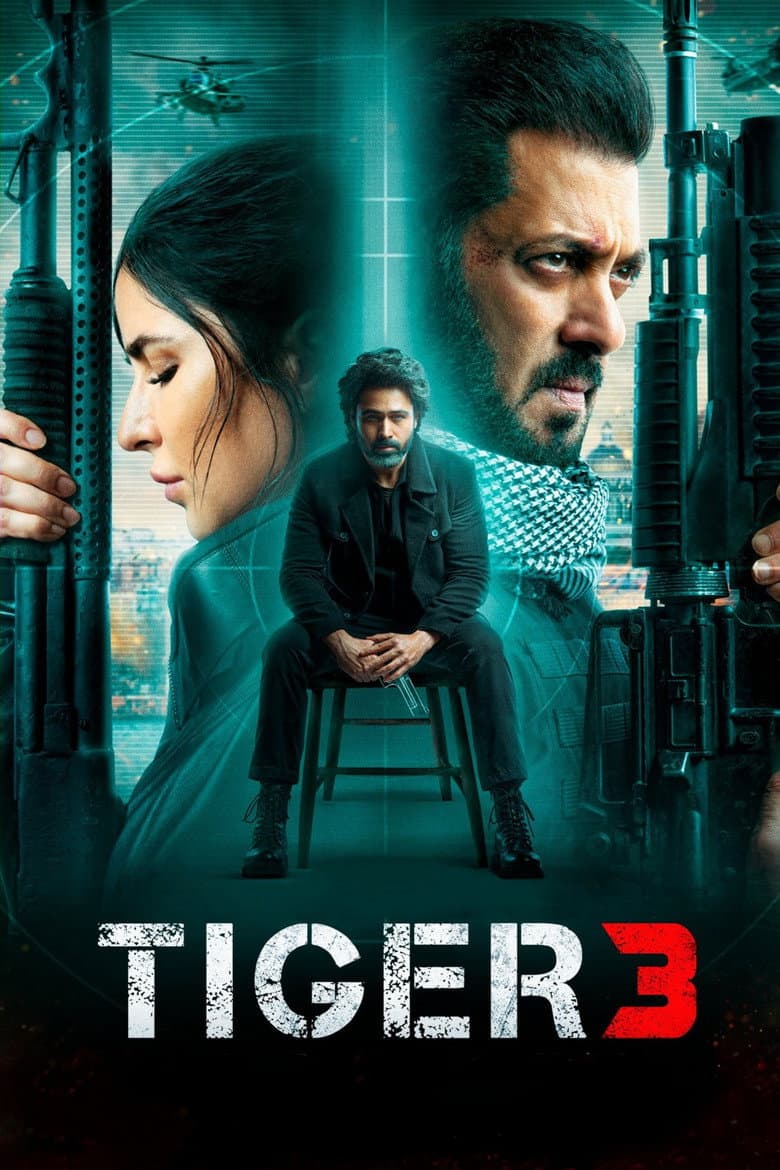
Avinash “Tiger” Singh Rathore is an Indian spy who lives quietly with his wife, Zoya, and their son. Zoya is a Pakistani spy, so their marriage is tested when Tiger learns that she may be helping a dangerous enemy. Aatish Rehman wants revenge and plans to remove Pakistan’s prime minister during a new peace effort with India. Tiger and Zoya travel through Europe, Russia, and Pakistan as they escape prison, protect their family, and stop a coup. The film uses huge fights, chases, spy tricks, family danger, and jokes in a loud action style.
The strongest social message supports friendship between India and Pakistan. It makes an Indian hero protect Pakistan’s female prime minister and treats ordinary Pakistani people as separate from the violent plotters in the army and spy groups. It gives Zoya equal space in the fights and places women in major jobs as spies, agency chiefs, and a national leader. The ending links peace to lower weapons spending, democracy, and choosing peace over hate. These ideas shape the main mission, but the film still spends most of its time on action, family loyalty, revenge, and spy twists.
Community feedback
Was our 54% Woke rating accurate?
Breakdown
These are the editorial factors and ratings behind our score for Tiger 3.
Woke representation / casting
Zoya is a Pakistani spy who matches Tiger in combat and planning. The film also places women in the top RAW job, the Pakistani prime minister role, and a dangerous field mission. These choices make women active leaders and fighters across the main plot. YRF marketed Zoya as the spy universe’s first female spy, and Katrina Kaif spoke about her equal footing in the action.
46%
Woke political dialogue
The Pakistani prime minister proposes a large cut in defense spending if India does the same. The film asks the audience to choose democracy over dictatorship. The closing message places peace against hate. These lines appear mainly around the main mission and ending, rather than throughout the whole film.
33%
Identity-driven story themes
An Indian spy and a Pakistani spy form a married couple, and their bond drives the main conflict. Tiger risks his family and life to save Pakistan’s peace-minded prime minister from a military takeover. The film separates ordinary Pakistanis and a democratic leader from rogue security figures. The ending shows Pakistani children thanking Tiger while singing India’s anthem. This peace and cross-border message drives much of the second half, but the movie remains mostly an action thriller.
48%
Western institutional / cultural critique
Not present. The film does not attack Western culture, Christianity, capitalism, family life, or traditional gender roles. Its coup conflict concerns Pakistan’s military and political power, not Western institutions.
0%
Woke character or canon changes
Not relevant. The film continues the established Tiger and Zoya characters in the YRF Spy Universe. It adds new plot events but does not change their established race, gender, or sexuality.
0%
Anti-woke backlash and complaints
Indian nationalist accounts repeatedly called the film pro-Pakistan, Pakistani propaganda, or an Aman Ki Asha message. Indian Express and The Lallantop reported the dispute. Some Boycott Bollywood posts urged people not to buy tickets. The supplied X research found no organized review-bombing, so the complaints stayed below a broad national campaign.
42%
Creator track record context
Maneesh Sharma’s cached record shows repeated stories about women with more choice, but little public activism. Aditya Chopra’s cached record includes several women-centered and social issue films. Shridhar Raghavan mainly writes mainstream spy and action stories. The other cached producers and crew show little documented activist record. This gives Tiger 3 some representation-oriented context without showing a strongly activist creative team.
30%
Production

Movie · 2016
A man who bears a striking resemblance to a renowned movie star becomes an obsessive fan, but when his fierce love is spurned by the star, he decides to destroy the star's life…

Movie · 2019
A battle for power ensues as warring gangters thrive to gain possession of a "black box" that can make them richer than they already are, and an undercover cop intervenes with the…
Movie · 2019
Shown from the perspective of a young submariner with unusually sensitive hearing and uncannily precise sound recognition.
Movie · 2018
Framed and on the run, a former FBI agent must save his family from a blazing fire in the world's tallest building.

Movie · 2024
Kraven Kravinoff's complex relationship with his ruthless gangster father, Nikolai, starts him down a path of vengeance with brutal consequences, motivating him to become not only…

Movie · 2023
Ethan Hunt and his IMF team embark on their most dangerous mission yet: To track down a terrifying new weapon that threatens all of humanity before it falls into the wrong hands.

Movie · 2019
A big-game hunter for zoos books passage on a Greek shipping freighter with a fresh haul of exotic and deadly animals from the Amazon, including a rare white Jaguar – along with a…

Movie · 2016
A suicidal artist goes into the desert, where he finds his doppelgänger, a homicidal drifter.
