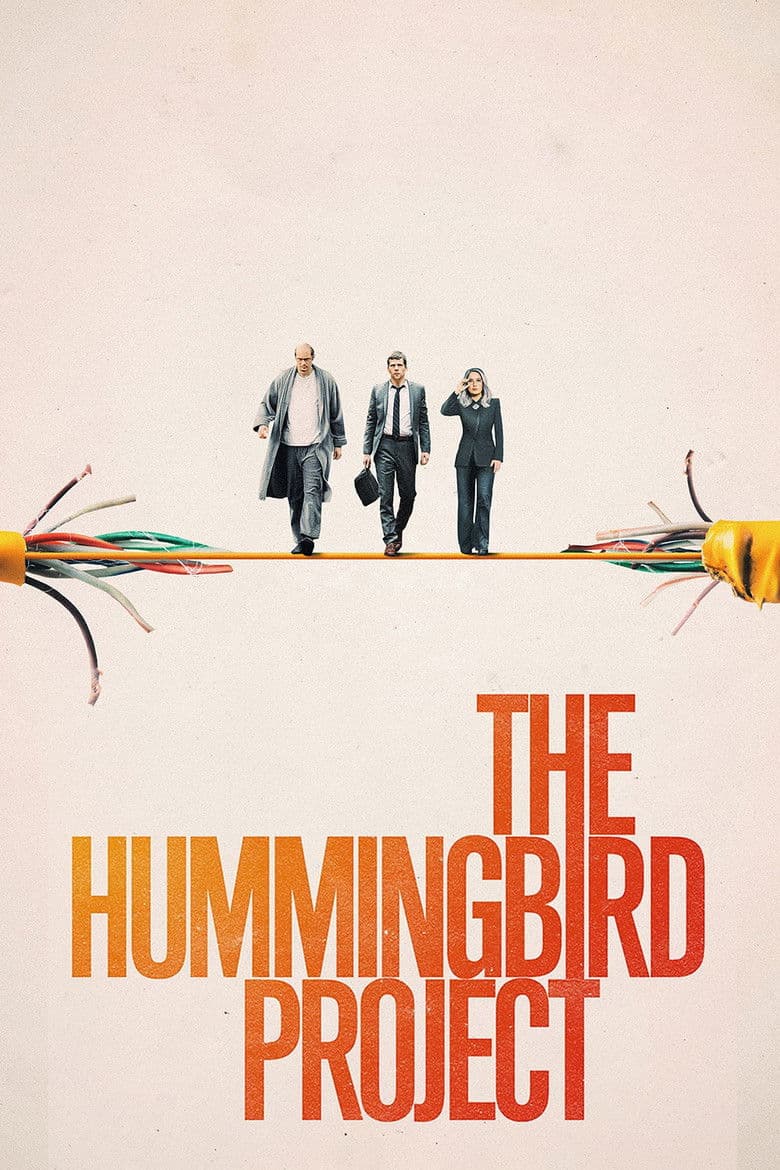
Vincent Zaleski is a fast-talking New York trader who wants to win a fortune by building a perfectly straight fiber-optic cable from Kansas to New Jersey. His cousin Anton writes the code, while their former boss Eva Torres tries to beat them with a faster plan of her own. Vincent sells the project as a fight between small players and a giant company, even though he is chasing millions for investors. The work forces the men through forests, mountains, land deals, legal trouble, and Vincent’s stomach cancer. The film feels tense, strange, and darkly funny, but its world grows colder as the race for milliseconds takes over their lives.
The clearest woke-leaning material is the film’s repeated attack on high-frequency trading and the wider money system. A waitress asks what Zimbabwe’s lemon farmers gain, and Anton admits that the system treats them as irrelevant. Mark, a working-class contractor, mocks rich gated communities and the way their waste is pushed back toward everyone else. The project cuts through forests and protected land, while Vincent’s illness turns his hunger for success into a warning about a life spent chasing money. Its social message is mainly an anti-capitalist critique, while representation and immigrant identity remain supporting elements.
Community feedback
Was our 38% Woke rating accurate?
Breakdown
These are the editorial factors and ratings behind our score for The Hummingbird Project.
Woke representation / casting
The film presents Eva Torres as a powerful Latina boss who runs the men’s former company and remains their strongest rival. The film also makes Vincent and Anton second-generation Eastern European New Yorkers and gives their immigrant family history a visible scene. The production notes frame those choices as part of an immigrant story and connect them to modern diversity. The plot stays centered on trading and greed, so the representation signal is clear but not dominant.
34%
Woke political dialogue
The film uses a few direct lines about the human cost of the market. A waitress asks what Zimbabwe’s lemon farmers gain, and Anton says the trading system treats them as irrelevant. Mark mocks rich gated communities and the way their waste is sent back toward poorer areas. These lines create a mild anti-capitalist and class-focused message, but the film has no repeated race, gender, DEI, or queer politics.
30%
Identity-driven story themes
Vincent tells a brief story about his Russian immigrant parents and his father’s arrest as a suspected spy. The film links that family history to his need to own his freedom and prove himself in America. The film does not turn the story into a wider race or immigration debate. Identity is a small character thread beside the main story about money, illness, and ambition.
18%
Western institutional / cultural critique
The film repeatedly attacks high-frequency trading, extreme wealth chasing, and the idea that every problem can be solved by faster money. It shows traders ignoring farmers, damaging forests, and treating workers and land as tools. Vincent’s illness and the project’s failure make the race for profit look empty. The critique targets finance, greed, and the American Dream, not Christianity or traditional gender roles.
38%
Woke character or canon changes
Not relevant. The film is an original story about fictional traders. No established characters or historical figures have their identity changed.
0%
Anti-woke backlash and complaints
Not present. Web searches and the cached X pass found no clear anti-woke complaint, boycott, or review-bombing tied to the film. The available public discussion focused on the story, acting, pacing, and capitalism.
0%
Creator track record context
Kim Nguyen’s cached record includes War Witch, which centers a young girl forced into war and carries humanitarian and gender-focused themes. Heidi Levitt’s cached record includes support for casting that reflects changing racial makeup. Several cached producers have credits involving queer stories or people pushed aside by society. Nguyen’s title-related comments also frame this film as an immigrant story set against modern America, so the context is noticeable but still mixed rather than a strong activist pattern.
22%
Production
Movie · 2023
In 1988, American video game salesman Henk Rogers discovers the video game Tetris. When he sets out to bring the game to the world, he enters a dangerous web of lies and…
Movie · 2017
A former rodeo star, now a motel manager, meets a young man who is responsible for the violence that suddenly has seized his small town.

Movie · 2016
Irish Commandant Pat Quinlan leads a stand off with troops against French and Belgian Mercenaries in the Congo during the early 1960s.

Movie · 2016
When Krisha returns to her estranged family for Thanksgiving dinner, past demons threaten to ruin the festivities.

Movie · 2021
A truffle hunter who lives alone in the Oregon wilderness must visit Portland to find the mysterious person who stole his beloved foraging pig.

Movie · 2017
In a small town in Maine, seven children known as The Losers Club come face to face with life problems, bullies and a monster that takes the shape of a clown called Pennywise.

Movie · 2020
2038: George Almore is working on a true human-equivalent AI, and his latest prototype is almost ready. This sensitive phase is also the riskiest as he has a goal that must be…

Movie · 2019
During the 1980s, a failed stand-up comedian is driven insane and turns to a life of crime and chaos in Gotham City while becoming an infamous psychopathic crime figure.
