Movie review
November 2, 2016 · 87 min · G · Documentary · Kids · Adventure · Family
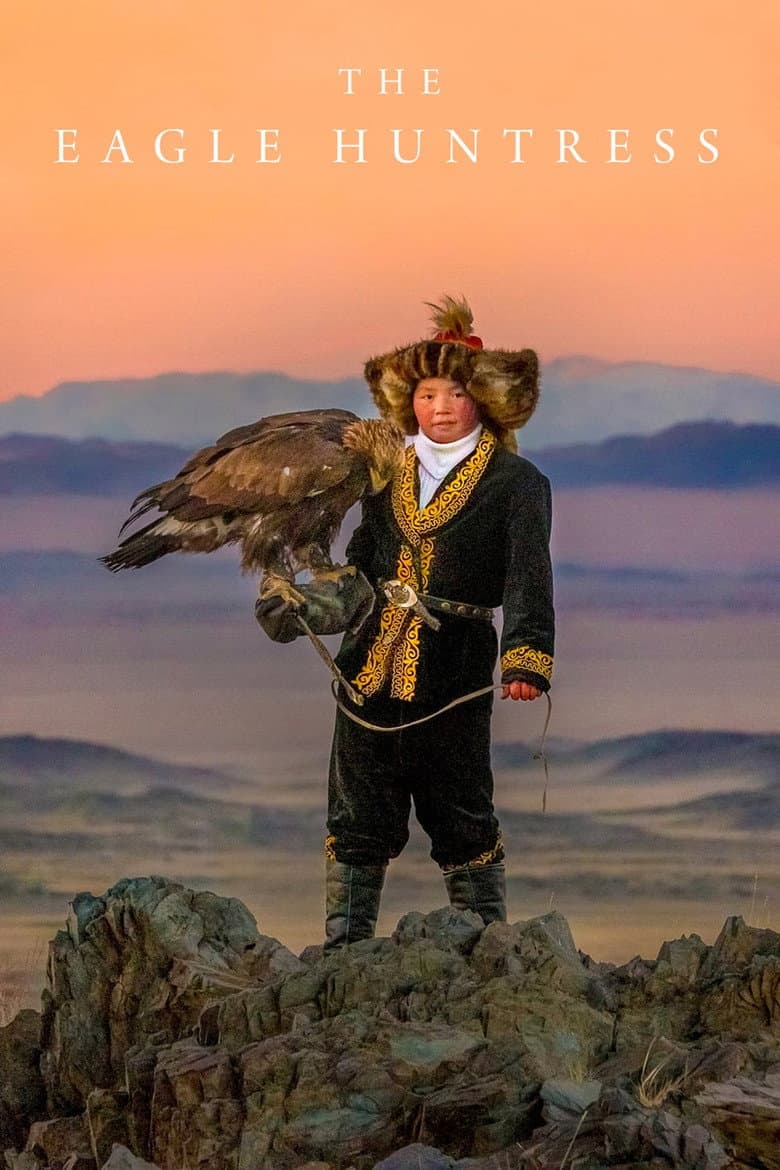
The Eagle Huntress follows Aisholpan, a 13-year-old Kazakh girl who lives with her family in Mongolia’s Altai Mountains. Her father teaches her to train a golden eagle, capture a young bird, and enter the Golden Eagle Festival. She faces older hunters who doubt that a girl can handle the cold, the mountains, or the work. The film then follows her into a dangerous winter hunt for a fox, while showing a warm family bond and a beautiful adventure.
The film makes gender the main part of Aisholpan’s challenge. Older men say that girls should stay home, make tea, or avoid eagle hunting, while her parents support her skills and goals. The story presents her win as proof that girls can succeed in a task usually passed from father to son. The message stays clear through the contest, the family’s support, the voice-over, and the closing song, while the film also teaches viewers about Kazakh family life and eagle hunting.
Community feedback
Was our 70% Woke rating accurate?
Breakdown
These are the editorial factors and ratings behind our score for The Eagle Huntress.
Woke representation / casting
The film centers a real 13-year-old girl in a tradition shown as mostly male. The choice is tied to a clear “first female” and girl-power frame, not just to an ordinary family portrait. Aisholpan is a real subject rather than a fictional role, and the film does not build a large cast around different identity groups.
30%
Woke political dialogue
Several older hunters say that girls are weaker, get cold, and should stay home to prepare tea and milk. The film places these lines against Aisholpan’s training and contest. Aisholpan and her father answer with the message that girls and boys can be equal. The comments are brief but repeated.
34%
Identity-driven story themes
The film makes Aisholpan’s gender the main part of her challenge. It shows her becoming the first woman in 12 generations of her family to enter and win a major eagle-hunting event. The story presents her success as proof that girls can do work usually passed from father to son. Her family helps her, so the story is also about family support and skill.
68%
Western institutional / cultural critique
The film presents the older rule that men hunt while women prepare tea and milk as an unfair limit on girls. It uses skeptical older men as the main example of a tradition that must change. The story does not attack Christianity, business systems, or Western institutions. Its cultural critique stays focused on local gender rules.
38%
Woke character or canon changes
The film presents Aisholpan as the first female eagle hunter in Mongolia and uses that claim to build its central conflict. Researchers and later reports note earlier female eagle hunters, including Makpal Abdrazakova. The film does not change a fictional character, but it simplifies a real history in a gender-focused way.
18%
Anti-woke backlash and complaints
Some reviewers objected that the film turns a real tradition into a simple girl-power or feminist story. Other reviews said the older men were selected or edited to make the culture look more sexist than it was. The separate X check found no anti-woke reaction and no title-specific complaints. The backlash was small and mixed, while many viewers praised the message.
24%
Creator track record context
Several producers have repeated records in gender equality, representation, or social-change documentaries. Other listed producers and Otto Bell have broader documentary or entertainment careers with less identity focus. The team gives the film a clear social-impact background, but the title is not made by an entirely identity-driven group.
50%
Production
Movie · 2019
The untold true story set in the winter of 1925 that takes you across the treacherous terrain of the Alaskan tundra for an exhilarating and uplifting adventure that will test the…
Movie · 2019
As Hiccup fulfills his dream of creating a peaceful dragon utopia, Toothless’ discovery of an untamed, elusive mate draws the Night Fury away.
Movie · 2016
For years, old wood carver Mr. Meacham has delighted local children with his tales of the fierce dragon that resides deep in the woods of the Pacific Northwest.

Movie · 2025
Gabby heads out on a road trip with her Grandma Gigi to the urban wonderland of Cat Francisco. But when Gabby's dollhouse, her most prized possession, ends up in the hands of an…

Movie · 2017
Despite his family’s baffling generations-old ban on music, Miguel dreams of becoming an accomplished musician like his idol, Ernesto de la Cruz.

Movie · 2024
Paddington travels to Peru to visit his beloved Aunt Lucy, who now resides at the Home for Retired Bears. With the Brown Family in tow, a thrilling adventure ensues when a mystery…

Movie · 2021
After her grandfather's death, 20-year-old Alma decides to go back to her childhood home - a little island in the heart of the majestic Canadian forest.

Movie · 2017
Ferdinand, a little bull, prefers sitting quietly under a cork tree just smelling the flowers versus jumping around, snorting, and butting heads with other bulls.
