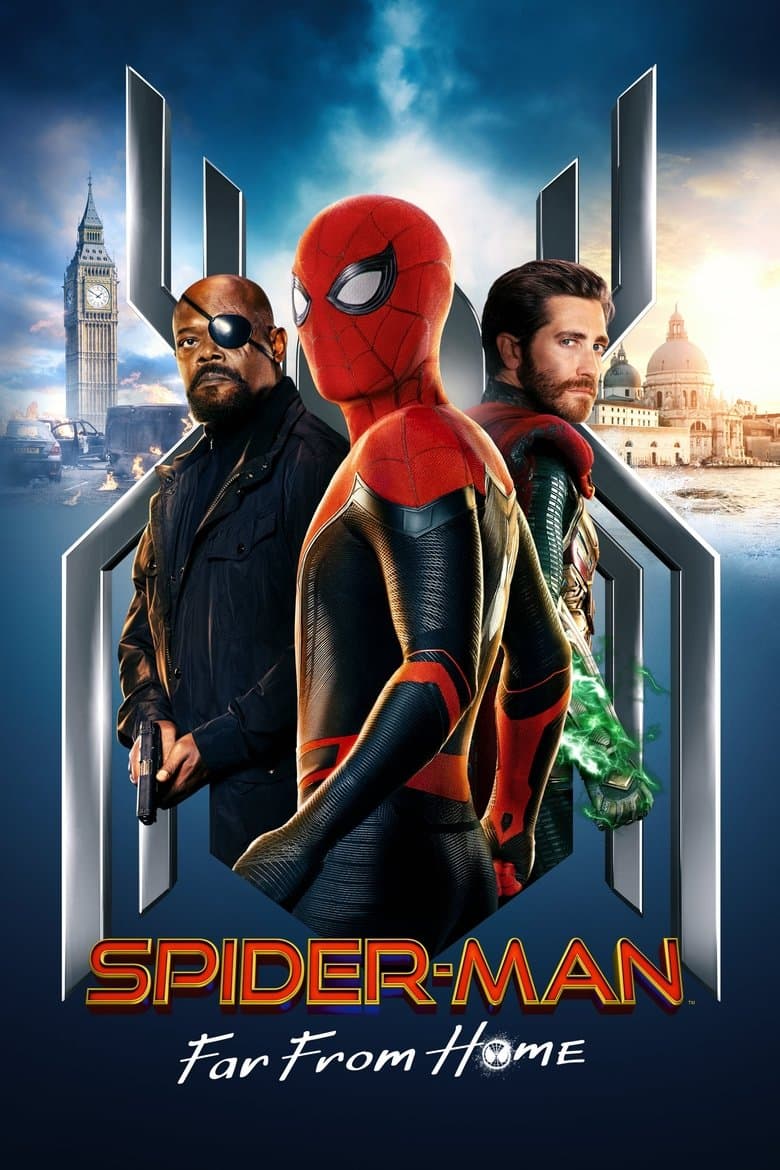
Peter Parker is a high school student who wants a quiet summer trip with his friends after the loss and return of many people in Avengers: Endgame. He travels through Venice, Prague, Berlin, and London while Nick Fury asks him to fight monsters linked to strange disasters. A new hero called Mysterio seems ready to help, but Peter soon faces lies, traps, and a threat tied to Tony Stark’s legacy. The movie mixes teen romance, school comedy, colorful superhero action, grief, and a lesson about accepting responsibility.
The class group is visibly diverse, with Zendaya playing Peter’s love interest Michelle Jones, Jacob Batalon playing Ned, Tony Revolori playing Flash Thompson, and other classmates from different backgrounds. The movie also includes a hijab-wearing classmate and a very small classmate role played by openly transgender actor Zach Barack. Those casting choices are easy to notice, but the story does not make race, gender identity, or sexuality part of the conflict. The larger character changes are that MJ is a new version of the familiar Spider-Man love interest and Flash is a smaller, internet-focused student instead of the usual big school athlete.
Community feedback
Was our 39% Woke rating accurate?
Breakdown
These are the editorial factors and ratings behind our score for Spider-Man: Far From Home.
Woke representation / casting
The school group shows a repeated pattern of visible identity casting. Zendaya’s MJ, Jacob Batalon’s Ned, Tony Revolori’s Flash, Remy Hii’s Brad, and a hijab-wearing classmate all have roles around Peter. Zach Barack appears as a minor classmate, and coverage treated his casting as a transgender visibility milestone even though the film does not state that the character is trans. The New York school setting makes a mixed class believable, so the pattern is noticeable but not the main story.
48%
Woke political dialogue
Not present. The movie mentions fake news, public trust, and the danger of false images. Those ideas serve Mysterio’s deception plot and do not become activist or identity-based political dialogue.
0%
Identity-driven story themes
Not present. Peter’s identity struggle is about hiding that he is Spider-Man, while his main problems are grief, duty, and trust. The movie does not build its story around race, gender, sexuality, or group oppression.
0%
Western institutional / cultural critique
Not present. The drone plot shows dangerous technology and a dishonest news broadcast. The movie does not attack Western institutions, family life, masculinity, or traditional social rules through a modern activist message.
0%
Woke character or canon changes
The film changes Flash Thompson from the blond white athlete of the comics to a smaller, online-focused student played by Guatemalan American actor Tony Revolori. The film calls Peter’s love interest Michelle Jones, or MJ, rather than the classic Mary Jane Watson identity. These visible identity and canon changes matter to the school and romance story, but the movie does not explain them through a diversity speech.
34%
Anti-woke backlash and complaints
Some fans complained that Zendaya’s MJ and Tony Revolori’s Flash were race-swapped or were not faithful versions of the comic characters. ComicBook.com reported backlash to Revolori’s casting, and the supplied X pass found only a few small accounts making similar complaints. Later posts called the MCU more woke, but they had little engagement and were not a campaign against this film. No organized boycott, review-bomb push, or large anti-woke drive was found.
15%
Creator track record context
The cached context gives Jon Watts a score of 8 and Chris McKenna and Erik Sommers scores of 13. Amy Pascal also has a low cached score of 13 and no known activist pattern. Kevin Feige has a higher cached score of 48 because he has publicly supported diversity across Marvel. The group therefore gives a low to moderate signal, with Feige as the main supporting context.
24%
Production

Movie · 2026
Fighting crime full-time as Spider-Man in a world that doesn't remember him—and the pressure of seeing his old friends move on without him—sparks a change in Peter Parker he may…
Movie · 2017
Fuelled by his restored faith in humanity and inspired by Superman's selfless act, Bruce Wayne and Diana Prince assemble a team of metahumans consisting of Barry Allen, Arthur…
Movie · 2016
Following the events of Age of Ultron, the collective governments of the world pass an act designed to regulate all superhuman activity.
Movie · 2017
The Guardians must fight to keep their newfound family together as they unravel the mysteries of Peter Quill's true parentage.

Movie · 2018
Primatologist Davis Okoye shares an unshakable bond with George, the extraordinarily intelligent, silverback gorilla who has been in his care since birth.

Movie · 2021
In a time when monsters walk the Earth, humanity’s fight for its future sets Godzilla and Kong on a collision course that will see the two most powerful forces of nature on the…
Movie · 2010
Cobb, a skilled thief who commits corporate espionage by infiltrating the subconscious of his targets is offered a chance to regain his old life as payment for a task considered…
Movie · 2021
Evan McCauley has skills he never learned and memories of places he has never visited. Self-medicated and on the brink of a mental breakdown, a secret group that call themselves…
