Movie review
October 26, 2020 · 104 min · PG · Kids · Horror · Fantasy · Comedy · Family
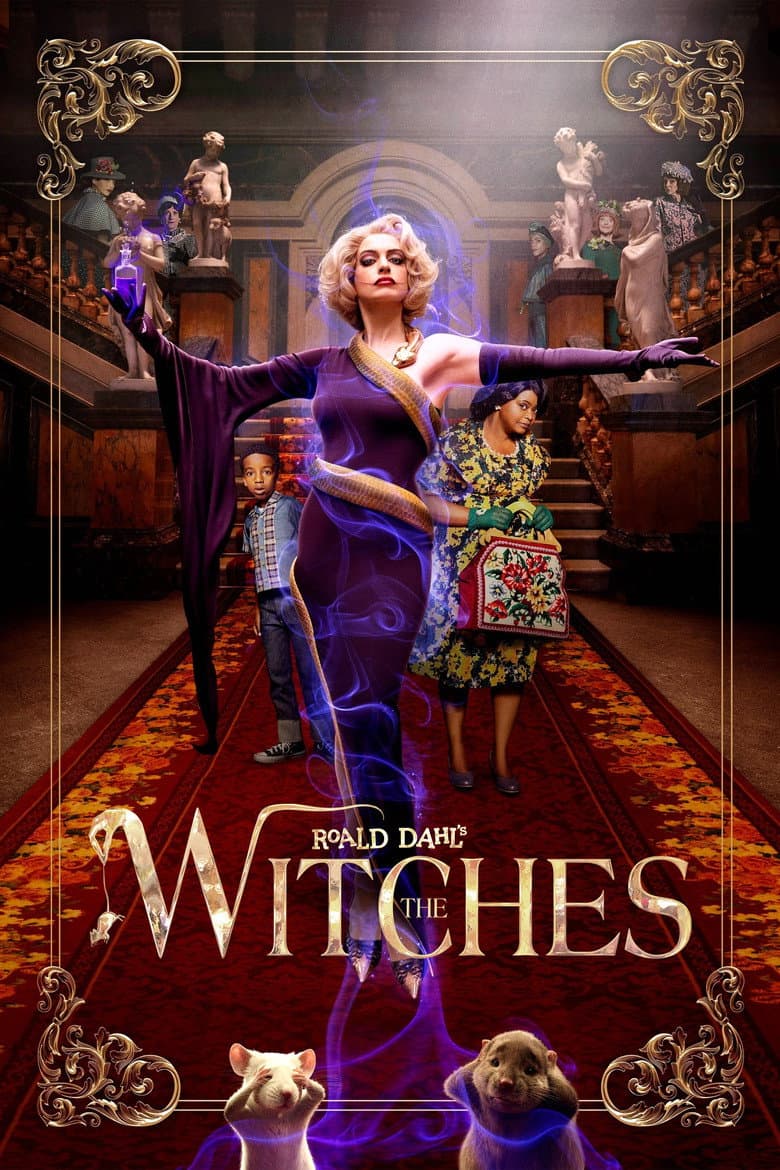
In 1967 Alabama, a young black boy named Charlie loses his parents and moves in with his grandmother Agatha. Agatha knows that real witches hide among ordinary people and want to turn children into mice. Charlie and Agatha find a witch meeting at a grand seaside hotel led by the Grand High Witch. Charlie becomes a mouse, and he must use his small size to help Agatha and two other changed children stop the plan. The film mixes scary body changes with broad jokes, warm family moments, and a bright fantasy style.
The movie makes the heroic family Black and places their past in a poor Alabama community shaped by segregation. A flashback shows Agatha's childhood friend being changed into a chicken, and the hotel shows Black workers serving wealthy white guests. Grandma says witches prey on children who are poor or overlooked, but the film does not turn that idea into a long political debate. The main story remains a fight against child-hating witches, with family love, courage, grief, and teamwork driving the ending.
Community feedback
Was our 47% Woke rating accurate?
Breakdown
These are the editorial factors and ratings behind our score for Roald Dahl's The Witches.
Woke representation / casting
The film places a black boy and his Black grandmother at the center of a story that originally used a European family. The change is audience-visible because both characters are the main heroes, and the film also presents Black hotel workers beside wealthy white guests. Zemeckis said making the hero African American was his main update, while Hathaway called increased representation a good reason to remake a classic. The Alabama setting makes the family historically plausible, but the clear identity framing lifts this above ordinary background diversity.
40%
Woke political dialogue
Not present. The characters discuss witches, grief, numerology, and the plan to change children into mice. The film has no modern activist speeches about DEI, identity politics, capitalism, elections, or current political groups.
0%
Identity-driven story themes
The film gives its main family a black identity and places their childhood history in a poor Alabama community shaped by segregation. The grandmother says witches prey on children who are poor and overlooked, which adds a small class and race angle to the danger. The hotel also contrasts Black workers with rich white guests, but the movie quickly returns to the simple fantasy plot about saving children. Race and class shape the setting, yet they do not control the main conflict or ending.
28%
Western institutional / cultural critique
The film briefly contrasts Black hotel staff with wealthy white guests. Grandma says witches target poor and overlooked children. These moments hint at race and class inequality, but the story does not make a sustained attack on Western institutions, family, religion, men, or traditional social rules.
12%
Woke character or canon changes
The film changes Dahl's unnamed English boy and Norwegian grandmother into a black boy and grandmother living in 1967 Alabama. The writers also add a history in a poor black community and place the witch meeting in a hotel serving wealthy white guests. Zemeckis said changing the hero's race was his main update, and Hathaway called increased representation a reason to remake the story. These identity-based changes affect the central heroes and setting, while the main witch plot stays close to the book.
45%
Anti-woke backlash and complaints
A small Christian-conservative review called the film a woke failure and objected to its diversity-driven casting and Chris Rock narration. No broad anti-woke campaign appeared on X, and no major news report described one. Most reported social media backlash came from disability advocates, not from people opposing identity politics. The anti-woke reaction appears real but fringe.
8%
Creator track record context
Kenya Barris has a 64/100 score because black-ish often uses race and social issues. Guillermo del Toro has a 41/100 score because his work often centers outsiders and minority representation. Robert Zemeckis and Roald Dahl have lower scores of 27/100 and 8/100. This mix gives the title some supporting context, but it does not make the whole film activist.
35%
Production
Movie · 2024
After discovering she can see everyone's imaginary friends, a girl embarks on a magical adventure to reconnect forgotten imaginary friends with their kids.

Movie · 2021
In suburban Chicago during the late 1980s, ten-year-old Jake Doyle embarks on a herculean quest to get the latest and greatest video game system for Christmas.
Movie · 2022
Disillusioned with life in the city, feeling out of place in suburbia, and frustrated that her happily ever after hasn’t been so easy to find, Giselle turns to the magic of…
Movie · 2022
A young girl discovers a secret map to the dreamworld of Slumberland, and with the help of an eccentric outlaw, she traverses dreams and flees nightmares, with the hope that she…
Movie · 2018
Be careful what you wish for. With their after school junk business, best friends Sonny and Sam hope to find treasure in other people’s trash.
Movie · 2018
When ten-year-old Lewis is suddenly orphaned, he is sent to live with his Uncle Jonathan in a creaky (and creepy) old mansion with a mysterious ticking noise that emanates from…
Movie · 2020
After losing his wife seven years earlier, the eccentric Dr. John Dolittle, famed doctor and veterinarian of Queen Victoria’s England, hermits himself away behind the high walls…
Movie · 2021
When Flora rescues a squirrel she names Ulysses, she is amazed to discover he possesses unique superhero powers, which take them on an adventure of humorous complications that…
