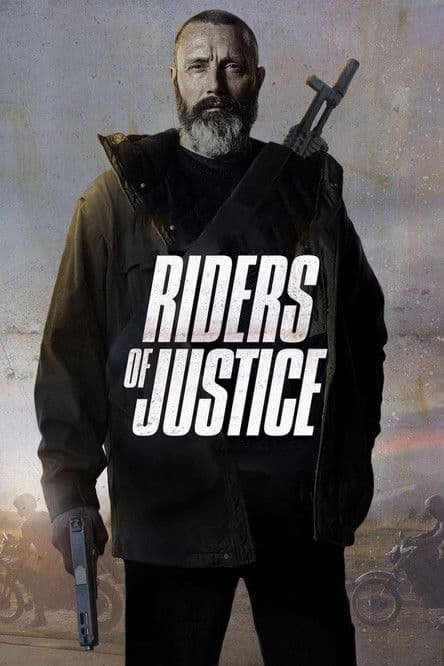
Movie review
November 19, 2020 · 116 min · NR · Danish · Comedy · Action · Thriller · Drama
Markus is a Danish soldier who returns home after his wife dies in a train crash. He must care for his teenage daughter, Mathilde, while he struggles with grief and anger. When statistician Otto claims that the crash was planned, Markus joins Otto and two odd computer experts to hunt a biker gang. The movie mixes brutal revenge violence with dry comedy, family drama, and questions about chance, guilt, and healing.
The clearest social message concerns Markus’s hard idea of manhood. He refuses counseling, shuts down his daughter’s feelings, and uses military violence to handle pain. Mathilde and the damaged men around him keep pushing him toward talk, friendship, and honest grief. The movie gives this message real space, but its main focus remains a broken family’s grief, a mistaken revenge mission, and the idea that random events can shape a life.
Community feedback
Was our 26% Woke rating accurate?
Breakdown
These are the editorial factors and ratings behind our score for Riders of Justice.
Woke representation / casting
Bodashka is presented as a gay Ukrainian sex worker who joins Markus’s group after being rescued. His identity is openly mentioned, and he remains a recurring supporting character. The film does not make him the hero or frame the cast as a diversity project. The main story still follows Danish characters dealing with grief and revenge.
20%
Woke political dialogue
Not present. The dialogue focuses on grief, fate, therapy, family, and revenge. The movie has no modern identity, DEI, or activist speech.
0%
Identity-driven story themes
Markus repeatedly treats emotional pain as a job for violence and silence. His daughter and his male friends keep pushing him toward counseling, open talk, and honest grief. The story makes his hard, old-school idea of manhood part of the problem. The main themes remain grief, chance, family, and revenge, so the identity-driven message is a smaller layer.
30%
Western institutional / cultural critique
Markus rejects counseling and mocks the priest’s claims about God, souls, and heaven. His daughter also challenges his control and his violent way of dealing with family problems. These scenes question old male habits and some religious comfort. The film keeps the conflict personal and does not attack Western institutions or current political groups.
20%
Woke character or canon changes
Not relevant. The movie is an original Danish screenplay with no established characters or historical figures being changed.
0%
Anti-woke backlash and complaints
Not present. The supplied X pass found no anti-woke complaints. Other coverage and audience discussions mainly praised the film or discussed grief, violence, and therapy.
0%
Creator track record context
Anders Thomas Jensen has a low recorded woke score of 15/100 and is mainly known for dark, politically incorrect stories about outsiders. The producers have no documented activist or DEI pattern. One casting director has a higher recorded score because of representation work elsewhere, but no title-related identity campaign is documented. The overall creator signal for this film is low.
15%
Production

Movie · 2022
Shiva, a tribal vagabond lives with his mother in hamlet, stays away from the traditional Daivaradhane and Bhoota Kola legacy due to an unforgettable childhood incident.
Movie · 2016
A young man washes ashore, his memory gone - but his past comes back to haunt him after he is nursed back to health and his killing ability is needed when he takes on a powerful…
Movie · 2021
An off-duty SAS soldier, Tom Buckingham, must thwart a terror attack on a train running through the Channel Tunnel.

Movie · 2019
Los Angeles, 1969. TV star Rick Dalton, a struggling actor specializing in westerns, and stuntman Cliff Booth, his best friend, try to survive in a constantly changing movie…
Movie · 2020
Spenser, a former Boston patrolman who just got out from prison, teams up with Hawk, an aspiring fighter, to unravel the truth behind the death of two police officers.

Movie · 2021
Jim Hanson’s quiet life is suddenly disturbed by two people crossing the US/Mexico border – a woman and her young son – desperate to flee a Mexican cartel.

Movie · 2026
A dysfunctional couple head to a remote cabin to "reconnect", but each has secret intentions to kill the other.
Movie · 2016
The Coast Guard makes a daring rescue attempt off the coast of Cape Cod after a pair of oil tankers are destroyed during a blizzard in 1952.
