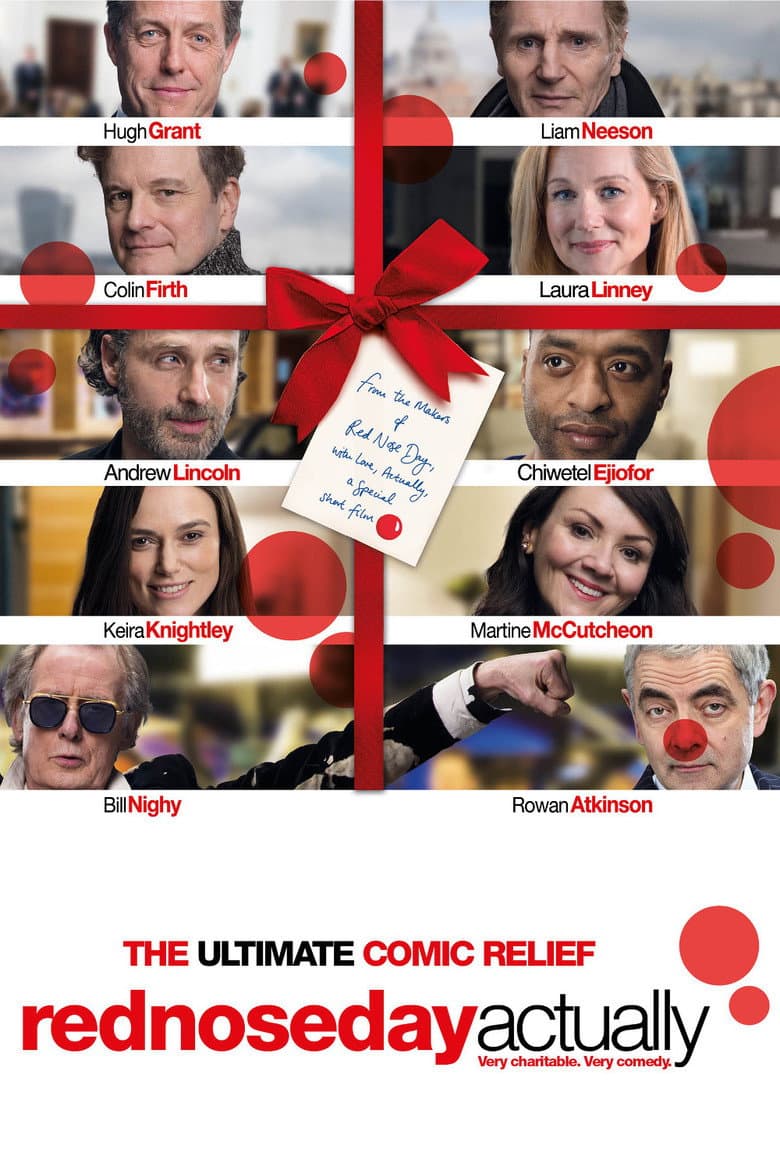
Red Nose Day Actually returns to Britain in March 2017, fourteen years after Love Actually. The short follows several linked couples, families, and friends as they show what happened after the first film. David is again Prime Minister and lives with Natalie, while Jamie and Aurelia raise children and Daniel meets his grown son Sam. Their small conflicts come from time passing, family duties, lost friends, and the need to keep love alive. The tone is warm, silly, and very nostalgic, with old jokes, new marriages, and a charity event tying the stories together.
Most of the short is about romance, marriage, family care, friendship, and the passing of time. Mark has married Kate Moss, Jamie misunderstands his Portuguese-speaking wife, and Sam brings Joanna home to ask for marriage. David gives a brief speech about fearful times, brave strangers, and people giving money to those in trouble. That message supports the Red Nose Day cause, while the rest of the story stays focused on personal love and broad kindness.
Community feedback
Was our 13% Woke rating accurate?
Breakdown
These are the editorial factors and ratings behind our score for Red Nose Day Actually.
Woke representation / casting
Not present. The short continues a previously established modern British cast and relationships. Juliet and Peter remain a black and white married couple, and Aurélia speaks Portuguese, but neither choice is made into a diversity message.
0%
Woke political dialogue
David gives a brief charity speech at a press conference. He says that hard times make people fearful. He praises ordinary people who give money to strangers in trouble. The scene uses general kindness rather than identity, gender, or party politics.
14%
Identity-driven story themes
Not present. The stories focus on romance, marriage, family care, friendship, and the passing of time. The short does not make race, sex, gender roles, or queer identity drive a character’s arc.
0%
Western institutional / cultural critique
Not present. The Prime Minister remains a comic public figure, but the short does not attack government, family, Christianity, or traditional social norms. Its jokes target celebrity behavior, gift wrapping, and Piers Morgan.
0%
Woke character or canon changes
Not relevant. The short updates established characters without changing race, gender, sexuality, or hero roles. Mark marries Kate Moss, David and Natalie are married, and Sam proposes to Joanna.
0%
Anti-woke backlash and complaints
Not present. No major news or audience posts called the short woke, DEI, or identity-driven. The recorded reaction focused on nostalgia, charity, and whether the jokes worked.
0%
Creator track record context
Richard Curtis has a mild activist and charity record, with work about poverty, inequality, climate, and diversity. Mat Whitecross has made some political documentaries, but his work does not show a steady identity-politics focus. The producers are mainly linked to comedy, live entertainment, and independent film. The title itself was framed as a nostalgic charity reunion.
28%
Production

Movie · 2020
Longtime friends and local radio hosts Maggie and Jack fake it as a couple for their families and listeners in hopes of getting their show syndicated.

Movie · 2026
After Matt's dreams of a picturesque Italian wedding are shattered when his fiancée leaves him at the altar, he embarks on his planned honeymoon across Italy alone, immersing…

Movie · 2016
Pop superstar Jordan Jaye has a big dream he just wants to live like a regular teenager. When he's chased down by some excited female fans, he finds a perfect hideout and a…

Movie · 2019
Kat is an aspiring singer-songwriter who dreams of making it big. However, her dreams are stalled by her reality: a conniving and cruel stepfamily and a demoralizing job working…

Movie · 2016
Set against the backdrop of a beautiful garden in the heart of London, this contemporary fairy tale revolves around the unlikely friendship between a reclusive young woman and a…

Movie · 2024
When a young widow's magic scarf brings a dashing snowman to life, can he help her rediscover romance, laughter and holiday cheer before he melts away?

Movie · 2020
In 1800s England, a well-meaning but selfish young woman meddles in the love lives of her friends.

Movie · 2018
When a down-to-earth Chicago baker and a soon-to-be princess discover they look like twins, they hatch a Christmastime plan to trade places.
