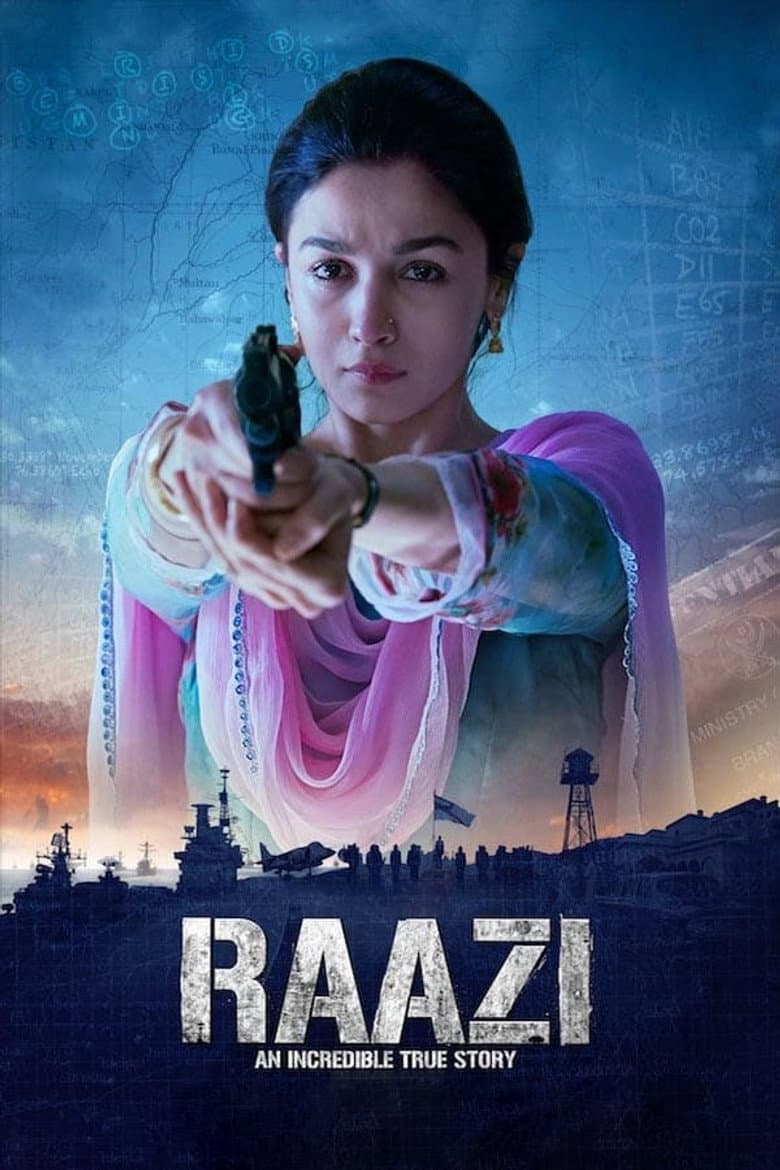
Raazi follows Sehmat Khan, a young woman from Kashmir who is asked by her dying father to become an Indian spy. She leaves college, marries Iqbal, a Pakistani army officer, and enters his family home in 1971, when India and Pakistan are close to war. She gathers secrets while trying to act like a loyal daughter-in-law and wife. The quiet thriller builds fear through spying, betrayal, family ties, and the heavy cost of killing for a country. The film puts a woman at the center of a spy story and shows her as brave, skilled, frightened, and deeply affected by what she does. Sehmat often drives the action, but the story also shows that her father and male handlers use her for the mission and expect her to obey. The Pakistani family is shown as human and caring, while the Indian side is also shown as willing to sacrifice people and order more killing. The main message values human life and personal guilt alongside patriotism, so the film questions loud nationalism without rejecting service to one’s country.
Community feedback
Was our 55% Woke rating accurate?
Breakdown
These are the editorial factors and ratings behind our score for Raazi.
Woke representation / casting
The film makes a young Kashmiri woman the lead spy in a male military world. Sehmat is trained to use weapons, Morse code, and surveillance, and she drives the mission. The trailer and interviews stress a female view of the spy genre. Her Kashmiri Muslim identity is part of the source story, while the female lead is the main representation signal.
38%
Woke political dialogue
Sehmat says that if sending a daughter on a dangerous mission is wrong, sending sons to war would also be wrong. She later tells Mir that his world has no respect for relationships or life and asks to go home. The film repeats country-first lines, but those support patriotism rather than a modern identity or DEI message. The gender-role challenge and human-life warning are brief parts of a 1971 war story.
28%
Identity-driven story themes
The story makes Sehmat’s change from college student to spy its main arc. Sehmat controls key missions and outsmarts people around her, but the film also shows fear, guilt, and lasting damage. Her marriage, pregnancy, and role as a daughter are central parts of the spy conflict. The film gives strong weight to female agency and to the cost placed on a young woman by national duty.
46%
Western institutional / cultural critique
Not present. The film does not attack Western institutions or modern conservative culture. Its criticism targets wartime intelligence orders and the human cost of a 1971 India-Pakistan conflict.
0%
Woke character or canon changes
Not relevant. The adaptation changes the third act and Iqbal’s character, but those are story and tone changes. The isolated claim that the heroine was changed from Hindu or Sikh to Muslim had almost no pickup and is not confirmed.
0%
Anti-woke backlash and complaints
The author Harinder Sikka has repeatedly alleged that the film softened Pakistan, removed a proud return scene, and made Sehmat seem broken after the mission. Hindustan Times reported his 2020 complaints, and Mint and NDTV reported renewed criticism in 2026. Right-leaning X posts repeated claims that the film was Lutyens or anti-Bharat propaganda and that RAW looked bad. The debate had no 2018 boycott, review-bomb, or organized campaign, so the backlash was real but limited.
46%
Creator track record context
Meghna Gulzar has repeatedly made women-centered stories and supported safer, more equal film work. Bhavani Iyer has described herself as a feminist and often writes about women, minority lives, and the human cost of nationalism. Karan Johar and Vineet Jain add a moderate representation-aware production context through films about gender and queer identity. Harinder Sikka and most of the remaining credited crew have neutral or patriotic profiles.
45%
Production

Movie · 2016
When Iraq invades Kuwait in August, 1990, a callous Indian businessman becomes the spokesperson for more than 170,000 stranded countrymen.
Movie · 2022
Shiva, a tribal vagabond lives with his mother in hamlet, stays away from the traditional Daivaradhane and Bhoota Kola legacy due to an unforgettable childhood incident.
Movie · 2021
Inspired by the life of Captain Vikram Batra (PVC), the film celebrates his bravery, valiant spirit and honors his invaluable sacrifice during the Kargil War of 1999, at the age…

Movie · 2024
A ride-share turns into a high-stakes game of cat and mouse after it follows a car fitting the description of an AMBER Alert.

Movie · 2024
While serving as a juror in a high profile murder trial, family man Justin Kemp finds himself struggling with a serious moral dilemma…one he could use to sway the jury verdict and…

Movie · 2017
A newly-released prison gangster is forced by the leaders of his gang to orchestrate a major crime with a brutal rival gang on the streets of Southern California.
Movie · 2016
Irish Commandant Pat Quinlan leads a stand off with troops against French and Belgian Mercenaries in the Congo during the early 1960s.
Movie · 2025
Seasoned deep-sea divers battle the raging elements to rescue their crewmate trapped hundreds of feet below the ocean's surface.
