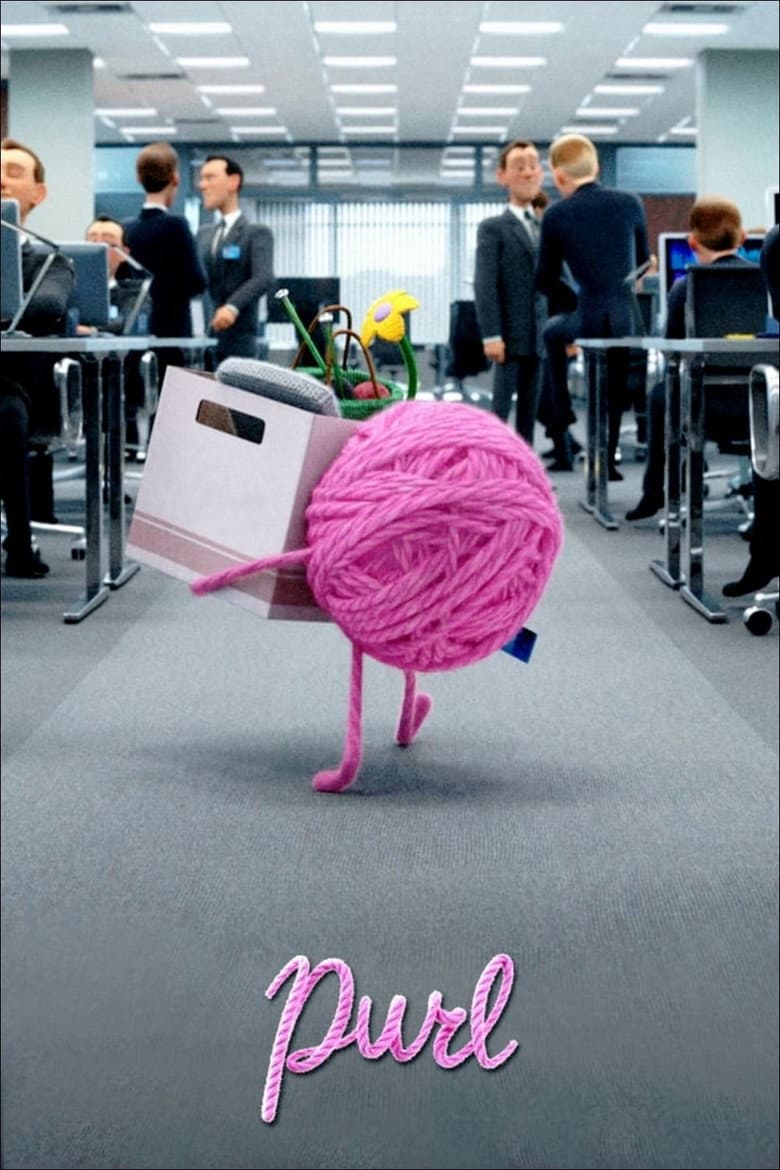
Purl is an upbeat pink ball of yarn who starts an entry-level job at B.R.O. Capital, a busy investment office. The office is filled with fast-talking men in suits who share jokes, drinks, and meetings while treating Purl as an outsider. Purl tries to join them, but her friendly style and yarn body make the group ignore her. She changes her look and behavior to become more like the men, then faces a choice when another yarn ball arrives. The short uses bright animation and quick comedy to tell a pointed workplace story.
The story openly presents the office as a male-centered group that rewards man-like behavior and shuts out a feminine outsider. Purl is ignored in meetings and social events until she copies the men, and the change makes her accepted without changing her skills. A new yarn worker helps Purl see that she has started treating outsiders in the same way. Purl then returns to her real self and helps create a workplace with more yarn workers and more varied human employees. The ending supports inclusion and rejects the idea that women must erase their identity to succeed.
Community feedback
Was our 80% Woke rating accurate?
Breakdown
These are the editorial factors and ratings behind our score for Purl.
Woke representation / casting
The office begins with a group of white men in matching suits, while Purl is the only visible woman and the only yarn worker. The short uses this contrast to show who gets welcomed and who gets ignored. The ending adds more yarn workers and more varied human employees after Purl helps change the office. This is a clear visual representation message, but it appears in one workplace setting.
45%
Woke political dialogue
The coworkers make gender-coded jokes about knitting and use a sexual joke to mark their group culture. Purl repeats their rough office language after she changes herself, including a line about telling finance to kiss its ass. These lines support the short's criticism of the group, but the short has no long political speech.
28%
Identity-driven story themes
Purl's whole conflict is about being pushed to hide a feminine identity in a male-centered workplace. She changes her body, clothes, voice, and behavior to become one of the men, and the office rewards her for doing so. A new yarn worker makes Purl see that she is now excluding someone else. The ending says that workers should keep their identity while changing the group around them.
78%
Western institutional / cultural critique
The short presents a finance startup as a closed club built around male entitlement and old boys' habits. The men ignore Purl in meetings, shut her out of social events, and mock feminine interests. The story treats this workplace culture as a system that must change, not as a problem caused by one rude coworker. The ending shows a more inclusive office as the answer, but it does not attack religion, family, or capitalism as a whole.
63%
Woke character or canon changes
Not relevant. Purl is an original short, so it does not change an established character, canon, source material, or historical figure.
0%
Anti-woke backlash and complaints
RedState called the short a cringey feminist workplace story and a social justice propaganda piece. The article objected to the white male coworkers being used as villains and to diversity appearing after Purl changes the office. Most entertainment coverage praised or accepted the message, and available public comments were largely supportive. The anti-woke backlash appears real but limited.
34%
Creator track record context
Kristen Lester's public work has a clear gender-inclusion focus in animation. She has discussed being the only woman on early teams and has linked belonging to making room for women and other groups. Lindsey Collins and Gillian Libbert have mainly worked as Pixar producers, with little public activist focus in the available record. The director's record supports the short's message, while the producers add little extra signal.
45%
Production
Movie · 2019
ZIM discovers his almighty leaders never had any intention of coming to Earth and he loses confidence in himself for the first time in his life, which is the big break his human…
Movie · 2021
Loki is banished from Asgard once again and must face his toughest opponents yet: the Simpsons and Springfield’s mightiest heroes.
Movie · 2026
A small goat with big dreams gets a once-in-a-lifetime shot to join the pros and play roarball, a high-intensity, co-ed, full-contact sport dominated by the fastest, fiercest…

Movie · 2016
A harried prehistoric bird mother entrusts her precious, soon-to-hatch egg to Sid. When she recommends him to her neighbours, business booms at his new egg-sitting service.
Movie · 2023
Jaded 74-year-old lizard Leo has been stuck in the same Florida classroom for decades with his terrarium-mate turtle.

Movie · 2021
Shaun's seasonal excitement turns to dismay when a farmhouse raid to get bigger stockings for the flock inadvertently leads to Timmy going missing.
Movie · 2016
This is the story of the internal struggle between a man's Brain—a pragmatic protector who calculates his every move, and his Heart—a free-spirited adventurer who wants to let…
Movie · 2021
With his best friend Luca away at school, Alberto is enjoying his new life in Portorosso working alongside Massimo—the imposing, tattooed, one-armed fisherman of few words—who's…
