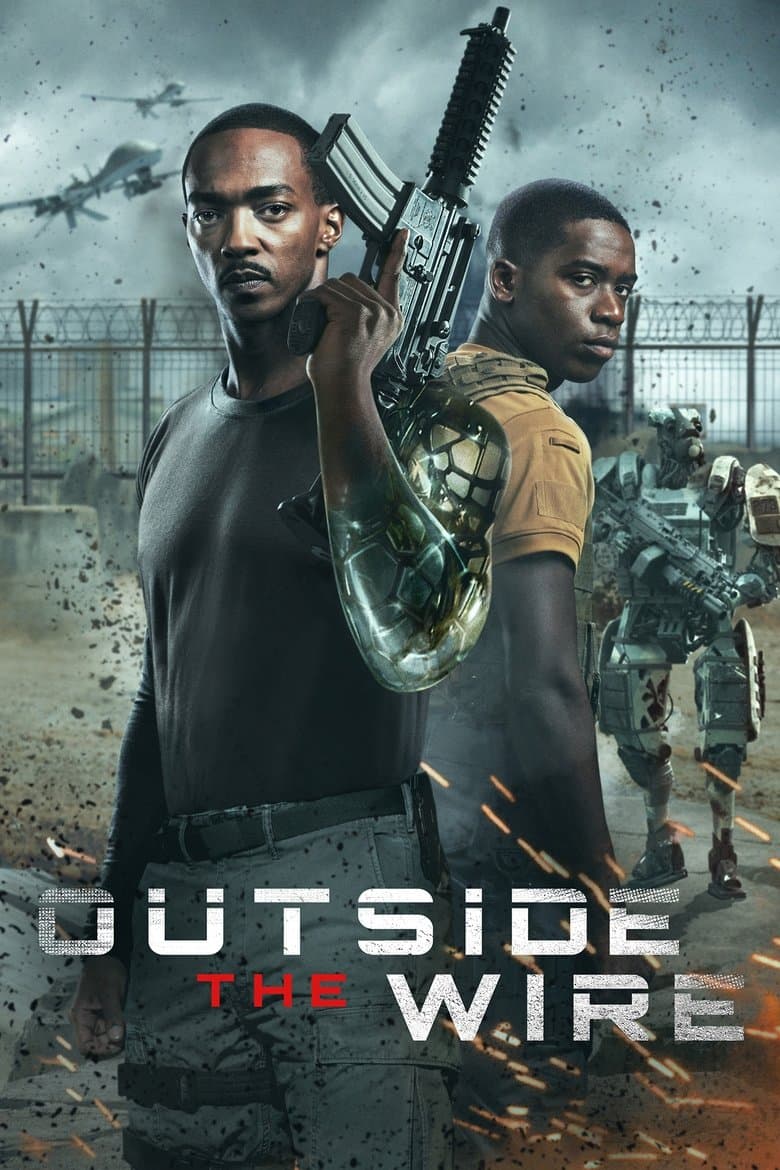
Outside the Wire follows Lieutenant Thomas Harp, a young drone pilot who is punished after he disobeys an order during a strike. He is sent from a remote control room to a war zone in 2036, where he must work with Captain Leo, a powerful android officer. They cross a broken part of Eastern Europe to stop Victor Koval from using hidden nuclear weapons. The film mixes loud gun battles, robot fights, and serious questions about war, machines, and human choices.
The film gives its clearest identity-focused moment to Leo’s talk about race and military image. Leo says the Army chose a black man because a black face may look less American and seem safer to people overseas. The scene makes race part of a military influence plan, while Harp and Leo remain the two main heroic soldiers. The larger story returns to civilian deaths, drone warfare, and the gap between U.S. peacekeeping claims and battlefield violence, so the identity message is brief but the anti-war and anti-military ideas run through the movie.
Community feedback
Was our 33% Woke rating accurate?
Breakdown
These are the editorial factors and ratings behind our score for Outside the Wire.
Woke representation / casting
The film puts two black men in its two central soldier roles. Leo explains that the Army chose a black face because it may seem less tied to the United States overseas. That makes race part of the casting logic on screen. The film does not build a wider diversity message around the rest of the cast.
26%
Woke political dialogue
Leo and Harp discuss why the Army chose a black officer to represent the United States overseas. Leo says a black face may look less American and make foreign people less likely to resist. The film also questions drone deaths and the logic of U.S. peacekeeping. These points appear in several parts of the story, but they do not control every scene.
30%
Identity-driven story themes
The film gives Leo a short identity-based explanation for why a black soldier is useful to U.S. military image abroad. The scene treats race as a tool of influence, not just a detail about the character. The main arc stays focused on human cost, artificial intelligence, and nuclear weapons, so this theme is limited.
18%
Western institutional / cultural critique
The film repeatedly shows U.S. drone strikes as distant and careless. Leo forces Harp to see the civilians and soldiers behind the word collateral. The story questions the U.S. claim that it brings peace while using robots and heavy weapons in another country. The criticism targets war and military power, not Christianity, family life, gender roles, or capitalism.
34%
Woke character or canon changes
Not relevant. The film uses original characters and is not an adaptation of established canon.
0%
Anti-woke backlash and complaints
Not present. Search results showed complaints about weak writing and possible U.S. military propaganda, but no clear backlash saying the film pushes woke, DEI, or identity politics.
0%
Creator track record context
The director and both writers have low cached woke scores and no strong activist record. Most producers and casting directors also have low scores. Anthony Mackie has some public race and voter activism context, while Arash Amel often works with minority and immigrant leads. This background adds only a mild signal.
15%
Production

Movie · 2024
Post-apocalyptic survivors find refuge in the Rocky Mountains to hide from giant, insect-like creatures that can't live above 8,000 feet.
Movie · 2023
When a tech blogger lands an interview with a tech guru and stops an attack on him, he finds a mysterious ring that takes him back 57 seconds into the past.
Movie · 2018
A brutal mugging leaves Grey Trace paralyzed in the hospital and his beloved wife dead. A billionaire inventor soon offers Trace a cure — an artificial intelligence implant called…
Movie · 2026
On one last grueling mission during Army Ranger training, a combat engineer must lead his unit in a fight against a giant otherworldly killing machine.

Movie · 2021
A former special forces agent is trapped in a time loop and relives his death over and over again. To escape the terrible situation, he must track down those responsible and stop…
Movie · 2018
A chief mechanic at a factory, haunted by apocalyptic nightmares, becomes a hero when Earth is invaded by a mysterious army bent on destruction.
Movie · 2016
A special-ops team is dispatched to fight supernatural beings that have taken over a European city.
Movie · 2026
In the near future, a detective stands on trial accused of murdering his wife. He has ninety minutes to prove his innocence to the advanced AI Judge he once championed, before it…
