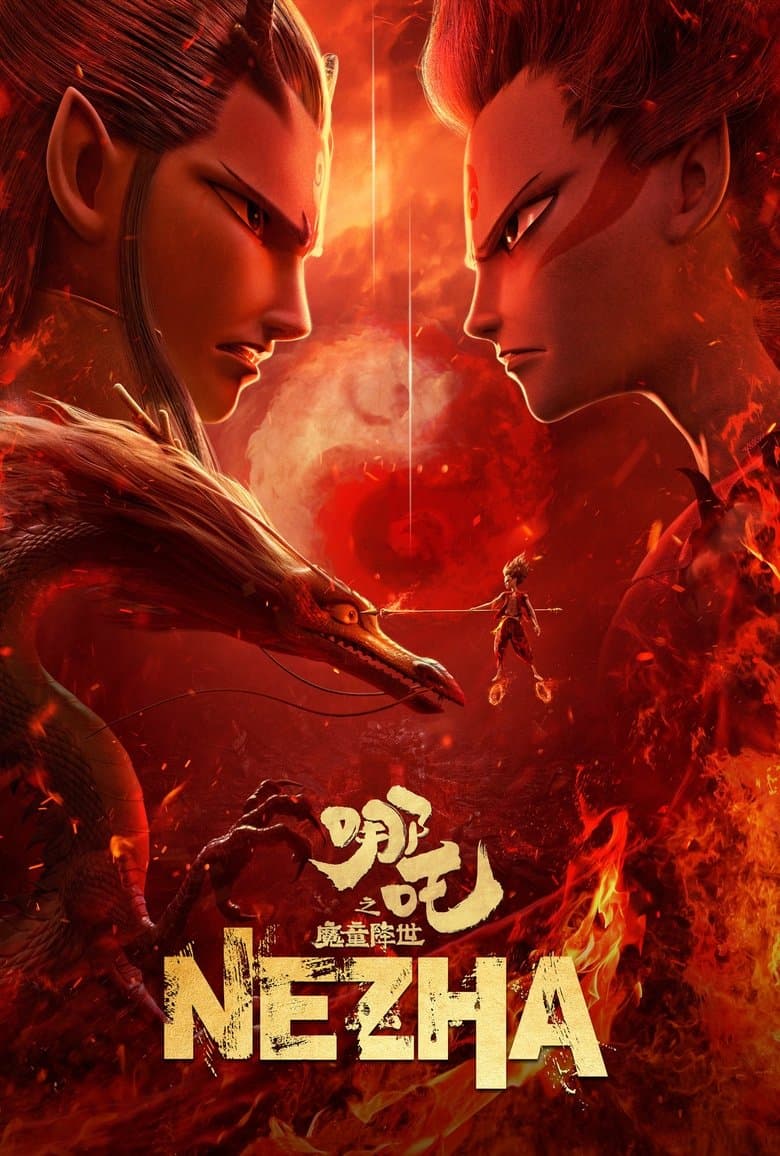
Ne Zha is a Chinese animated fantasy adventure set in a world of gods, demons, dragons, and heavenly rules. A powerful Demon Orb enters the body of a baby boy, and the people of Chentang Pass fear him before he can choose his own path. Ne Zha's parents love him, but they must guide a wild child who is expected to destroy the world after three years. Ne Zha trains with the comic master Taiyi and faces a fate that seems fixed. The film mixes loud jokes, strange creatures, family emotion, and large magical battles.
The story asks whether a person can choose good actions when others have already named that person evil. Ne Zha wants his choices to matter more than the label placed on him, while Ao Bing struggles under pressure from his father and his dragon clan. Their friendship changes an old hero tale into a story about trust, sacrifice, and shared pain. The film also gives Ne Zha's parents a warmer and more active role than older versions gave them. The ending joins personal choice with duty to protect family and the village.
Community feedback
Was our 9% Woke rating accurate?
Breakdown
These are the editorial factors and ratings behind our score for Ne Zha.
Woke representation / casting
Not present. The film uses a Chinese voice cast for a Chinese myth setting. The character choices fit the story world and do not use diversity-first or identity-framed casting.
0%
Woke political dialogue
Not present. Ne Zha speaks about fate, choice, family, and courage. The film does not use modern identity, DEI, or activist lines.
0%
Identity-driven story themes
The film repeatedly shows villagers rejecting Ne Zha because he was born from the Demon Orb. Ne Zha learns that his actions matter more than the label others give him. That is a mild identity-driven message about prejudice and choosing who he becomes, but the story presents it through Chinese myth, family love, and fate.
15%
Western institutional / cultural critique
Not present. The film questions heavenly fate, but it does not connect that conflict to Western institutions, Christianity, capitalism, or modern gender roles.
0%
Woke character or canon changes
Not relevant. The film changes older versions by making Ao Bing a friend and by giving Ne Zha supportive parents. Ne Zha remains the central male hero, and the story does not make a race, gender, or sexuality change.
0%
Anti-woke backlash and complaints
Not present. No clear anti-woke backlash was found. Public discussion focused on animation, family emotion, fate, source changes, and fan shipping. A plagiarism dispute also appeared, but it was not about woke or identity politics.
0%
Creator track record context
Jiao Zi's public work centers on Chinese mythology, animation craft, and persistence. The listed writers and producers mainly work in commercial Chinese film and animation. Their public profiles show no strong record of DEI advocacy, identity politics, or culture-war activism. This background adds only a very small woke signal to the film.
4%
Production
Movie · 2025
After a catastrophic event leaves their bodies destroyed, Ne Zha and Ao Bing are granted a fragile second chance at life.
Movie · 2022
A new adventure begins for Luffy and his crew when mysterious pop superstar Uta unveils her identity — and launches a misguided plan for world peace.
Movie · 2022
The vicious, power-mad Kano is determined to take over Earthrealm, one soul at a time. Assisted by a trio of cold Black Dragon mercenaries, he embarks on a brutal assault from…
Movie · 2019
As the gang return to Jumanji to rescue one of their own, they discover that nothing is as they expect. The players will have to brave parts unknown and unexplored in order to…
Movie · 2021
The Earthrealm heroes must journey to the Outworld and fight for the survival of their homeland, invaded by the forces of evil warlord Shao Kahn, in the tournament to end all…
Movie · 2023
Following the sudden death of his mother, a mild-mannered but anxiety-ridden man confronts his darkest fears as he embarks on an epic odyssey back home.
Movie · 2025
The Demon Slayer Corps are drawn into the Infinity Castle, where Tanjiro, Nezuko, and the Hashira face terrifying Upper Rank demons in a desperate fight as the final battle…
Movie · 2023
Paul and Sophie, interns at a mysterious London firm, become steadily aware their employers Humphrey and Dennis are anything but conventional – they are disrupting the world of…
