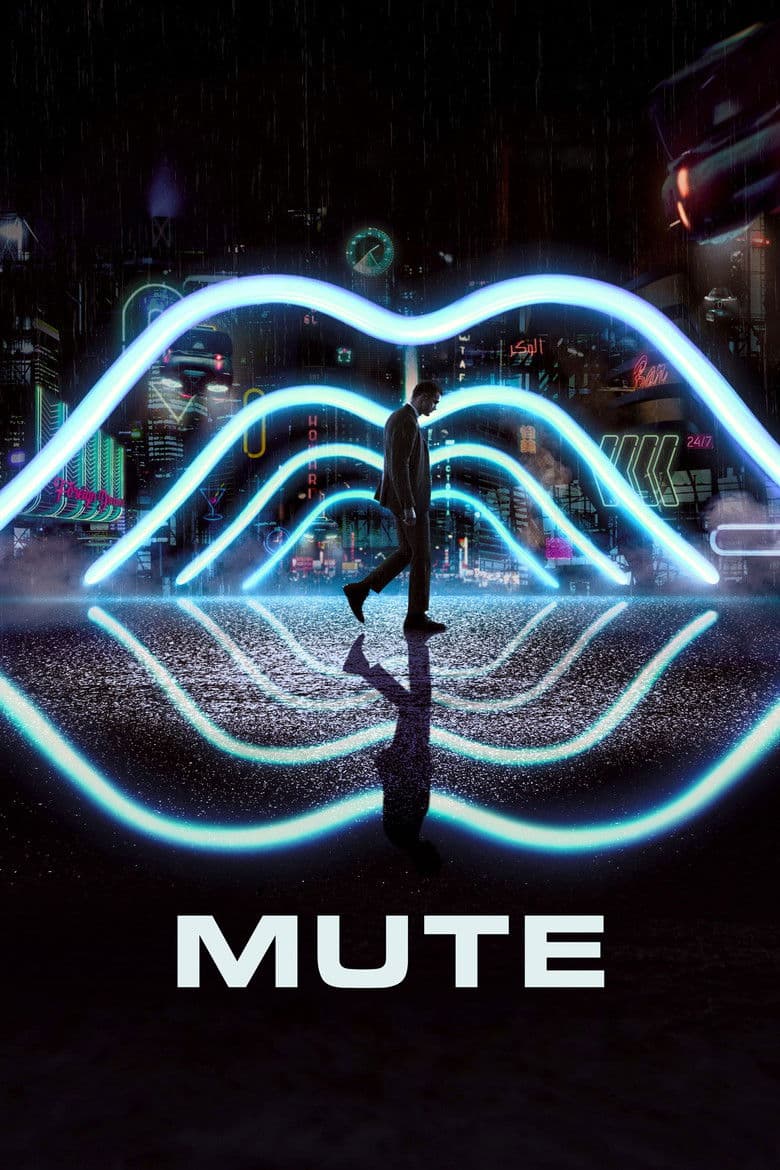
Leo Beiler is a quiet Amish bartender in a future Berlin where neon signs, sex clubs, gangs, and high-tech services fill the streets. Leo lost his voice as a child after a boating accident, and his family refused surgery because of their faith. When his girlfriend Naadirah vanishes, Leo follows clues into the city's criminal world. The film mixes a sad love story with violent noir, strange humor, and grim science fiction.
Naadirah's hidden past connects Leo to her daughter Josie and to the dangerous Cactus Bill. Luba, an androgynous pansexual escort, has feelings for Naadirah and helps reveal the truth. The film also uses suggestive affection between Bill and Duck and briefly presents them as a gay couple. These identity elements stay in side characters, while the main story focuses on parenthood, guilt, violence, and the struggle to communicate.
Community feedback
Was our 24% Woke rating accurate?
Breakdown
These are the editorial factors and ratings behind our score for Mute.
Woke representation / casting
The film uses Robert Sheehan as Luba, an androgynous pansexual escort, and it fills future Berlin with a visibly mixed cast. Those choices are audience-visible, but the city is meant to be a diverse future capital and no marketing or interview frames them as a diversity goal. Leo is a white Amish man, and the two major American surgeons are white men. The identity emphasis stays in supporting nightlife roles.
18%
Woke political dialogue
Not present. The dialogue covers crime, sex, family, war, and Leo’s search. The film does not use a clear speech or repeated lines to push modern identity, DEI, or activist ideas.
0%
Identity-driven story themes
The film includes Luba, an androgynous pansexual escort who loves Naadirah. The film also shows suggestive affection between Cactus Bill and Duck and briefly has them pose as a gay couple. These queer and gender-play details are visible but remain a side thread. Leo’s main journey centers on Naadirah, Josie, violence, and parenthood.
26%
Western institutional / cultural critique
The film shows a long-running U.S. war, AWOL soldiers, and a system that hunts deserters while corrupt people sell papers and identities. The film also hints at corporate control through future services and news about the ongoing war. These ideas criticize war and power, but the story does not connect them to modern identity politics or a broad activist program. The critique stays behind the crime plot.
18%
Woke character or canon changes
Not relevant. Mute is an original story with no established identity or historical character being changed.
0%
Anti-woke backlash and complaints
Not present. The X search found no anti-woke reaction. Reddit and review coverage mainly attacked the plot, pacing, tone, and sexual violence, not woke, DEI, or identity politics messaging.
0%
Creator track record context
Duncan Jones has a mild public record of supporting diverse casting and has called representation organic in earlier comments. His Mute interviews focus on Berlin, parenthood, and noir design rather than identity politics. The other writers and producers have little public activist history. Casting director Mary Vernieu has spoken about representation, which adds a small supporting signal.
18%
Production
Movie · 2018
In 1984, a young programmer begins to question reality as he adapts a dark fantasy novel into a video game. A mind-bending tale with multiple endings.
Movie · 2022
Mike and Kate, a young couple, get the once-in-a lifetime chance to win a cool five million dollars. The challenge: Live for 50 days in a blank space.
Movie · 2023
A detective becomes entangled in a mystery involving his missing daughter and a secret government program while investigating a string of reality-bending crimes.
Movie · 2019
Three lighthouse keepers on an uninhabited island off the coast of Scotland discover something that isn't theirs to keep.
Movie · 2017
Jimmy is a committed child psychologist who uses his own playbook, but when he is brought in to work with Ellie, he is completely unprepared for his subject—a 9-year-old…
Movie · 2024
When an 8-year-old girl mysteriously vanishes on Caddo Lake, a series of past deaths and disappearances begin to link together, forever altering a broken family’s history.
Movie · 2017
Two planes almost collide after a blinding flash of light paralyzes air traffic controller Dylan Branson for a few seconds.
Movie · 2026
A strange doorway appears in the basement of a furniture showroom.
