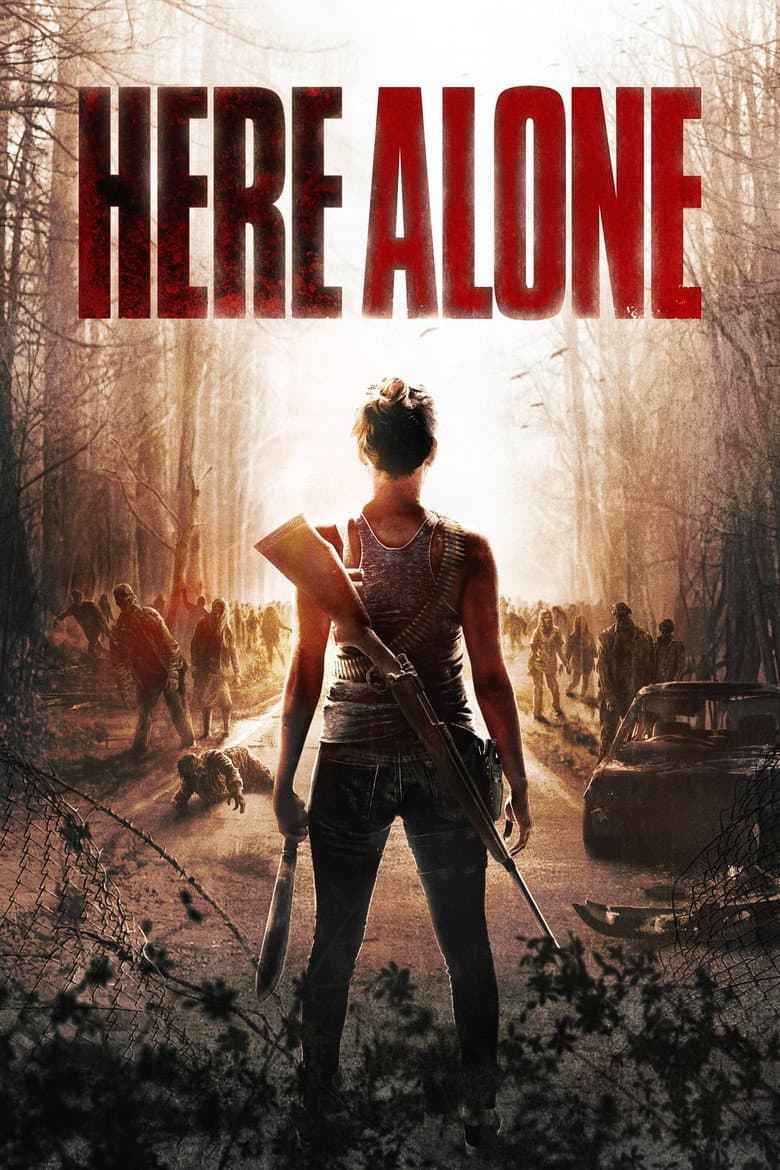
Here Alone follows Ann, a young woman living alone in an upstate New York forest after a virus destroys most of society. She gathers berries, traps small animals, searches empty homes for canned food, and hides from infected people who hunt by scent. Flashbacks show Ann with her husband Jason and their baby during the first days of the outbreak. Those memories explain why Ann lives like she is serving a punishment. When Ann finds the injured Chris and his teenage stepdaughter Olivia, she must decide whether other survivors are worth the danger.
The film gives Ann most of the practical work, but it presents her skills as the result of nursing experience, hard practice, and lessons from Jason. Chris adds jokes and hope while Olivia brings fear, jealousy, and sudden danger into the small group. The story spends more time on grief, guilt, trust, and the need for human company than on fights with infected people. Ann’s choice to help others drives the plot, even after Olivia betrays her and leaves her for dead. The final escape feels painful rather than triumphant because survival does not erase Ann’s losses.
Community feedback
Was our 4% Woke rating accurate?
Breakdown
These are the editorial factors and ratings behind our score for Here Alone.
Woke representation / casting
Not present. The small cast centers on Ann, Chris, and Olivia in an upstate New York survival setting. The film does not present their race, gender, or relationships as a diversity message.
0%
Woke political dialogue
Not present. The dialogue deals with food, danger, guilt, and trust between survivors. No character gives modern political, identity, or activist speeches.
0%
Identity-driven story themes
Not present. The story focuses on grief, guilt, trust, and survival after a plague. Ann’s strength comes from nursing experience, hard practice, and lessons from her family life.
0%
Western institutional / cultural critique
Not present. The film shows a collapsed society and dangerous infected people. It does not blame capitalism, patriarchy, religion, conservatives, or Western institutions.
0%
Woke character or canon changes
Not relevant. The film uses an original screenplay about survivors after a plague. It does not change a known character or real event around race, gender, or sexuality.
0%
Anti-woke backlash and complaints
Not present. Searches found no anti-woke complaints tied to this film. Online comments mainly discuss the slow pace, the ending, and Olivia’s choices.
0%
Creator track record context
Rod Blackhurst has a 19/100 woke score because he made a 2014 parody commercial that criticized the GOP health-care plan. David Ebeltoft and Arun Kumar each have a 0/100 score and no known activist pattern. This context is limited and does not match the film’s survival story.
19%
Production
Movie · 2018
After waking up to find himself all alone in an apartment where a massive party was being held the night before, Sam is immediately forced to face a terrifying reality: the living…
Movie · 2018
Set in the small town of Devil's Gate, North Dakota, the film examines the disappearance of a local woman and her young son.
Movie · 2017
Two brothers return to the cult they fled from years ago to discover that the group's beliefs may be more sane than they once thought.
Movie · 2023
A powerful biotech company has breakthrough technology allowing them to clone history’s most influential people with just a few fragments of DNA.
Movie · 2024
The infinite playground of forbidden worlds and dangerous lifeforms offered by the sci-fi horror genre will lead to the biggest, maddest, bloodiest V/H/S ever.

Movie · 2018
Held captive in a futuristic smart house, a woman hopes to escape by befriending the A.I. program that controls the house.
Movie · 2024
Lost in a world reclaimed by nature and overrun by mysterious creatures, Ethan, a young man with amnesia navigates the dangerous landscape in search of his lost love Emma.
Movie · 2022
A brilliant toy company roboticist uses artificial intelligence to develop M3GAN, a life-like doll programmed to emotionally bond with her newly orphaned niece.
