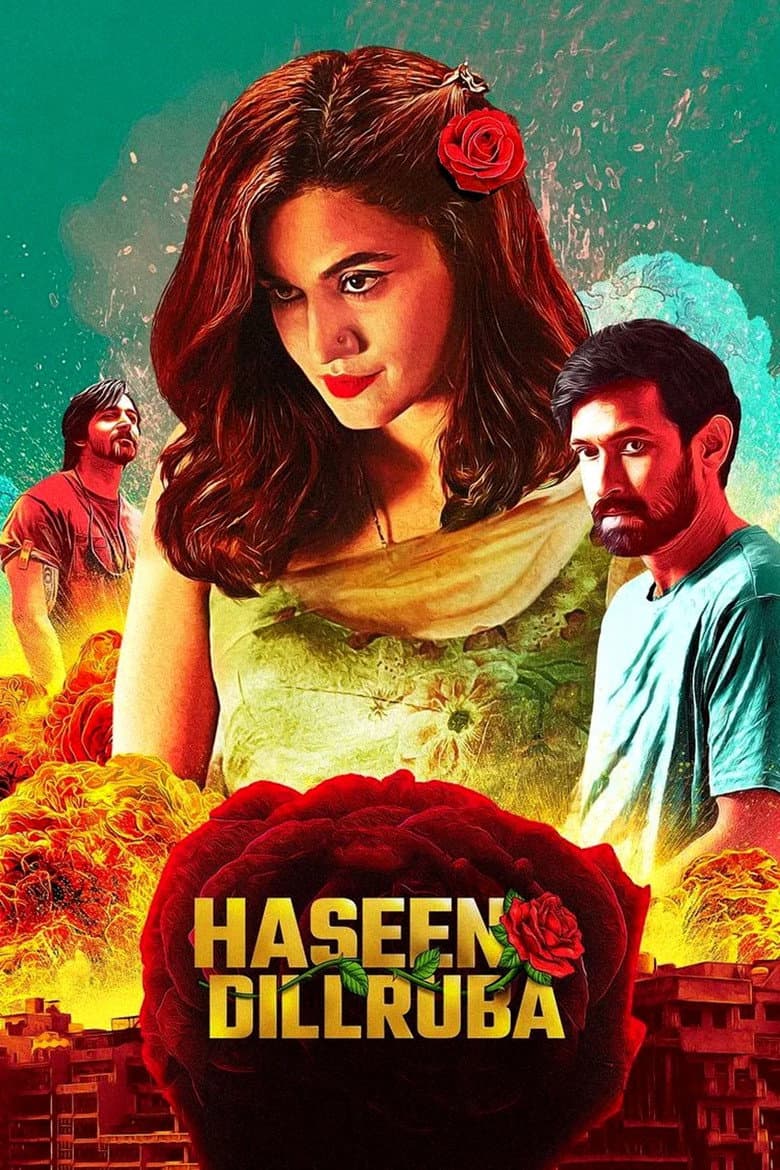
Haseen Dillruba is a Hindi romance mystery set in the small North Indian town of Jwalapur. Rani Kashyap, a lively Delhi salon manager, enters an arranged marriage with Rishu, a shy electricity-board engineer. Rani feels trapped by the quiet town, a dull marriage, and a family that expects her to cook and serve. When Rishu dies in a house blast, the police question Rani as the main suspect while her memories reveal an affair, jealousy, and violence. The film shifts from bright comedy to a dark and bloody thriller.
The film makes gender roles a central part of the marriage conflict. Rani openly rejects being a docile housewife and speaks about how arranged marriages can hand a wife to a man who expects food and service. The story gives her sexual wants, anger, and bad choices major space, while it shows the police and family judging her as a bad woman. It also presents Rishu’s struggle with masculinity, jealousy, and abuse as part of a twisted love story that ends with the couple choosing each other. These ideas are strong and easy to notice, but the film treats both partners as flawed and does not offer a clear political lesson.
Community feedback
Was our 60% Woke rating accurate?
Breakdown
These are the editorial factors and ratings behind our score for Haseen Dillruba.
Woke representation / casting
Not present. The main cast fits a modern Hindi story set in North India. No diversity-first casting message or identity mismatch is confirmed.
0%
Woke political dialogue
The film has Rani say that arranged marriages hand a wife to a man who expects her to cook. Rani also rejects housework and demands more from a husband than looks and manners. The family then jokes about training her to serve tea, cook, and follow a timetable. These lines make gender roles a clear topic, but the film has no long political speech or repeated activist slogan.
34%
Identity-driven story themes
Rani makes her own sexual and romantic choices instead of acting like a quiet arranged-marriage bride. Rani’s affair, wish to leave, and later choice to stay shape nearly the whole plot. Rishu starts as a shy man with sexual problems, then becomes jealous and violent while the story treats his change as part of their dark love story. The police and family judge Rani by old ideas about a good wife and a bad woman. The film gives these gender roles and power struggles a central place, even though it calls both partners flawed.
61%
Western institutional / cultural critique
The film shows Rani’s in-laws treating marriage as training a wife for cooking, cleaning, and service. Rani pushes back against that family system and calls out the way a husband can take a wife for granted. The police quickly label her a cunning or immoral woman and question her without much care for her side. The story also mocks the demand that Rishu become a macho man, but it does not attack capitalism, Christianity, or Western institutions. The critique of family and gender rules is recurring, but it stays tied to this one marriage.
48%
Woke character or canon changes
Not relevant. The film uses original characters and a made-up story. It does not change an established character or real historical figure.
0%
Anti-woke backlash and complaints
A few small accounts and one minor review called the film a woke or feminist title. Those comments had little reach and did not grow into a sustained anti-woke campaign. The louder Hindu objections focused on alcohol, meat, and temple or Ganga imagery, not DEI or identity politics. The 2020 Justice for SSR boycott also named the film, but it was not an anti-woke campaign. The available anti-woke complaint evidence is fringe.
10%
Creator track record context
Kanika Dhillon has a repeated track record of writing women who resist social rules and of discussing patriarchy and gender inequality. Aanand L. Rai and Himanshu Sharma have backed stories about women, class, masculinity, and LGBTQ relationships. Mukesh Chhabra has a record of opening auditions to outsiders, which is a mild representation signal. Vinil Mathew and the other listed producers do not add a strong public activist record. The combined context is moderate and supports the film’s gender focus without making it a political project.
49%
Production
Movie · 2022
When the CIA discovers one of its agents leaked information that cost more than 100 people their lives, veteran operative Henry Pelham is assigned to root out the mole with his…
Movie · 2021
A psychiatrist, whose client commits suicide, finds his family life disrupted after introducing her surviving brother to his wife and daughter.
Movie · 2018
Over the course of 12 years, and three stages of life, Sidney Hall falls in love, writes the book of a generation and then disappears without a trace.
Movie · 2019
Three lighthouse keepers on an uninhabited island off the coast of Scotland discover something that isn't theirs to keep.
Movie · 2017
Jin-seok, 21-year-old, moves into a new house with his family. He suffers from a slight schizophrenia but he carries an ordinary life under the warm care of the family.
Movie · 2023
Noah must leave her city, boyfriend, and friends to move into William Leister's mansion, the flashy and wealthy husband of her mother Rafaela.
Movie · 2021
Aaron Falk returns to his drought-stricken hometown to attend a tragic funeral. But his return opens a decades-old wound - the unsolved death of a teenage girl.

Movie · 2025
Two highly trained operatives grow close from a distance after being sent to guard opposite sides of a mysterious gorge.
