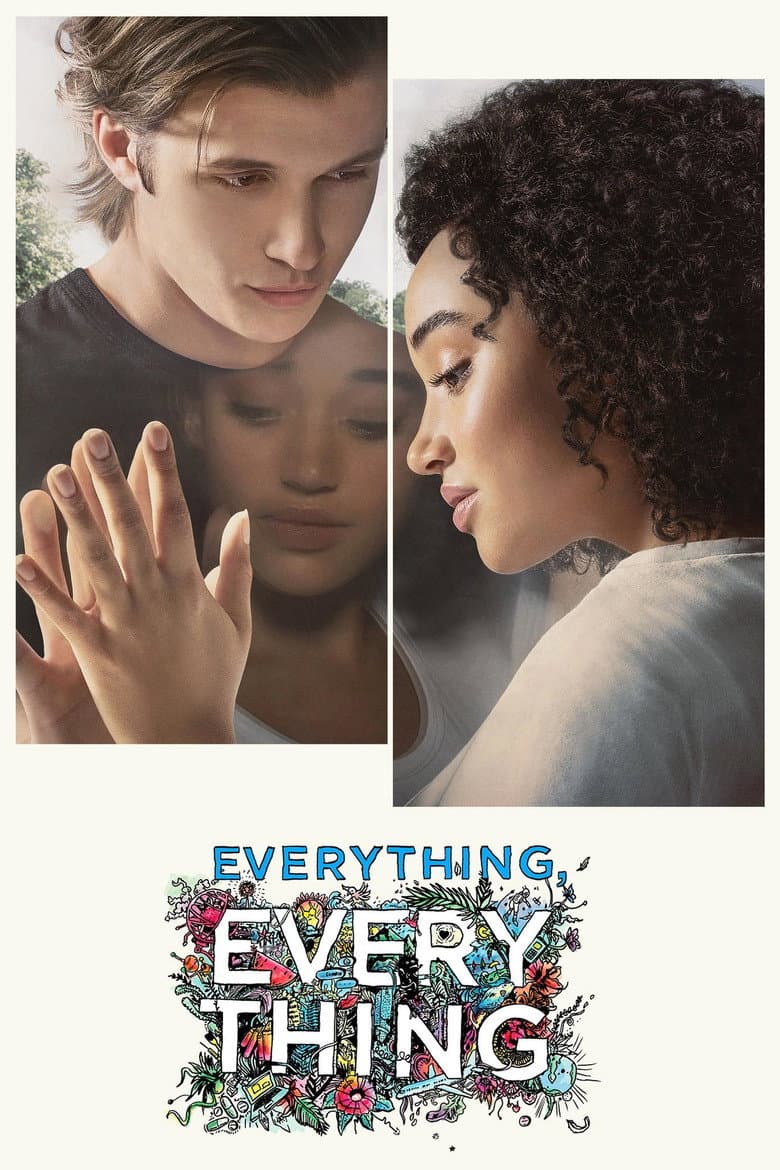
Madeline Whittier is an 18-year-old girl who has spent her whole life inside a sealed home in Los Angeles. Her mother says a rare immune illness makes the outside world too dangerous, so Madeline studies online and sees almost no one. When Olly moves next door, the two teens begin a romance through windows, texts, and secret visits. The gentle romance turns tense when Madeline leaves home, becomes sick in Hawaii, and learns that her mother has kept her isolated through a false belief.
The film gives a black girl the lead role in a mainstream teen romance with a white boy. Their race is visible, but the story does not make the interracial relationship a conflict or give it a political speech. The movie instead follows Madeline as she seeks freedom, faces grief, and learns to question a parent who has controlled her life. It also shows a black mother and a Latina nurse in important roles, which makes representation easy to notice even though identity politics are not the story’s main subject.
Community feedback
Was our 41% Woke rating accurate?
Breakdown
These are the editorial factors and ratings behind our score for Everything, Everything.
Woke representation / casting
The film places a black girl at the center of a mainstream teen romance with a white boy. It also gives important roles to a black mother and a Latina nurse. The interracial couple and the women of color are visible throughout the film, even though the setting is a modern Los Angeles suburb. Interviews from the filmmakers and Stenberg openly frame these choices as diversity and visibility, which raises this factor beyond ordinary casting.
43%
Woke political dialogue
Not present. The film has no speeches or repeated lines about race, gender, DEI, or activism. Its dialogue focuses on illness, love, fear, and family control.
0%
Identity-driven story themes
The film makes a black girl the hero of a mainstream young adult love story. It treats her interracial romance as normal instead of making race a problem to solve. That creates a light representation message because the movie lets a black teenager be romantic, smart, and joyful. The central themes remain freedom, grief, trust, and family control, so identity is present but not dominant.
24%
Western institutional / cultural critique
Not present. The film criticizes a mother's fear and an abusive father's behavior as personal problems. It does not attack Western institutions, traditional gender roles, or Christianity.
0%
Woke character or canon changes
Not relevant. The movie is based on Nicola Yoon's novel and keeps its central characters and interracial romance. The visible changes are normal movie adaptation choices, not identity-driven changes to established characters.
0%
Anti-woke backlash and complaints
Not present. The separate X pass found no anti-woke complaints, boycott, or campaign. News criticism focused on SCID accuracy and the film's weak plot, not identity politics.
0%
Creator track record context
Nicola Yoon has a strong record of writing love stories with Black and other underrepresented leads. Stella Meghie often centers black female characters and has spoken about diversity in hiring. Interviews about this movie present the black lead, interracial romance, and women of color in major roles as meaningful visibility. J. Mills Goodloe and most of the cached producers and crew have little activist record, so this factor comes mainly from Yoon and Meghie.
64%
Production
Movie · 2020
Young musician Zach Sobiech discovers his cancer has spread, leaving him just a few months to live. With limited time, he follows his dream and makes an album, unaware that it…
Movie · 2016
Set during the last days of the Ottoman Empire, a love triangle develops between Mikael, a brilliant medical student, the beautiful and sophisticated artist Ana, and Chris, a…
Movie · 2020
When a young woman meets an aspiring saxophonist in her father’s record shop in 1950s Harlem, their love ignites a sweeping romance that transcends changing times, geography, and…
Movie · 2024
Aza confronts her potential for love, happiness, friendship, and hope while navigating an endless barrage of invasive, obsessive thoughts.
Movie · 2017
The story of four characters whose lives intertwine amid the hustle and bustle of the Coney Island amusement park in the 1950s: Ginny, an emotionally volatile former actress now…
Movie · 2020
It was a chance meeting started by one of Sol’s friends trying to chat up Jennifer. However, in the end, it was those two who hit it off.
Movie · 2016
A boy growing up in Dublin during the 1980s escapes his strained family life by starting a band to impress the mysterious girl he likes.
Movie · 2016
The story of a young man who arrives in Hollywood during the 1930s hoping to work in the film industry, falls in love, and finds himself swept up in the vibrant café society that…
