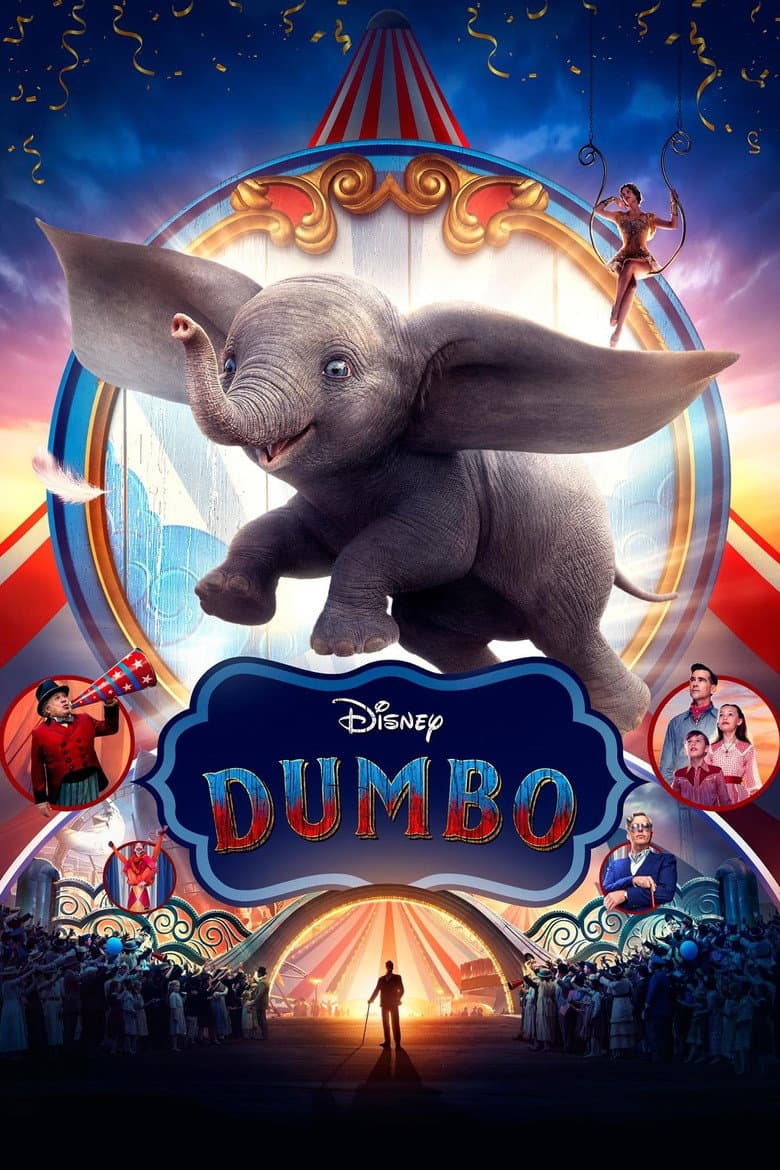
Tim Burton’s live-action Dumbo is a human-centered 1919 circus story about a flying outsider elephant. A family of performers joins a traveling show and bonds with the big-eared calf who is mocked for how he looks. The plot follows corporate greed, animal cruelty at a big dream park, and a push to free animals from show business. The film keeps the classic misfit path of bullying, confidence, and family love from the older tale. It is light on modern identity politics and stronger on family and animal care.
Audience-visible progressive choices still show up in clear ways. The Farrier family is mixed-race in a 1919 United States setting, and the circus has a multiethnic supporting cast that reads as intentional modern casting. The remake drops the original crow scene long tied to racial stereotypes and gives that confidence role to the children. The ending sends the elephants to freedom in the wild and turns the show into an animal-free act. Those are the main woke-facing elements, not race speeches, queer plots, or gender revolution stories.
Community feedback
Was our 36% Woke rating accurate?
Breakdown
These are the editorial factors and ratings behind our score for Dumbo.
Woke representation / casting
Diversity is easy to see but does not rule the movie. The human leads are mostly familiar stars, while Nico Parker’s Milly makes the Farrier family clearly mixed-race in a 1919 United States story, and supporting roles include a black strongman accountant and South Asian performers. Visible audience diversity through biracial child in a lead kid role and positive portrayal of a disabled veteran hero; some modern STEM interest added for the girl, but it stays background in a family story without heavy signaling or story-world mismatch.
32%
Woke political dialogue
There are no long race, gender, or identity politics speeches that stand out. Talk mostly covers family reconnection, outsider acceptance, and animal care. Interview talk about Colette succeeding in a male-dominated field is stronger than activist speeches on screen. The film is mild and not driven by political dialogue.
12%
Identity-driven story themes
The main arc is classic misfit acceptance with big ears, bullying, confidence, and family love, not modern identity politics. The remake adds a clear animal-rights path through sale, cruelty, escape, return to the wild in India, and an animal-free circus. Eva Green publicly linked the film to protecting elephants and animal-free shows. Queer, racial-justice, or gender-revolution plots are not the story.
10%
Western institutional / cultural critique
The main target is greedy big entertainment money as Vandevere’s Dreamland swallows the small circus, fires workers, cages animals, and puts spectacle over safety and loyalty. That reads as corrupt-tycoon satire more than an identity attack on whiteness, patriarchy, or faith. There is no major attack on Christianity or traditional family, and Holt’s arc about fatherhood and disability after war is handled gently.
15%
Woke character or canon changes
Several deliberate fixes to the 1941 material are progress-driven rather than simple cuts for time. The crow characters and their song, long criticized as racial stereotyping, are removed, and their feather and confidence role moves to the Farrier kids. Talking animals are dropped, partly for style and partly to avoid the crow issue. The ending changes from Dumbo as a permanent circus star to wildlife freedom and an animal-free show.
48%
Anti-woke backlash and complaints
At release, talk focused more on mixed reviews, box office, and the original’s racial baggage than on a large “too woke” campaign. Later chatter sometimes drops the film into a general Disney DEI remake pile, and a few users mock progressive sanitization such as the crow handling. Others say the 2019 film has no hot woke garbage. Complaint is thin and scattered, not the main reception story.
8%
Creator track record context
Key creatives score low in the source summaries. Tim Burton has criticized forced diversity quotas and prioritizes story fit, and Ehren Kruger and the listed producers lack activist or DEI patterns. Original book authors are historical and non-activist. This is supporting context only and does not push the title’s content score upward.
10%
Production
Movie · 2025
When a young girl’s sketchbook falls into a strange pond, her drawings come to life—chaotic, real, and on the loose.
Movie · 2016
A teenager finds himself transported to an island where he must help protect a group of orphans with special powers from creatures intent on destroying them.
Movie · 2020
After losing his wife seven years earlier, the eccentric Dr. John Dolittle, famed doctor and veterinarian of Queen Victoria’s England, hermits himself away behind the high walls…
Movie · 2016
For years, old wood carver Mr. Meacham has delighted local children with his tales of the fierce dragon that resides deep in the woods of the Pacific Northwest.
Movie · 2019
The untold true story set in the winter of 1925 that takes you across the treacherous terrain of the Alaskan tundra for an exhilarating and uplifting adventure that will test the…
Movie · 2018
Siblings Kate and Teddy try to prove Santa Claus is real, but when they accidentally cause his sleigh to crash, they have to save Christmas.
Movie · 2016
After a threat from the tiger Shere Khan, Mowgli, a man-cub fostered by wolves, is forced to flee the jungle, and he embarks on a journey of self-discovery with the help of the…
Movie · 2017
A new dark force threatens Ponyville, and the Mane 6 – Twilight Sparkle, Applejack, Rainbow Dash, Pinkie Pie, Fluttershy and Rarity – embark on an unforgettable journey beyond…
