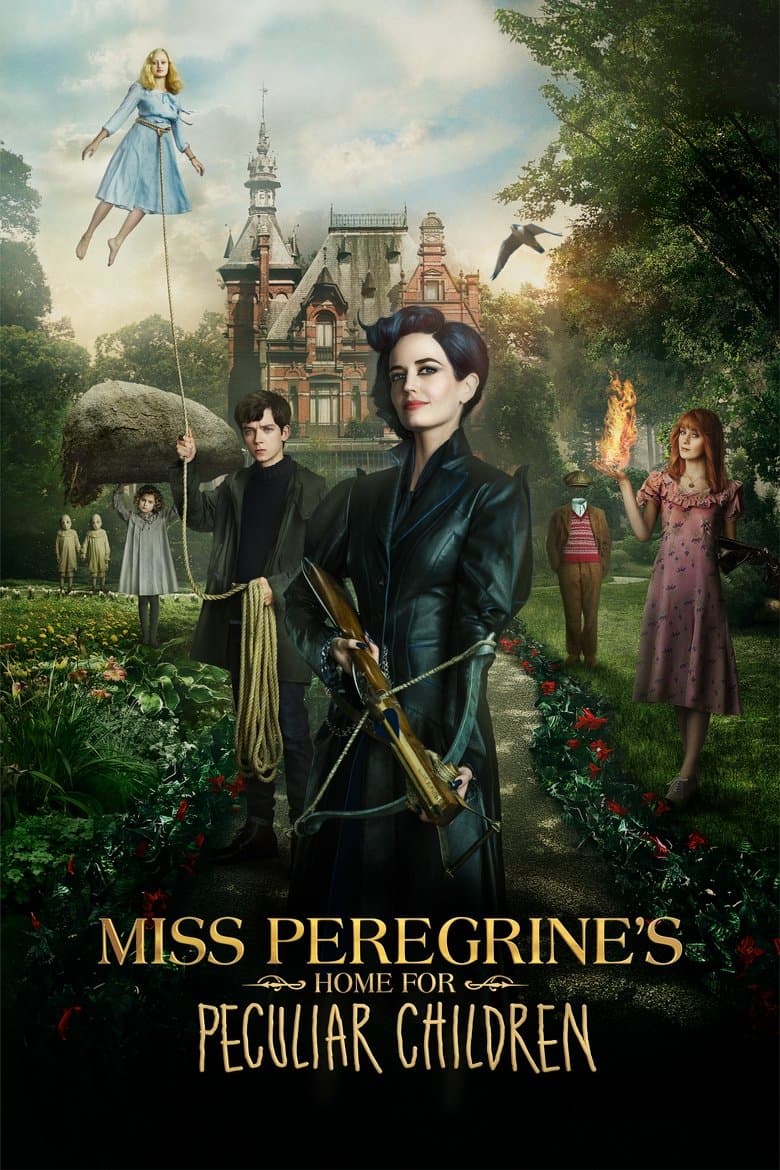
Movie review
September 28, 2016 · 127 min · PG-13 · Fantasy · Thriller · Adventure · Family · Drama
Sixteen-year-old Jake Portman feels cut off from his family and other teenagers. After his grandfather dies in a violent attack, Jake follows old clues to a Welsh island and finds a house hidden in a repeating day from 1943. Miss Peregrine protects children who can float, make fire, become invisible, control bees, or see the monsters hunting them. Jake learns that he can see the Hollows, so he must help his new friends save their home from a dangerous leader. The film moves between Florida, a lonely island, and a strange wartime town with a dark but playful fairy tale tone.
The film makes belonging its main emotional idea. People outside the home fear the children, but the story treats their unusual powers as part of who they are. The house gives them family and protection, while Jake learns that being ordinary does not make him safe or complete. Miss Peregrine is a strict guardian who puts the children’s safety above her own freedom, and Jake and Emma form a gentle romance as the group fights together. The message supports acceptance of outsiders, but it stays within a fantasy story about grief, courage, and friendship.
Community feedback
Was our 10% Woke rating accurate?
Breakdown
These are the editorial factors and ratings behind our score for Miss Peregrine's Home for Peculiar Children.
Woke representation / casting
Not present in this title.
0%
Woke political dialogue
Not present. Zero activist language, political statements, gender or racial lectures, or ideological messaging in dialogue or story.
0%
Identity-driven story themes
The film makes acceptance of outsiders a direct lesson. The peculiar children hide because ordinary people fear and reject them. The story treats their unusual powers as part of who they are and presents the home as a safe family. The message uses a fantasy metaphor and does not turn into modern race, gender, or political identity claims.
15%
Western institutional / cultural critique
Not present. Conflict is strictly against eye-eating monsters with no reframing as critiques of patriarchy, capitalism, toxic masculinity, colonialism, or Western institutions.
0%
Woke character or canon changes
Not relevant. minor film adaptations like power reassignments serve pacing and romance without identity-based or political alterations to source characters.
0%
Anti-woke backlash and complaints
Not present. Backlash was exclusively progressive complaints about insufficient diversity and the director's anti-quota stance; no backlash accused the film of advancing woke or activist content.
0%
Creator track record context
The creative team’s background contains two mild woke-context signals. Jane Goldman has a pattern of writing capable female leads, and Peter Chernin has a record of Democratic donations. Tim Burton’s relevant background is low, and his interviews for this film focus on feeling like an outsider and making a fantasy story. These signals are limited and do not show an activist pattern driving this film.
12%
Production
Movie · 2021
To save their cash-strapped orphanage, a guardian and his kids partner with a washed-up boat captain for a chance to win a lucrative fishing competition.
Movie · 2016
12-year-old Conor encounters an ancient tree monster who proceeds to help him cope with his mother's terminal illness and being bullied in school.
Movie · 2025
Charles Dickens tells his young son Walter the greatest story ever told, and what begins as a bedtime tale becomes a life-changing journey.
Movie · 2025
When a young girl’s sketchbook falls into a strange pond, her drawings come to life—chaotic, real, and on the loose.
Movie · 2015
When 11-year-old Riley moves to a new city, her Emotions team up to help her through the transition. Joy, Fear, Anger, Disgust and Sadness work together, but when Joy and Sadness…
Movie · 2016
An orphan little girl befriends a benevolent giant who takes her to Giant Country, where they attempt to stop the man-eating giants that are invading the human world.
Movie · 2018
Siblings Kate and Teddy try to prove Santa Claus is real, but when they accidentally cause his sleigh to crash, they have to save Christmas.

Movie · 2019
A dog finds the meaning of his own existence through the lives of the humans he meets.
