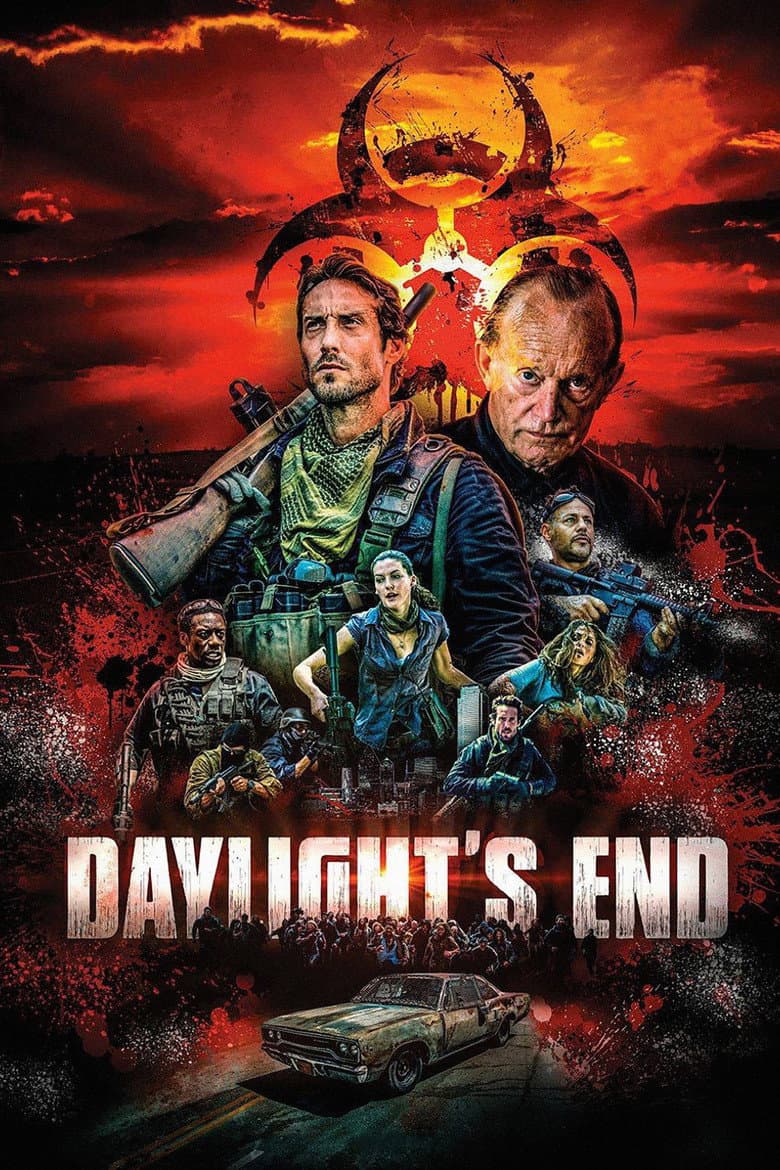
Daylight's End follows Thomas Rourke, a quiet drifter who travels through ruined Texas after a plague turns most people into blood-hungry creatures. He rescues Sam from raiders and reaches a police station in Dallas, where Chief Frank Hill leads a small group of survivors. The group plans to reach a cargo plane and a safer settlement in Baja California. Rourke wants revenge on the creature that destroyed his life, but he agrees to protect the group when the creatures surround their shelter. The film uses a dark, tense action-horror tone with guns, close fights, and long stretches of harsh survival.
Rourke is the main fighter and decision maker, while Frank provides authority and Sam helps the group move toward escape. Sam helps find the plane and stays with the group during the attacks. Earnesta is another armed survivor who joins the defense. Rourke's memories of his wife explain why revenge has controlled his life, and his bond with the survivors gives him a reason to keep going. The ending leaves the group alive but still facing a dangerous world.
Community feedback
Was our 0% Woke rating accurate?
Breakdown
These are the editorial factors and ratings behind our score for Daylight's End.
Woke representation / casting
Not present. The cast presents a normal modern Texas survivor group, and no public marketing frames it as a diversity statement. The story does not build its main roles around identity signaling.
0%
Woke political dialogue
Not present. Characters talk about weapons, shelter, infected creatures, revenge, and escape. Their harsh lines come from the survival situation and do not promote modern identity or activist ideas.
0%
Identity-driven story themes
Not present. The story follows survival, revenge, grief, duty, and group trust after a plague. Rourke is the central fighter, and the main conflict does not depend on race, sex, sexuality, or modern identity politics.
0%
Western institutional / cultural critique
Not present. The former police chief and armed survivors defend people inside a police station. The film treats order, teamwork, and self-defense as useful after society collapses, with no modern attack on family, religion, masculinity, or Western institutions.
0%
Woke character or canon changes
Not relevant. Daylight's End is an original post-apocalyptic story rather than an adaptation of known characters or real history. It does not change an established character or historical figure.
0%
Anti-woke backlash and complaints
Not present. The supplied X check found no anti-woke reaction or specific complaint. Broader discussion praises the movie for avoiding modern political messaging or focuses on its action and weak plot.
0%
Creator track record context
William Kaufman and Chad Law mainly make action, military, and thriller films. Johnny Strong's title-related interview centers on serious survival horror and independent filmmaking. Jay Stamper has mild conventional progressive politics, but the wider crew shows no clear identity-driven or activist film pattern.
1%
Production
Movie · 2025
Special Forces commandos on a mission are abducted mid-operation by a mysterious spacecraft. Upon waking aboard, they find themselves prey to a relentless alien race in a fight…

Movie · 2023
In postwar Japan, Godzilla brings new devastation to an already scorched landscape. With no military intervention or government help in sight, the survivors must join together in…
Movie · 2020
As a grisly virus rampages a city, a lone man stays locked inside his apartment, digitally cut off from seeking help and desperate to find a way out.
Movie · 2020
After an earthquake destroys their underwater station, six researchers must navigate two miles along the dangerous, unknown depths of the ocean floor to make it to safety in a…
Movie · 2016
Picking up immediately after the events in Resident Evil: Retribution, Alice is the only survivor of what was meant to be humanity's final stand against the undead.

Movie · 2016
Brothers Mike and Jody join family friend Reggie to battle the Tall Man and his evil minions from another dimension, for the final time.
Movie · 2024
In the near future, on a decimated Earth, Paul and his twin sons face terror at night when ferocious creatures awaken.
Movie · 2025
During the Vietnam War, a recon unit ventures to an isolated jungle valley to uncover the fate of a missing platoon.
