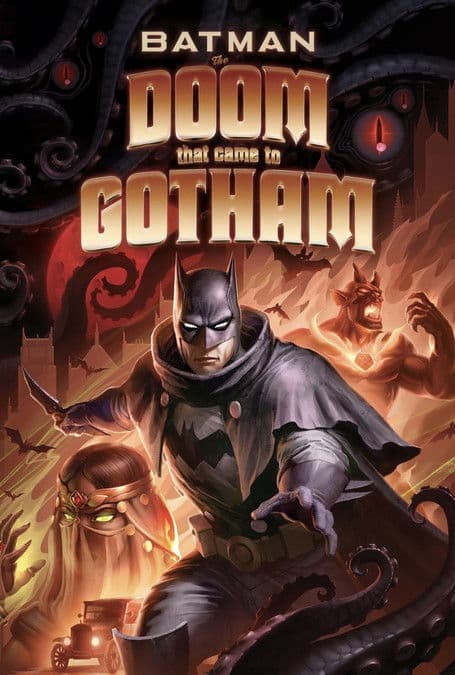
Movie review
March 10, 2023 · 86 min · PG-13 · Fantasy · Animation · Mystery · Action
Batman: The Doom That Came to Gotham follows Bruce Wayne after he spends twenty years traveling the world to learn about crime and prepare to protect Gotham. In this 1920s Elseworlds story, Bruce returns with Alfred and three young wards after an Arctic expedition wakes an ancient evil. The force spreads through cults, demons, strange creatures, and cursed people, while Bruce struggles to accept that science cannot explain everything. The film has a dark, violent, and strange horror tone with mystery, action, and a bleak ending.
The film gives a major role to Kai Li Cain, a young female ward who acts as Bruce's conscience, challenges his hard logic, fights beside him, and takes control of his estate after his final sacrifice. The movie also presents Sanjay Tawde as an Indian ward and gives the Black Lucius Fox a key support role while a company board resists his orders. These choices make the Bat-family look more international and place a young woman at the center of Gotham's future. The identity message stays in the background because the main plot remains a battle against ancient evil, family guilt, and the limits of human reason.
Community feedback
Was our 33% Woke rating accurate?
Breakdown
These are the editorial factors and ratings behind our score for Batman: The Doom That Came to Gotham.
Woke representation / casting
The film gives Batman a prominent female ward, Kai Li Cain, who serves as his closest conscience and later takes charge of his estate. The film also makes Jason Todd's counterpart, Sanjay Tawde, an Indian ward and gives Black businessman Lucius Fox a major support role. Bruce's world travel makes the international mix plausible within the story. The writer and director also said diversity and variety were part of the adaptation thinking.
34%
Woke political dialogue
Not present. The film has no sustained modern political or activist speech. Its dialogue centers on demons, family guilt, science, and saving Gotham.
0%
Identity-driven story themes
Not present. Kai Li is a strong ally and future leader, but the story does not make identity politics or DEI a theme. The main themes are supernatural danger, family guilt, and Bruce learning to accept what science cannot explain.
0%
Western institutional / cultural critique
Not present. The film shows a cursed family legacy and a board that doubts Lucius, but it does not build a modern critique of Western institutions, capitalism, patriarchy, Christianity, or social norms. The main conflict is a supernatural curse.
0%
Woke character or canon changes
The movie replaces comic-book Tim Drake with Kai Li Cain, a female blend of Cassandra Cain and Carrie Kelley. It changes Jason Todd's counterpart into Sanjay Tawde, an Indian ward, and adds Lucius Fox as a visible ally. Writer Jase Ricci said diversity was in mind, while also saying Bruce's worldwide travel made the changes fit the story. Kai Li remains important through the ending, but these changes support the horror plot rather than replace it.
44%
Anti-woke backlash and complaints
A few online viewers objected to the film's altered Bat-family. One Reddit discussion blamed Kai Li, Sanjay, and Lucius on inclusivity and said the changes weakened the story. Another complaint called the Indian version of Jason Todd a social-justice move. The reaction was small and mostly forum-based, while larger reviews focused on pacing, horror, and adaptation quality.
20%
Creator track record context
The cached creator context gives the main writers and directors low woke scores. The producers also have low scores and are mainly known for commercial animation. No strong activist pattern is tied to this creative team.
15%
Production
Movie · 2025
The Demon Slayer Corps are drawn into the Infinity Castle, where Tanjiro, Nezuko, and the Hashira face terrifying Upper Rank demons in a desperate fight as the final battle…
Movie · 2021
The Earthrealm heroes must journey to the Outworld and fight for the survival of their homeland, invaded by the forces of evil warlord Shao Kahn, in the tournament to end all…
Movie · 2016
Robin is sent by Batman to work with the Teen Titans after his volatile behavior botches up a Justice League mission.
Movie · 2019
In the wake of The Death of Superman, the world is still mourning the loss of the Man of Steel following his fatal battle with the monster Doomsday.
Movie · 2018
Amanda Waller's top-secret "Task Force X" — consisting of Deadshot, Bronze Tiger, Killer Frost, Captain Boomerang, Harley Quinn, and Copperhead — is on a mission to retrieve a…
Movie · 2021
Yuta Okkotsu is a nervous high school student who is suffering from a serious problem—his childhood friend Rika has turned into a curse and won't leave him alone.
Movie · 2022
The vicious, power-mad Kano is determined to take over Earthrealm, one soul at a time. Assisted by a trio of cold Black Dragon mercenaries, he embarks on a brutal assault from…
Movie · 2020
A professional cellist has an encounter with a stranger on the subway which has unexpected and far-reaching ramifications on his life.
