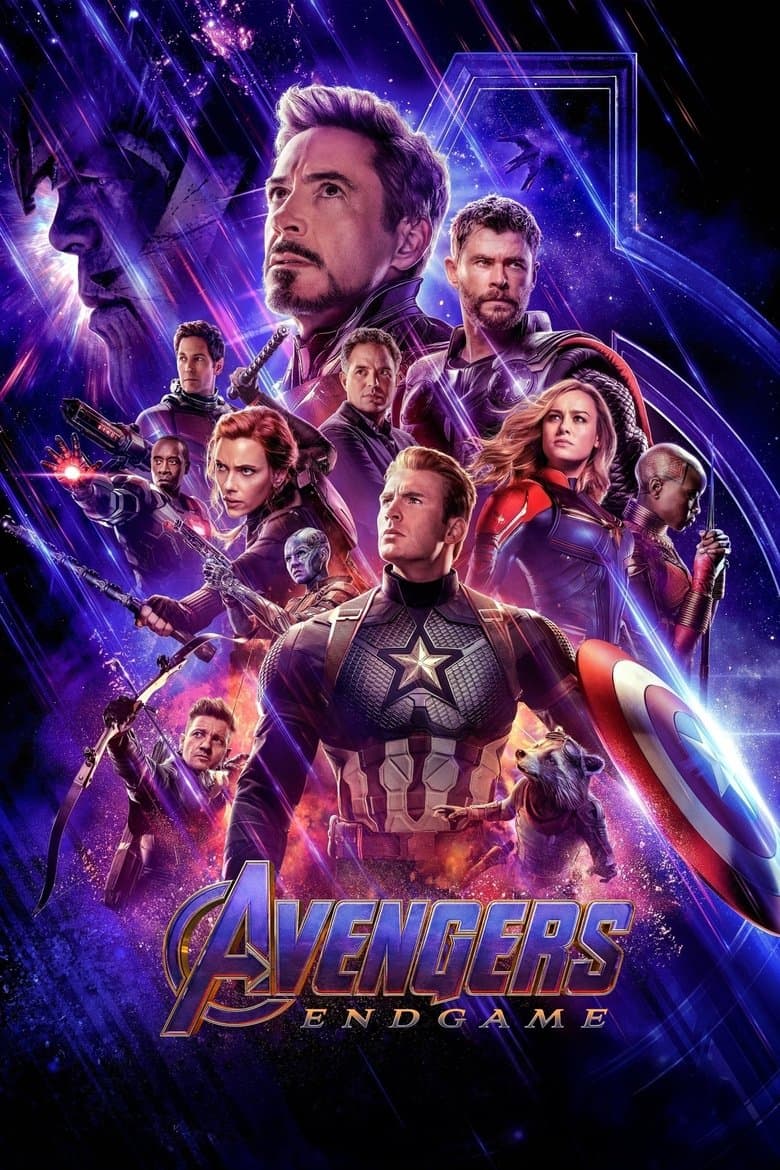
Avengers: Endgame follows the surviving Avengers after Thanos wipes out half of all life. Tony Stark, Steve Rogers, Natasha Romanoff, Thor, Bruce Banner, Clint Barton, and their allies live with grief and failure while they search for a way to undo the Snap. They travel through time to collect the Infinity Stones and face Thanos again in a huge battle on Earth. The movie is serious and sad, but it also uses jokes, family moments, and a hopeful sense of closure.
Most of the story centers on sacrifice, loss, friendship, family, duty, and the cost of saving others. A brief final-battle shot gathers Captain Marvel, Scarlet Witch, Valkyrie, Okoye, Shuri, Wasp, Mantis, Nebula, Gamora, and Pepper Potts to help carry the gauntlet, making female solidarity an audience-visible moment. A short support-group scene gives an unnamed man a male partner and has him talk about dating after the Snap. These moments are clear but brief, and they do not control the main plot or the major character endings.
Community feedback
Was our 31% Woke rating accurate?
Breakdown
These are the editorial factors and ratings behind our score for Avengers: Endgame.
Woke representation / casting
The movie puts many female superheroes into visible fighting roles, including Captain Marvel, Scarlet Witch, Valkyrie, Okoye, Shuri, Wasp, Mantis, Nebula, Gamora, and Pepper Potts. Most of these are established MCU characters, so the casting is not a story-world mismatch. The brief “She’s got help” shot turns the women’s shared identity into the focus of one heroic image. That makes the representation emphasis noticeable, but it is isolated rather than spread through the whole film.
30%
Woke political dialogue
Not present. The dialogue centers on grief, time travel, sacrifice, family, and the battle. The support-group scene mentions a man dating another man, but it does not make a political argument.
0%
Identity-driven story themes
A brief final-battle shot gathers the female heroes around Captain Marvel as they carry the gauntlet. A short support-group scene shows an unnamed man mourning a male partner and dating after the Snap. The main arcs follow grief, sacrifice, friendship, family, duty, and redemption. Identity-driven themes are clear in those two moments, but they do not control the story.
18%
Western institutional / cultural critique
Not present. The movie presents the Avengers as flawed heroes who work together to stop Thanos. It does not frame patriarchy, capitalism, Western institutions, or traditional family life as the cause of the crisis.
0%
Woke character or canon changes
Not relevant. The returning heroes keep their established identities from earlier MCU films. The movie adds a new unnamed gay survivor, but it does not change a known hero into a different identity.
0%
Anti-woke backlash and complaints
Anti-woke viewers on X and Reddit repeatedly called the “She’s got help” moment forced girl-power, pandering, or virtue signaling. Some right-leaning posts said the shot pulled attention from the fight and treated Captain Marvel’s presence as part of the same message. The complaints came from scattered accounts and never became a meaningful boycott or review-bomb against this film. Anti-woke MCU discussion also often treats Endgame as a peak film before later titles, which keeps the backlash score moderate.
34%
Creator track record context
Christopher Markus and Stephen McFeely have mostly story-focused superhero credits and no documented activist or identity-politics focus. The listed editors have low scores from 8 to 18/100 and no known political or identity-driven public work. Joe Russo did say representation and diversity mattered when he added the brief gay survivor scene. The overall creator signal is mild and tied more to this title than to a long activist record.
22%
Production
Movie · 2018
As the Avengers and their allies have continued to protect the world from threats too large for any one hero to handle, a new danger has emerged from the cosmic shadows: Thanos.
Movie · 2017
The Guardians must fight to keep their newfound family together as they unravel the mysteries of Peter Quill's true parentage.
Movie · 2017
Fuelled by his restored faith in humanity and inspired by Superman's selfless act, Bruce Wayne and Diana Prince assemble a team of metahumans consisting of Barry Allen, Arthur…
Movie · 2023
Until now, the Justice League has been a loose association of superpowered individuals. But when they are swept away to Warworld, a place of unending brutal gladiatorial combat…
Movie · 2026
Fighting crime full-time as Spider-Man in a world that doesn't remember him—and the pressure of seeing his old friends move on without him—sparks a change in Peter Parker he may…
Movie · 2022
A mysterious force knocks the moon from its orbit around Earth and sends it hurtling on a collision course with life as we know it.
Movie · 2016
Through a technology that unlocks the genetic memories of his ancestor in 15th century Spain, Callum Lynch discovers he is a descendant of an ancient line of Assassins and amasses…
Movie · 2021
Evan McCauley has skills he never learned and memories of places he has never visited. Self-medicated and on the brink of a mental breakdown, a secret group that call themselves…
