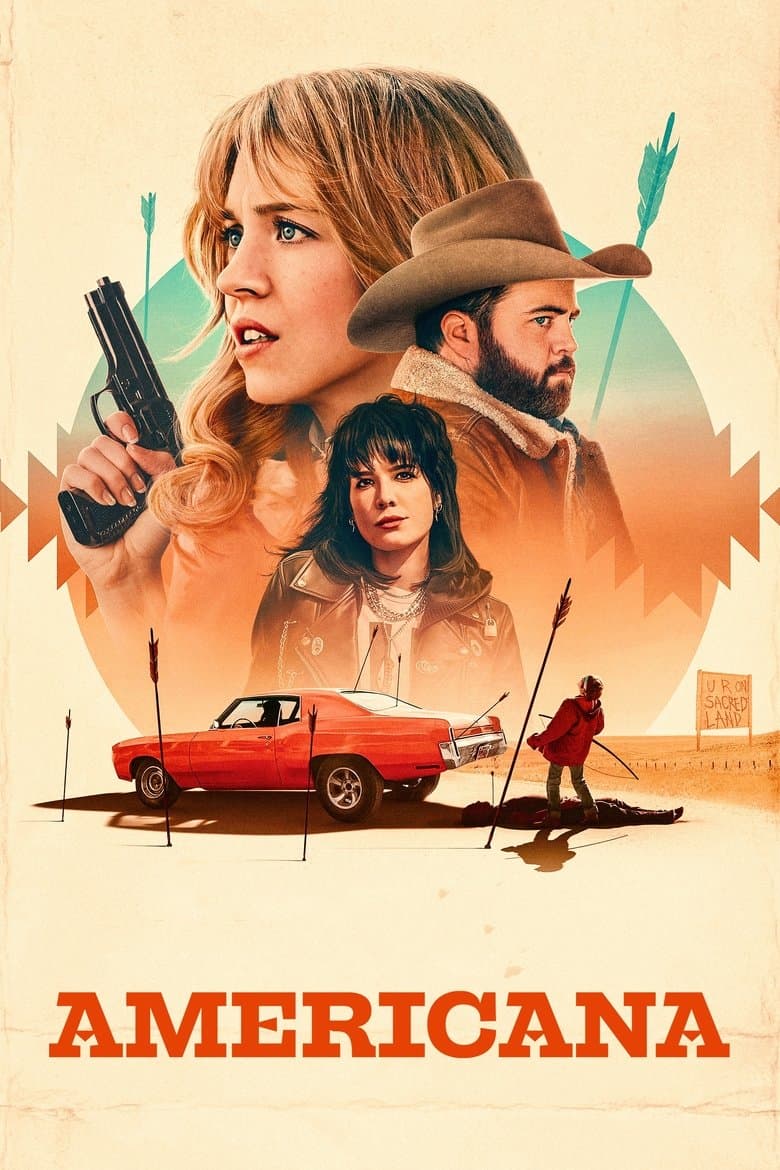
Americana follows Penny Jo Poplin, a shy diner waitress in a small South Dakota town. She dreams of singing in Nashville, so she joins a lonely military veteran named Lefty in a plan to steal a rare Lakota Ghost Shirt. The artifact also draws a criminal dealer, a desperate young mother, a violent religious family, and a Lakota group led by Ghost Eye. The movie uses dark jokes, sudden violence, and a story that jumps back and forth between its characters.
The film makes the Ghost Shirt more than a valuable object because the Lakota group says it was taken from their people. A boy who claims to be the reincarnation of Sitting Bull is used to show confused cultural borrowing, and other characters warn him about it. The movie also presents Mandy's father as a racist and sexist religious ruler who controls the women in his family. Mandy and those women fight back, while Penny Jo gains money and a stronger voice, so native identity, cultural theft, and female resistance affect the final shootout.
Community feedback
Was our 51% Woke rating accurate?
Breakdown
These are the editorial factors and ratings behind our score for Americana.
Woke representation / casting
Not present. The cast is mostly white, and the native characters are played by native actors in a story about a Lakota artifact. The film does not show a clear diversity-first casting pattern.
0%
Woke political dialogue
Ghost Eye quotes Karl Marx and Frantz Fanon while leading the Red Thunder Society. The group says the Lakota Ghost Shirt was taken from its people and must be reclaimed. Cal is warned that pretending to be Sitting Bull is cultural appropriation. These ideas recur around the artifact plot, but most scenes focus on crime, family abuse, and gunplay.
34%
Identity-driven story themes
The Ghost Shirt plot treats a Lakota object as a stolen part of native identity and gives its recovery to a Lakota-led group. Cal's claim to be Sitting Bull is used to show confused cultural appropriation. Mandy escapes an abusive, racist, and sexist family and helps the women fight back. These ideas shape the final conflict, although the movie remains mainly a violent crime comedy.
47%
Western institutional / cultural critique
The movie portrays the antiquities market as profiting from a Lakota object taken from its people. Mandy's father runs a religious compound where women must obey strict old-fashioned rules. The story marks controlling men as racist, sexist, or abusive, while the women arm themselves and fight back. The critique is recurring but mixed with ordinary crime satire and does not attack every Western institution.
49%
Woke character or canon changes
Not relevant. The movie is an original story, not an adaptation. It uses Sitting Bull and the Lakota Ghost Dance as background, but it does not rewrite a known character or historical event.
0%
Anti-woke backlash and complaints
A Washington Examiner review said the movie becomes “dangerously close to woke” when it turns to colonization, cultural appropriation, and female empowerment. Film Threat said it leans too hard on identity politics and labels the men, women, and native characters by group. Some Reddit comments called it feminist, woke, or “go woke go broke.” The reaction was small, and most online noise involved Sweeney's separate American Eagle ad.
18%
Creator track record context
Tony Tost has a cached score of 24/100 and is described as focused on class and blue-collar America while criticizing Hollywood's liberal echo chamber. Angelique Midthunder has a cached score of 34/100 because her work often supports Indigenous talent and cultural accuracy. Several producers have low cached scores, but Brenda Gilbert, Aaron L. Gilbert, Marcus RedThunder, and Alison-Jane Roney have cached scores from 40 to 50 for race or representation-focused work. The overall creator context is mild to moderate and supports the film's Native and anti-capitalist material.
32%
Production
Movie · 2024
Rory and Cobby are unlikely partners thrown together for a heist. But when it goes awry, they team up with an unusual accomplice — Rory's therapist — to outrun police, backward…
Movie · 2019
Based on the extraordinary true story of the European city’s 1973 bank heist and hostage crisis that was documented in the 1974 New Yorker article “The Bank Drama” by Daniel Lang.
Movie · 2025
Only one man has the particular set of skills... to lead Police Squad and save the world: Lt. Frank Drebin Jr.
Movie · 2026
To save his career, a 40-year-old ad exec joins a crew of twentysomethings for a wild Miami bachelor party after they mistakenly add him to a group chat.
Movie · 2024
Stuck at a dead end but vying for the love of spunky club manager Anata, aging contract killer Danny Dolinski is thrilled when The Company pulls him back in the field, but only to…
Movie · 2025
A former Army Ranger and struggling father turns to robbing McDonald’s restaurants by cutting holes in their roofs, earning him the nickname "Roofman." After escaping prison, he…
Movie · 2022
The roguishly charming and endlessly troublesome Fletch becomes the prime suspect in a murder case while searching for a stolen art collection.
Movie · 2024
A mild-mannered professor moonlighting as a fake hit man in police stings ignites a chain reaction of trouble when he falls for a potential client.
