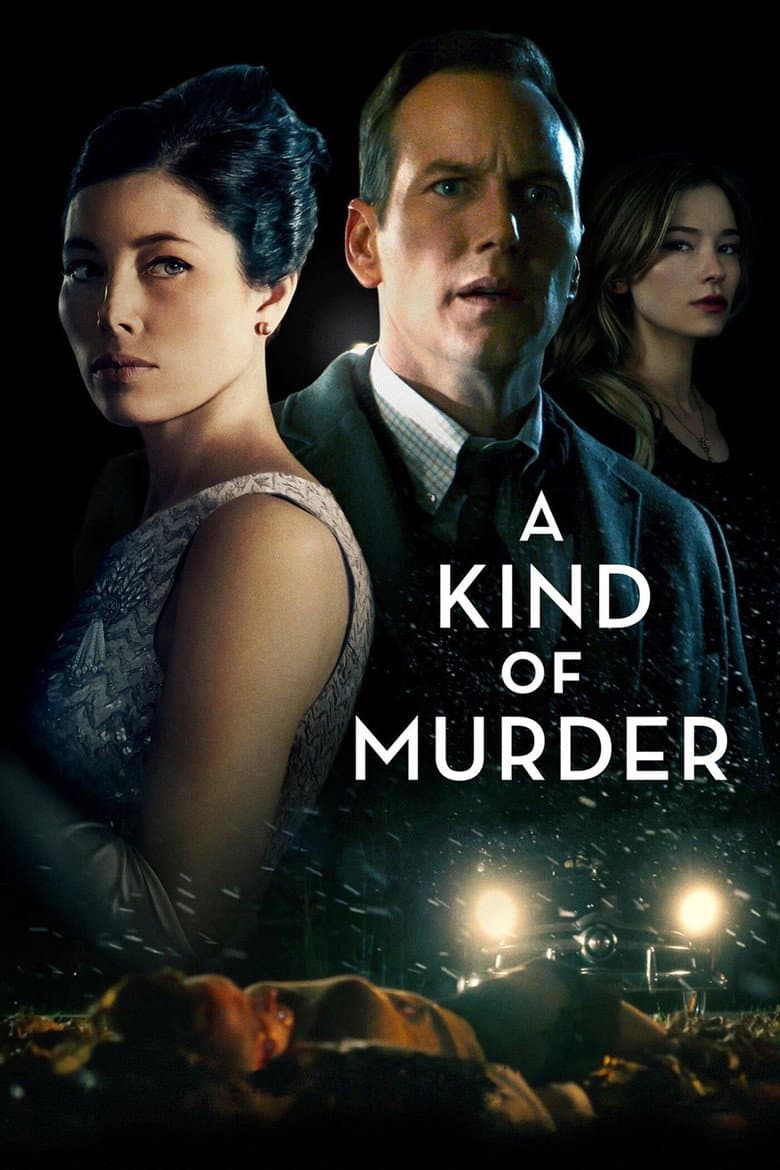
A Kind of Murder is a crime thriller set in New York and its nearby suburbs in the early 1960s. Walter Stackhouse is a rich architect and part-time crime writer who feels trapped in his unhappy marriage to Clara. After a bookstore owner's wife is murdered, Walter studies the case and begins imagining how a husband might kill his own wife. Clara then dies near the same bus stop, and a determined police detective links Walter to the first killing. The film uses snowy streets, stylish homes, jazz clubs, and dark rooms to create a tense and old-fashioned noir mood.
The story centers on guilt, desire, lies, and the thin line between thinking about murder and committing it. Walter has an affair with Ellie, a jazz singer, and his wish to escape Clara makes his thoughts look dangerous. The film treats Walter's selfish choices as more important than blaming the other woman, while Clara's pain keeps shaping the mystery after her death. This gives the story a mild feminist edge about male sexual freedom and old family rules, but it is not a race, sexuality, or social rights story.
Community feedback
Was our 33% Woke rating accurate?
Breakdown
These are the editorial factors and ratings behind our score for A Kind of Murder.
Woke representation / casting
Not present. The main cast is made up of white characters whose roles fit the period setting. The film does not use a visible diversity pattern or identity-based casting message.
0%
Woke political dialogue
Not present. The spoken conflict concerns murder, marriage, adultery, guilt, and police suspicion. The film does not use modern DEI, activist, or identity-politics lines.
0%
Identity-driven story themes
The film repeatedly links Walter's wish to escape marriage with his affair and his thoughts about murder. The story makes his selfish choices more important than blaming Ellie, the other woman. Clara's pain and death keep shaping the mystery after she is gone. This gives the crime story a noticeable feminist edge about male sexual freedom and old family rules.
34%
Western institutional / cultural critique
The film shows Walter treating marriage as a prison while he takes an affair. The story places blame on his choices instead of making Ellie the only cause. The police and family are not shown as systems of oppression, and the film does not attack Christianity or other Western institutions. The result is a mild critique of male sexual entitlement and old family rules inside a period crime plot.
26%
Woke character or canon changes
Not relevant. The adaptation changes Walter's job from lawyer to architect and crime writer, but it does not change race, sex, sexuality, or a hero's identity. No real historical figure is being reworked.
0%
Anti-woke backlash and complaints
Not present. No anti-woke complaints were found in news, audience reviews, or the separate X research pass. Public discussion focused on the slow plot, confusing ending, acting, and period style.
0%
Creator track record context
Christine Vachon has a strong record of queer and identity-focused films. Ted Hope and Brad Becker-Parton have moderate links to socially focused or representation-minded projects, and Jenny Jue has advocated for more Asian American and Pacific Islander representation. Andy Goddard, Patricia Highsmith, Susan Boyd, and most of the other producers have low or mainly industry-focused context. This background raises the creator track record context, but the film itself does not show a matching diversity or activist push.
43%
Production

Movie · 2017
Cairo, 2011. A police officer investigates the murder of a woman in a luxurious hotel in the days leading up to the Egyptian revolution.

Movie · 2022
After escaping a Michigan prison, a charming career criminal assumes a new identity in Canada and goes on to rob a record 59 banks and jewellery stores while being hunted by a…

Movie · 2021
The seemingly casual reunion of three old friends at an out-of-the-way repair shop masks a hidden agenda fuelled by the arrival of a privileged young yuppie.
Movie · 2019
In New York, former convict Pete Koslow, related to the Polish mafia, must deal with both Klimek the General, his ruthless boss, and the twisted ambitions of two federal agents…

Movie · 2016
Alex, an immigrant from Ukraine comes to Canada and becomes involved with an online criminal organization called Darkweb.
Movie · 2016
As a math savant uncooks the books for a new client, the Treasury Department closes in on his activities and the body count starts to rise.

Movie · 2020
A small time delinquent, turned police mechanic for a go fast task force, is forced to defend his innocence when his mentor is killed by dirty cops.
Movie · 2017
After a botched bank robbery lands his younger brother in prison, Connie Nikas embarks on a twisted odyssey through New York City's underworld to get his brother Nick out of jail.
