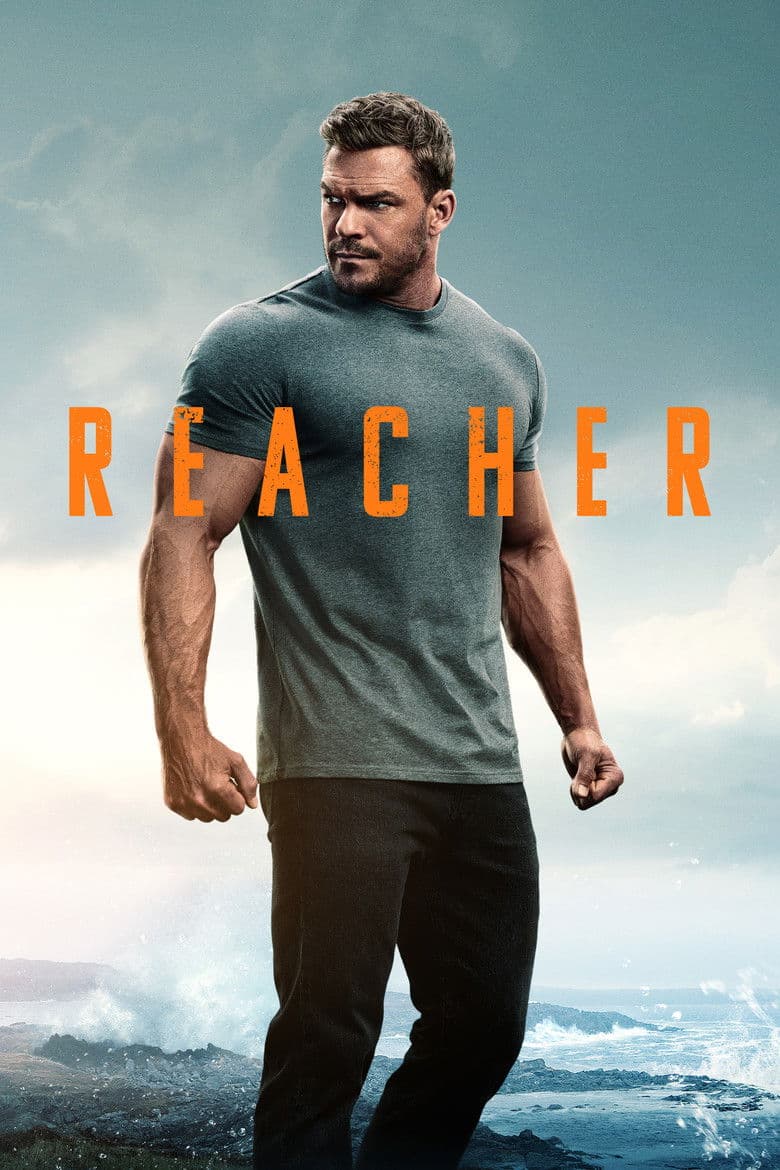
Started February 3, 2022 · Returning Series · Based on 3 seasons, 24 episodes through March 27, 2025 · TV-MA
Amazon's Reacher adapts Lee Child's Jack Reacher thrillers as self-contained seasonal cases. Season 1 covers a corrupt town in Georgia, Season 2 reunites Reacher's old military police unit against a defense contractor arms plot, and Season 3 sends him undercover with a DEA agent against arms trafficking and his military enemy Quinn. Across three seasons the core product is pulp vigilante action. Reacher is a highly skilled male drifter who solves crimes with fists, guns, and short clear logic.
The cast mixes races and includes many capable women as partners and co-leads, which mostly matches the books rather than pure DEI casting. Seasons 1 and 2 largely avoid identity lectures. Season 3 includes a flashback where Reacher helps a female protégé get arrest credit so people will not assume she was only along for the ride with a male senior officer. Strong women and light elevation of female fighters appear, but identity is not the main story structure. Institutions fail through corrupt people, not modern activist theories of culture.
Community feedback
Was our 31% Woke rating accurate?
Breakdown
These are the editorial factors and ratings behind our score for Reacher.
Woke representation / casting
A modern U.S. military and crime setting makes a mixed cast normal rather than a historical mismatch. Key allies largely track the novels, including a Black Harvard detective co-lead who matches the book. Recurring highly capable female partners are already in Child's material, not a race-swap of Reacher himself. Mild elevation of women as fighters and lead investigators is the main light signal.
24%
Woke political dialogue
Seasons 1 and 2 are largely free of identity lectures, which is a big reason non-woke fans liked the show. Season 3 Episode 4 is the clearest bump when Reacher frames a flashback so Dominique Kohl gets arrest credit against gender-bias assumptions. Some anti-woke viewers read a wider DEI speech in that arc. The dialogue is occasional and tied to military professionalism, not a season-long sermon.
22%
Identity-driven story themes
Core arcs are brotherhood, revenge, arms dealing, and civic corruption. They are not systemic racism, queer identity, or representation-first storytelling. Strong women work as allies inside thriller genre norms while Reacher stays the center of competence. Identity is not the premise structure.
14%
Western institutional / cultural critique
Institutions fail because of corrupt individuals such as dirty cops, crooked mayors, and rogue officers. That is classic pulp anti-corruption storytelling. It is not a modern activist reframe of whiteness, colonial guilt, toxic masculinity as ideology, or Christianity as oppressor. Resistance to bullies and criminals is story-logical, not identity politics.
12%
Woke character or canon changes
The adaptation is comparatively faithful on identity axes. Finlay's race matches the book and female partners exist in the source material. A documented Season 3 change makes Kohl a platonic protégé rather than more romantic book shading, which is craft choice rather than DEI. There are no major gender-swaps of Reacher or established icons.
10%
Anti-woke backlash and complaints
Title-directed anti-woke criticism is real but limited. Season 2 draws complaints that female hand-to-hand fights feel unrealistic or girlboss-adjacent. Season 3 draws comments about Duffy as a girlboss, Kohl casting, DEI-tinged dialogue, and claims the show went woke. A larger right-leaning conversation still treats Reacher as a non-woke oasis, and much louder anger targets Ritchson's personal politics rather than the series text.
24%
Creator track record context
Cached creatives are mostly low, with Santora around 10 and Child around 18 for entertainment-first thrillers. Most listed writers and producers score in the single digits to mid teens. MJ Bassett scores higher but directed only one Season 1 episode and is not the show's ideological center. Aggregate supporting context is mild with no dominant activist showrunner brand.
14%
Production
TV Show · 2022
Navy SEAL Commander James Reece turns to vengeance as he investigates the mysterious forces behind the murder of his entire platoon.
TV Show · 2017
Action drama series inspired by the real missions of Navy SEAL Team Six.
TV Show · 2020
Desperate to take care of his pregnant wife before a terminal illness can take his life, Dodge Maynard accepts an offer to participate in a deadly game where he soon discovers…

TV Show · 2016
The story of Mac Conway, a Marine who returns home to Memphis from Vietnam in 1972 and finds himself shunned by those he loves and demonized by the public.

TV Show · 2021
Takemichi Hanagaki is a freelancer that’s reached the absolute pits of despair in his life. He finds out that the only girlfriend he ever had, in middle school, Hinata Tachibana…
TV Show · 2017
The origin story of younger, hungrier, former Green Beret Bryan Mills as he deals with a personal tragedy that shakes his world.
TV Show · 2025
Before The Terminal List, Navy SEAL Ben Edwards finds himself entangled in the black operations side of the CIA.
TV Show · 2023
During his glory days, Berlin and a gang assembled in Paris for one of his greatest plans ever: stealing 44 million euros' worth of jewels in one night.
