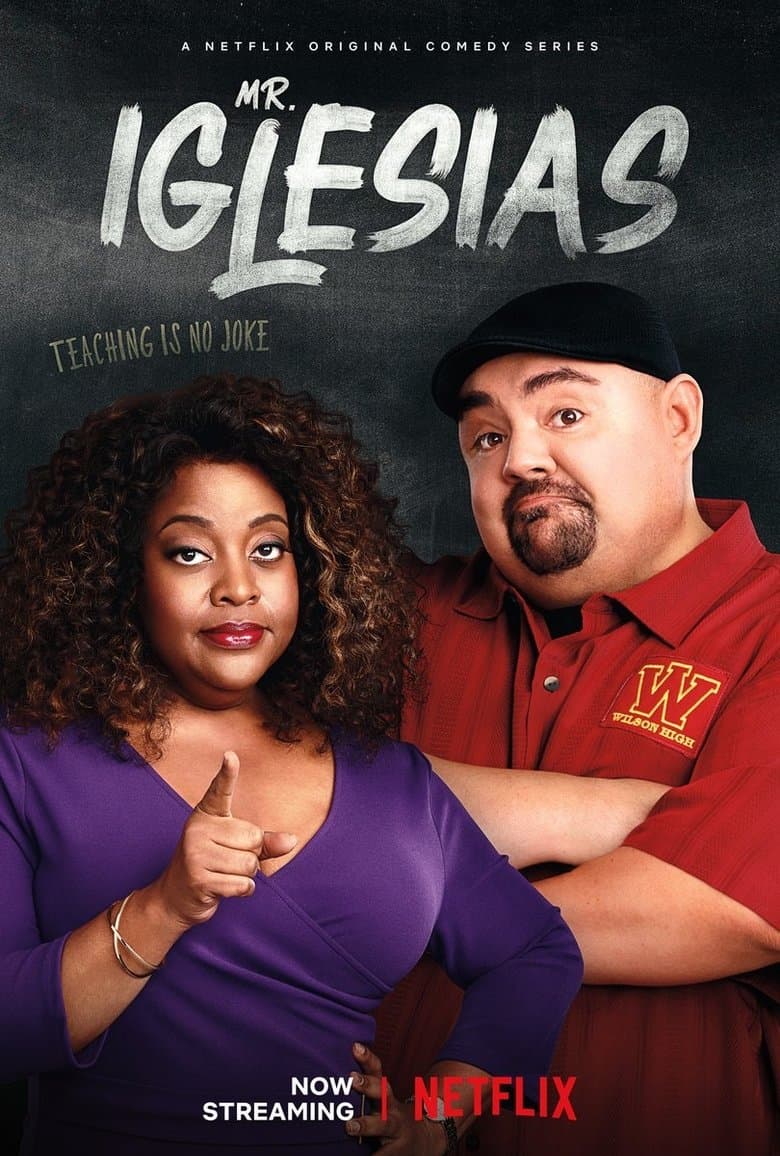
Started June 21, 2019 · Canceled · Based on 3 seasons, 21 episodes through December 8, 2020 · TV-14 · 30 min
Mr. Iglesias is a warm school comedy set at Woodrow Wilson High in Long Beach, California. Gabe Iglesias returns to his old school as a history teacher and fights to keep a group of smart but struggling students from being pushed out. He teaches Marisol, Mikey, Lorenzo, Grace, and Walt while dealing with school rules, money pressure, dating, drinking, and his noisy friends at work. The show uses a bright sitcom tone, with jokes wrapped around lessons about effort, fairness, friendship, and second chances.
The show has a few clear modern social themes. One episode debates the word Latinx and inclusive language, and another centers on cultural appropriation when a Filipino seller runs a taco truck that sells Mexican food. Other episodes discuss climate change, privilege, school funding, student removal, security rules, and a teachers' strike. These ideas usually appear as one-episode lessons inside a teacher-and-student story, while the last five episodes focus more on technology, romance, family problems, and a school dance.
Community feedback
Was our 56% Woke rating accurate?
Breakdown
These are the editorial factors and ratings behind our score for Mr. Iglesias.
Woke representation / casting
The main cast visibly mixes Latino, Black, Asian, and white characters in the teacher group and the student class. Marisol is a central Latina student, and Grace is a highly skilled Asian girl who is good with computers. The mix is believable for a modern Long Beach school, but the repeated mixed group gives the show a clear diversity-first feel. The show does not use a strong identity slogan or a setting mismatch, so this remains mild.
27%
Woke political dialogue
The students and staff openly debate Latinx and inclusive language in “Bullying.” The show also talks about privilege, climate change, cultural appropriation, school funding, and a teachers' strike. These subjects appear in several episodes across the first two seasons, so the political talk returns more than once. The later five episodes mostly return to technology, romance, family, and school life.
44%
Identity-driven story themes
The show repeatedly makes modern identity and social issues part of the lesson. Marisol's Latinx debate and her fight over a Filipino man's taco truck center race, culture, and who may profit from a tradition. Green Week and the privilege lesson add climate and fairness themes. These stories matter for individual episodes, but the series remains mainly about teaching, friendship, and romance.
41%
Western institutional / cultural critique
School leaders and grading systems are often shown as cold or self-serving, especially when students are pushed out for low scores. The show criticizes clear-backpack rules, school funding pressure, and a teachers' strike. Gabe's students also blame adults for climate change and question school power. The show does not build a broad attack on men, Christianity, capitalism, or Western culture.
31%
Woke character or canon changes
Not relevant. The show is an original sitcom with no established story world, famous character, or real event that it changes for identity reasons.
0%
Anti-woke backlash and complaints
Some Reddit and Hacker News users called the show too political or woke. They pointed to jokes about white people, the Latinx debate, and what they saw as a left-wing view of race and school issues. A conservative family review also complained about a political agenda. The reaction was small and scattered, while wider coverage mostly treated the show as a warm school comedy.
33%
Creator track record context
Peter Murrieta has a strong public record of promoting Latino representation in Hollywood. Chris Garcia's work often centers his Cuban-American background and Latino representation. Julia Ahumada Grob and Aaron Serna have also discussed Latino identity and inclusion, while Kevin Hench has no high-confidence activist record. Gabriel Iglesias is generally known for cultural humor without strong political advocacy. This gives the writing team a representation-focused context, but the title is still a broad school comedy.
47%
Production
TV Show · 2018
Offbeat comic James Acaster covers the strange, the mundane and everything in between in this collection of four wide-ranging stand-up specials.
TV Show · 2023
The inner workings of an American jury trial through the eyes of one particular juror, Ronald Gladden. Gladden is unaware the entire case is fake, everyone except him is an actor…
TV Show · 2020
David Tennant and Michael Sheen (playing themselves) were due to star in a production of 'Six Characters in Search of an Author' in the West End.
TV Show · 2025
Eight years after an unforgivable mistake nukes his promising college football career, hotshot quarterback Russ Holliday tries to resurrect his dreams by disguising himself as…
TV Show · 2016
After North Jackson High's long-time principal steps down to tend to his ailing wife, Neal Gamby and Lee Russell, the school's vice principals, are forced to put their mutual…

TV Show · 2016
Jeremy Clarkson, Richard Hammond and James May are back with a show about adventure, excitement and friendship...

TV Show · 2019
Considered a genius due to having the highest grades in the country, Miyuki Shirogane leads the prestigious Shuchiin Academy's student council as its president, working alongside…
TV Show · 2020
All Nikki and Jason want is a baby—the one thing they can't have. So they decide to adopt. With their dysfunctional friends, screwball families, and chaotic lives, will the…
