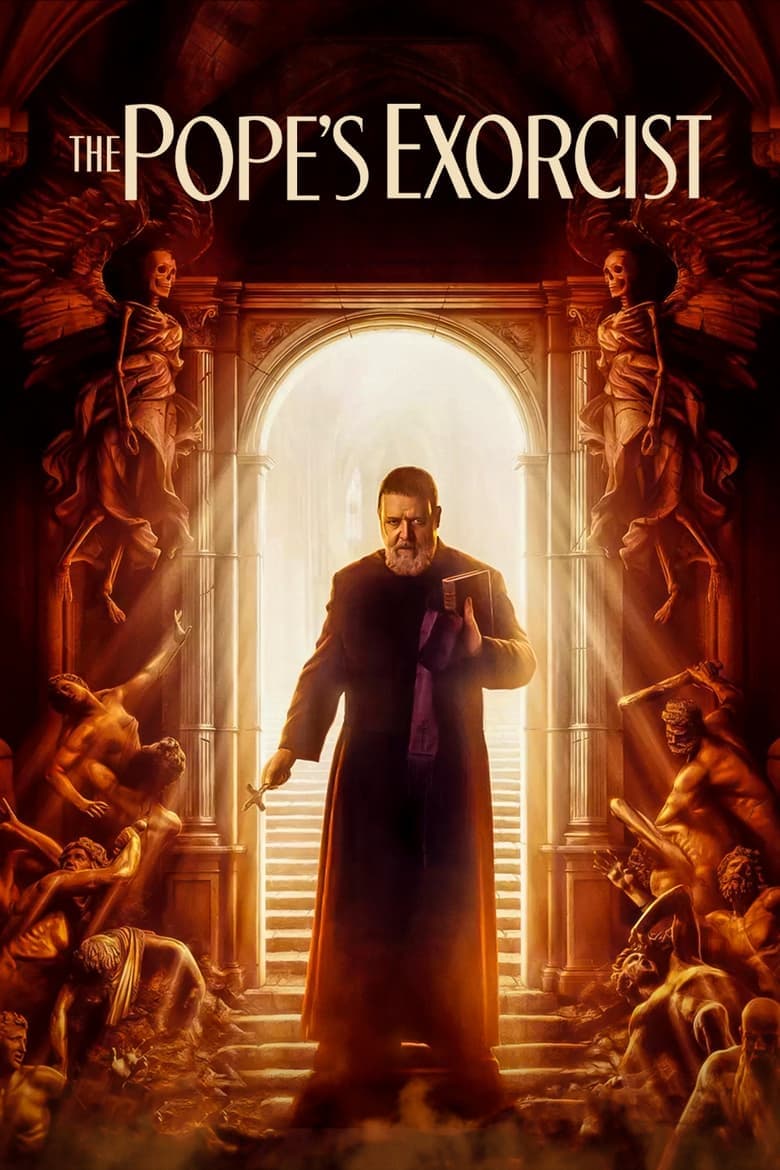
Father Gabriele Amorth is the Vatican chief exorcist in 1987. He is sent to a Spanish abbey after a traumatized American boy named Henry is seized by a powerful demon. Working with local priest Father Esquibel, he learns the abbey hides a centuries-old Church secret about a possessed Spanish Inquisition founder who was left entombed there. The demon Asmodeus wants to corrupt Amorth and weaken the Church from within. The climax turns on confession, prayer, self-sacrifice, and a successful exorcism that reconsecrates the abbey.
The movie has little modern identity politics content. Christian faith is shown as real and effective, skeptics inside the hierarchy look weak, and good wins through prayer. The tone is a pulpy possession adventure rather than a stiff religious drama. Talk on screen stays on possession, prayer, confession, sin, and spiritual war, not race, gender, or activist slogans. The real story themes are faith against demonic evil, guilt and redemption, and a Vatican cover-up thriller that still backs Catholic belief.
Community feedback
Was our 11% Woke rating accurate?
Breakdown
These are the editorial factors and ratings behind our score for The Pope's Exorcist.
Woke representation / casting
The cast is mostly white European and American for a 1987 Italy and Spain Catholic story, with Russell Crowe as the Italian priest. The main visible identity pick is Cornell John as Bishop Lumumba, a capable black friend of Amorth who is raised up after a skeptical white cardinal steps aside. That is clear supporting representation. It is not a full quota ensemble, a girlboss lead pattern, or a diversity marketing pitch.
12%
Woke political dialogue
Not present. Dialogue centers on possession, prayer, confession, sin, and spiritual warfare with no modern activist talk about race, gender, sexuality, or DEI.
0%
Identity-driven story themes
Not present. Core themes are faith versus demonic evil, guilt and redemption, and a Vatican conspiracy thriller, not race, gender, queer, or identity-politics arcs.
0%
Western institutional / cultural critique
The film includes a skeptical Church tribunal and a buried Inquisition-era cover-up in the style of standard pulp horror secrecy. The story still backs Catholic faith and the Pope supports Amorth. The ending reconsecrates the abbey instead of pushing modern activist attacks on Christianity, patriarchy, or the West.
10%
Woke character or canon changes
Not relevant. Amorth is not race- or gender-swapped. Fiction expands his memoirs into a demon-conspiracy adventure without identity-driven rewrites of established figures.
0%
Anti-woke backlash and complaints
Not present. No meaningful anti-woke campaign treated the film as DEI or identity propaganda. Reaction more often calls it faith-respecting or not woke, while critics focus on accuracy, violence, or pro-Church apologetics.
0%
Creator track record context
Profiles for Avery, the writers, producers, and casting team show little to no activist or identity-driven history. Most scores sit in the single digits. Casting director Dan Hubbard is only modestly higher for ordinary industry diversity interest.
8%
Production

Movie · 2019
When a huge hurricane hits her hometown in Florida, Haley ignores evacuation orders to look for her father. After finding him badly wounded, both are trapped by the flood.

Movie · 2021
Paranormal investigators Ed and Lorraine Warren encounter what would become one of the most sensational cases from their files.

Movie · 2024
Stranded in the open sea after a fatal accident, a young woman and her two friends are rescued by a fishing vessel's captain, unaware that the ship harbors a chilling secret.

Movie · 2025
When Polly receives a mysterious box, it comes with one rule: place inside something she needs, something she hates, and something she loves.
Movie · 2017
A straight-edged teacher finds trouble when an honors student is willing to do anything to get an A.

Movie · 2017
Though Kevin has evidenced 23 personalities to his trusted psychiatrist, Dr. Fletcher, there remains one still submerged who is set to materialize and dominate all the others.

Movie · 2023
Recently fired and desperate for work, a troubled young man named Mike agrees to take a position as a night security guard at an abandoned theme restaurant: Freddy Fazbear's…
Movie · 2018
A man recently released from a mental institute inherits a mansion after his parents die. After a series of disturbing events, he comes to believe it is haunted.
