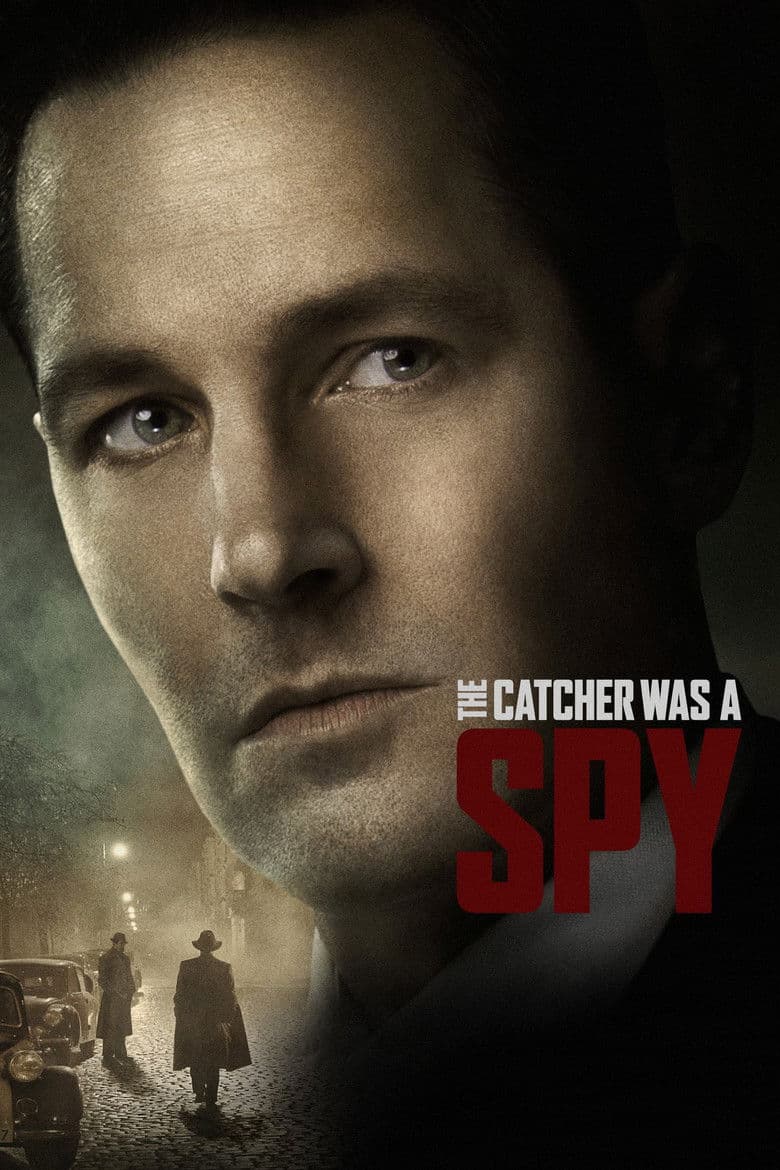
The Catcher Was a Spy follows Moe Berg, a Princeton-educated baseball catcher who speaks many languages and keeps his private life hidden. After his playing days, the United States sends him to Europe during World War II as an Office of Strategic Services agent. Berg must learn whether German physicist Werner Heisenberg is close to building an atomic bomb for the Nazis. If the danger is real, Berg must kill him. The movie uses a quiet, serious tone as Berg moves through baseball memories, spy missions, and tense talks with scientists.
The film repeatedly suggests that Berg may be gay or bisexual, even though it never confirms his sexuality. A teammate accuses him of being queer, a spy chief asks him about it, and the film hints at a close bond with the Japanese man Kawabata. Berg also has sex with Estella, which keeps the question open while making secrecy and hidden identity part of his character. The movie adds a synagogue visit and presents Berg's Jewish background as another part of his sense of being different. These identity themes matter in Berg's character study, but the main story remains his wartime mission and the choice of whether to kill Heisenberg.
Community feedback
Was our 43% Woke rating accurate?
Breakdown
These are the editorial factors and ratings behind our score for The Catcher Was a Spy.
Woke representation / casting
Not present. The film uses a mostly white cast for real American and European figures in a 1930s and 1940s setting. The movie does not present casting as a diversity or identity statement.
0%
Woke political dialogue
Not present. The film has period talk about Berg's Jewish background and rumors about his sexuality. Those lines build the character and the era, but they do not push a modern activist or DEI message.
0%
Identity-driven story themes
The film makes possible same-sex attraction a recurring part of Berg's mystery. It uses the teammate's accusation, the question from Donovan, the bond with Kawabata, and Berg's relationship with Estella to keep the issue alive. The film links hidden sexuality with his larger habit of hiding. The spy mission remains the main plot, and Berg's sexuality stays uncertain rather than becoming a full queer story.
48%
Western institutional / cultural critique
Not present. The film shows wartime conflict, military orders, and a period insult about homosexuality. It does not turn those events into a modern attack on Western institutions, masculinity, family, religion, or social norms.
0%
Woke character or canon changes
The film presents a real historical person as possibly gay or bisexual. The source book says there was no evidence of a gay relationship and only discusses speculation, while the movie makes the question a repeated part of Berg's story. The movie adds the teammate accusation, Donovan's direct question, and the suggestive Kawabata scenes. Berg's sexuality stays unconfirmed, so the change is important but not the whole film.
55%
Anti-woke backlash and complaints
A small conservative X account said it quit after about 20 minutes because the film portrayed Berg as a closeted homosexual. Replies said Hollywood turns everything gay, and another small account called the bisexual suggestion made up. A few other audience posts and reviews questioned the added sexuality, but most focused on accuracy rather than a wider woke agenda. No boycott, review-bombing campaign, or broad anti-woke news fight appeared.
16%
Creator track record context
Ben Lewin has a moderate track record because his past work often explores disability, sexuality, and people who feel outside the group. His interview comments connect this film to Berg's hidden identity and Jewish background. Robert Rodat and Nicholas Dawidoff have low cached scores and no strong record of identity-driven activism. The producers also have little public evidence of that kind of work. This gives some supporting context, but it is not a broad team pattern.
25%
Production
Movie · 2016
Irish Commandant Pat Quinlan leads a stand off with troops against French and Belgian Mercenaries in the Congo during the early 1960s.
Movie · 2018
Two lifelong friends head up to an isolated Scottish Highlands village for a weekend hunting trip that descends into a never-ending nightmare as they attempt to cover up a…
Movie · 2017
A former rodeo star, now a motel manager, meets a young man who is responsible for the violence that suddenly has seized his small town.

Movie · 2021
A head chef balances multiple personal and professional crises at a popular restaurant in London.
Movie · 2017
After a botched bank robbery lands his younger brother in prison, Connie Nikas embarks on a twisted odyssey through New York City's underworld to get his brother Nick out of jail.
Movie · 2019
Los Angeles, 1969. TV star Rick Dalton, a struggling actor specializing in westerns, and stuntman Cliff Booth, his best friend, try to survive in a constantly changing movie…
Movie · 2025
Seasoned deep-sea divers battle the raging elements to rescue their crewmate trapped hundreds of feet below the ocean's surface.

Movie · 2016
When Krisha returns to her estranged family for Thanksgiving dinner, past demons threaten to ruin the festivities.
