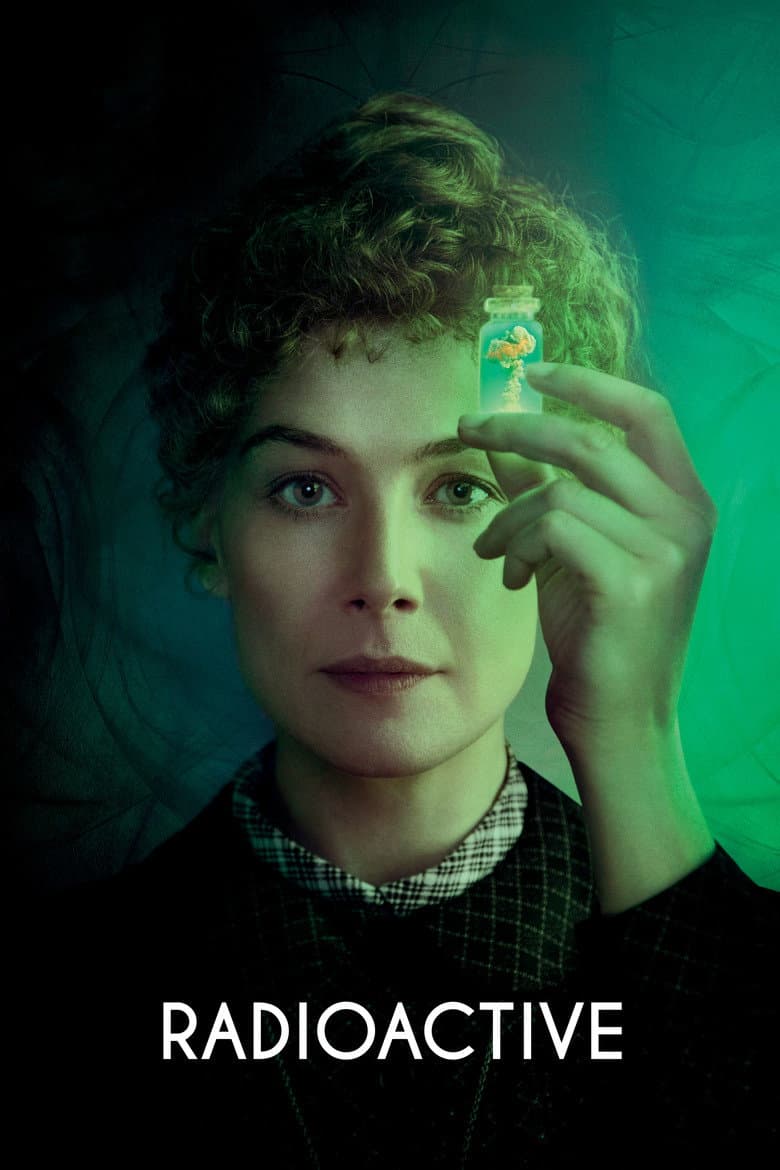
Radioactive follows Maria Skłodowska, a Polish student who moves to Paris and becomes Marie Curie. She works with Pierre Curie, her husband and science partner, to study strange rays and isolate polonium and radium. The story follows their love, his sudden death, her grief, and her later work with X-ray units in wartime France. Flash-forwards show cancer treatment, atomic bombs, and Chernobyl, so the tone moves between romance, grief, science, and warning.
The film repeatedly presents Marie as a woman fighting male control in universities, science groups, newspapers, and government offices. It treats her first female professor role and her daughter’s science work as proof that women can lead serious science while raising a family. It also links public attacks on her to her love outside marriage and her identity as a Polish immigrant. These ideas matter to the story, but Marie also says that lack of money hurt her more than being a woman, which makes the message less simple.
Community feedback
Was our 60% Woke rating accurate?
Breakdown
These are the editorial factors and ratings behind our score for Radioactive.
Woke representation / casting
Rosamund Pike plays the real Polish scientist Marie Curie, so the central casting fits the story. Anya Taylor-Joy plays Curie’s real daughter Irène, who also became a scientist. Amazon’s campaign repeatedly presents the movie as the story of a woman changing science and stresses that Curie was the first woman to win the Nobel Prize. That creates a mild representation signal, but the film has no invented diverse group or casting mismatch.
15%
Woke political dialogue
The film gives Marie repeated arguments with male academics and officials about respect, access, funds, and the place of women in science. It also shows the press and crowds attacking her as a Polish outsider, while a women’s movement supports her Nobel visit. The language turns these period events into broad lines about challenging old views and women’s freedom. The dialogue is tied to her life and work, but it is not a modern political debate throughout the film.
38%
Identity-driven story themes
Marie’s struggle to be respected as a woman and a Polish outsider runs through her lab work, Nobel career, and wartime service. The film treats her first female professor job and her daughter’s science work as part of a story about women claiming space in science. It also links Marie’s affair and public shame to the idea that women are judged for having sexual freedom. These themes are important, but the movie remains a biography about science, marriage, grief, and the dangers of radioactivity.
56%
Western institutional / cultural critique
The film repeatedly shows male university leaders moving Marie’s equipment, denying her space, and treating her as a problem. It shows newspapers and crowds using her affair and Polish background to attack her, while officials resist her wartime X-ray plan. These scenes present older Western institutions and gender roles as unfair, but they belong to the historical setting rather than a broad attack on today’s society. The critique becomes more activist through its repeated focus on male control, immigrant hostility, and women’s right to work and love.
39%
Woke character or canon changes
Not relevant. The film dramatizes some events, but no clear woke or identity-driven change to Curie’s known story is confirmed.
0%
Anti-woke backlash and complaints
A small number of Reddit and IMDb users said the film looked like a strong independent woman checklist, gender baiting, or wokeism. Those comments objected to the feminist framing and to the film’s treatment of male scientists. Larger audience and critic discussions focused on weak science, fast time jumps, and historical accuracy instead. The anti-woke reaction was real but small and mostly forum-based.
17%
Creator track record context
Marjane Satrapi has the strongest context because her public work supports women’s rights and freedom. Jack Thorne has a strong record of advocating disability inclusion and has publicly discussed transgender issues. Lauren Redniss brings a milder Indigenous-rights and environmental-justice context through the source book. Most other listed crew have little public activist history, so creator context is noticeable but not uniform.
56%
Production

Movie · 2019
England, early 20th century. The future writer and philologist John Ronald Reuel Tolkien (1892-1973) and three of his schoolmates create a strong bond between them as they share…

Movie · 2025
Morgan Grant and her daughter Clara explore what's left behind after a devastating accident reveals a shocking betrayal and forces them to confront family secrets, redefine love…

Movie · 2018
Katie, a 17-year-old, has been sheltered since childhood and confined to her house during the day by a rare disease that makes even the smallest amount of sunlight deadly.

Movie · 2025
Two artistic souls find harmony through music despite their contrasting worlds. As feelings deepen, age and circumstances challenge their undeniable bond.
Movie · 2017
The story of four characters whose lives intertwine amid the hustle and bustle of the Coney Island amusement park in the 1950s: Ginny, an emotionally volatile former actress now…

Movie · 2020
Young musician Zach Sobiech discovers his cancer has spread, leaving him just a few months to live. With limited time, he follows his dream and makes an album, unaware that it…

Movie · 2023
Hadley and Oliver begin falling in love on a flight from New York to London, but when they lose each other at customs, can they defy all odds to reunite?
Movie · 2018
As a young New York couple goes from college romance to marriage and the birth of their first child, the unexpected twists of their journey create reverberations that echo over…
