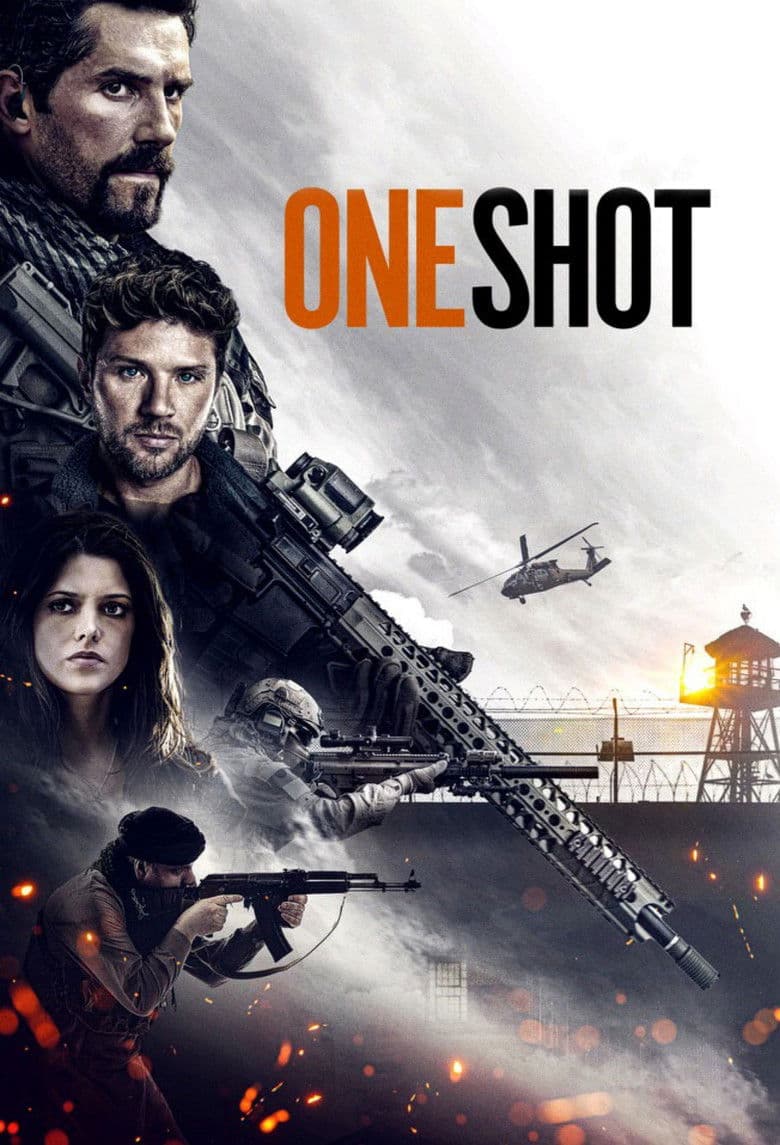
One Shot follows Navy SEAL Lieutenant Jake Harris as he leads a team onto a secret prison island in the Baltic Sea. CIA analyst Zoe Anderson arrives with orders to take Amin Mansur, a British detainee, to the United States because he may know about a dirty bomb aimed at Washington. The prison boss refuses to release Mansur, and armed attackers storm the base. Harris must protect the prisoner and decide whom he can trust as the action unfolds in near real time. The tone is harsh and tense, with close gunfights, knife attacks, torture, and a high body count.
The film’s strongest social message concerns the black-site prison and Mansur’s treatment. The story shows prisoners held without normal rights, lost citizenship, and torture that produces fear instead of truth. Mansur says a United States drone strike killed his young son and pushed him toward radicals, so the film presents him as guilty but also shaped by American violence. The movie questions revenge and false intelligence, but most of its running time remains a fast military siege rather than a broad political debate.
Community feedback
Was our 34% Woke rating accurate?
Breakdown
These are the editorial factors and ratings behind our score for One Shot.
Woke representation / casting
Not present. The film uses a white male SEAL leader, a white female CIA analyst, and a mixed supporting cast without presenting the casting as a diversity goal. The roles fit a modern military action story, and no identity-first casting message is clear.
0%
Woke political dialogue
The film has repeated talk about torture, lost citizenship, drone strikes, and the War on Terror. Mansur says a United States drone attack killed his son and asks why he is called a terrorist. Other characters defend black-site work as a way to stop another 9/11. This political talk supports a critical view of the mission, but the dialogue mostly serves the siege plot.
31%
Identity-driven story themes
The story gives a foreign detainee a sympathetic backstory tied to the death of his son in a United States drone strike. Mansur admits that he helped radicals, but the film also shows how grief and anger pulled him toward them. His identity as a suspected Islamist shapes the prison conflict and the final choice. The film does not turn this into a wider race, gender, or queer message.
18%
Western institutional / cultural critique
The story repeatedly shows a CIA black site that holds people without normal legal rights. The prison leader uses torture and revenge, while the film says torture creates bad information. Mansur links his radicalization to a United States drone strike that killed his son, and the ending blocks a revenge killing. These ideas make modern criticism of war-on-terror institutions a continuing part of the main conflict, although the film stays focused on action.
45%
Woke character or canon changes
Not relevant. One Shot is an original story, not an adaptation or a remake of established characters or events.
0%
Anti-woke backlash and complaints
Not present. The reviewed news and audience discussion does not show notable complaints that the film pushes woke, DEI, or identity politics. Reaction centers on action, dialogue, violence, and the one-take style.
0%
Creator track record context
James Nunn is known mainly for commercial action films and has no known activist profile. Jamie Russell has described himself as a climate activist, but his public work is tied to climate stories rather than identity politics. Nunn said the film was entertainment and was not made to change the world. The track record adds only a weak signal.
6%
Production
Movie · 2019
While on a prison furlough, a lowly criminal evades his guards and returns to his old stomping ground to take revenge on the people who turned him into a cold blooded killer.
Movie · 2026
As rival gangs, corrupt officials and a ruthless Major Iqbal close in, Hamza's mission for his country spirals into a bloody personal war where the line between patriot and…
Movie · 2025
Newly released from prison and marked for death by unrelenting enemies, Nate must now protect his estranged 9-year-old daughter, Polly, at all costs.
Movie · 2016
A troubled veteran gets a chance at redemption by protecting a girl from an assassin after she witnesses a murder.
Movie · 2019
A former mob enforcer who is released from prison after serving 22 years for a crime he didn't commit sets out on a path for revenge against the people who wronged him.
Movie · 2024
A contract killer, after being diagnosed with a fast-moving form of dementia, is presented with the opportunity to redeem himself by saving the life of his estranged adult son.
Movie · 2026
A man living in self-imposed exile on a remote island rescues a young girl from a violent storm, setting off a chain of events that forces him out of seclusion to protect her from…
Movie · 2020
A bank robber tries to turn himself in because he's falling in love and wants to live an honest life...but when he realizes the Feds are more corrupt than him, he must fight back…
