Movie review
July 8, 2017 · 103 min · PG · Japanese · Kids · Fantasy · Animation · Adventure · Family
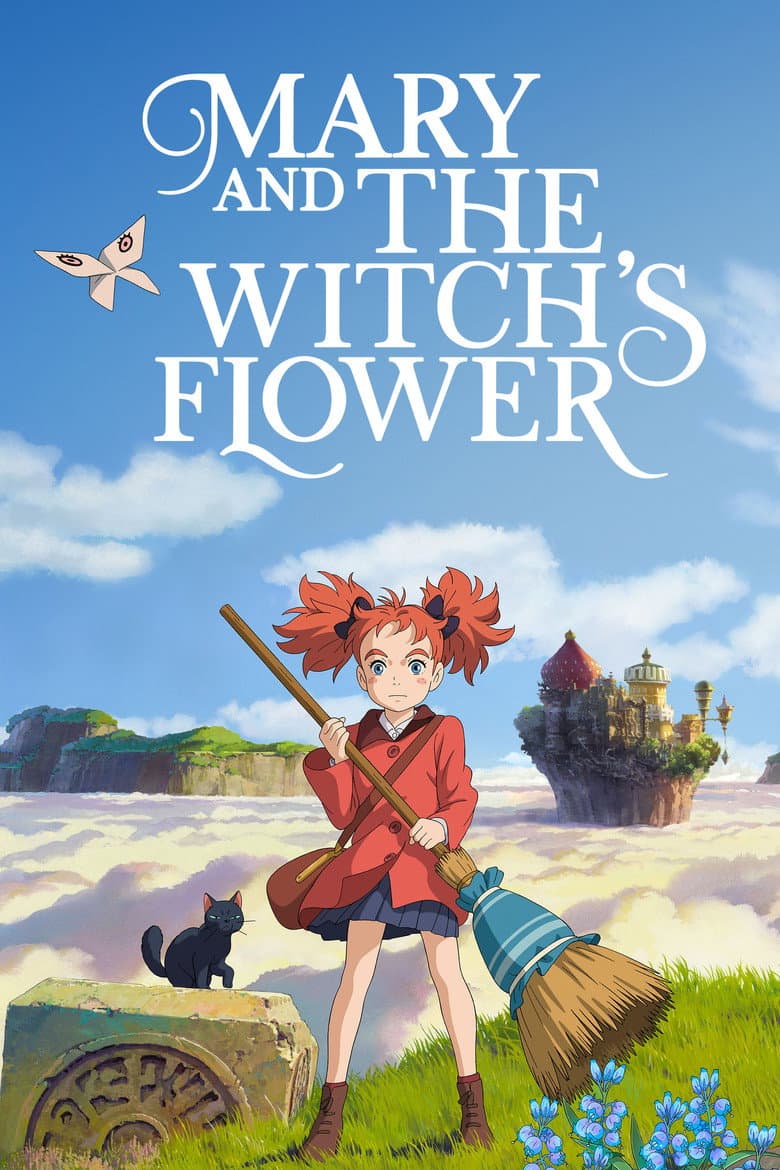
Mary Smith is an awkward eleven-year-old girl staying with her great-aunt Charlotte in the green English countryside. She follows two cats into a forest and finds a rare flower that gives her magic for one night. The flower carries her on a broom to Endor College, a school in the clouds run by Madam Mumblechook and Doctor Dee. Mary soon learns that the school hides dangerous experiments, and she must rescue Peter and the transformed animals before the magic causes a disaster.
The clearest identity-focused element is Mary's journey from shame about her red hair and clumsiness to trust in her own courage. The story keeps a young girl at the center and lets her choose friendship and bravery over borrowed power. The female headmistress and an older female witch also hold major roles in the magic world. The film's other main ideas concern lies, animal cruelty, unchecked science, family, and learning that a person can do good without special powers.
Community feedback
Was our 25% Woke rating accurate?
Breakdown
These are the editorial factors and ratings behind our score for Mary and The Witch's Flower.
Woke representation / casting
Not present. The visible cast fits the film's British setting and story. The female lead and female headmistress come from the story itself, and no diversity-first casting message appears.
0%
Woke political dialogue
Not present. The dialogue covers magic, science, friendship, courage, and a lie. It contains no modern DEI, gender-role, or activist speech.
0%
Identity-driven story themes
Mary's main arc moves from shame about her red hair and clumsiness to trust in her own courage. The story gives a young girl the central adventure and makes her courage, kindness, and self-worth part of the solution. Peter helps Mary but is also captured and needs rescue, so the film gives him a real role without making him a joke. The film keeps this message personal and child-focused rather than turning it into current identity politics.
38%
Western institutional / cultural critique
Not present. Endor College's secret experiments are a fantasy danger tied to the plot. The film does not connect them to modern Western politics, family life, religion, or social customs.
0%
Woke character or canon changes
Not relevant. The movie adapts Mary Stewart's book and keeps Mary as its young female lead. No race, gender, sexuality, or identity change to an established character is confirmed.
0%
Anti-woke backlash and complaints
Not present. The supplied X research reports no anti-woke complaints. Web searches found ordinary praise and criticism about animation, pacing, Ghibli influence, and the animal experiment subplot. No sustained complaint about DEI, identity politics, or activist messaging reached major coverage.
0%
Creator track record context
Hiromasa Yonebayashi has a cached score of 50 for repeated girl-centered films, and Riko Sakaguchi has a cached score of 58 for stories about women's freedom and sexuality. Their public records do not show a strong partisan or activist profile. The other listed creators have low cached scores and add little identity-focused context. This gives the movie a moderate creator track record signal, mainly through its female-led story.
32%
Production

Movie · 2019
It's been ten years since the dragons moved to the Hidden World, and even though Toothless doesn't live in New Berk anymore, Hiccup continues the holiday traditions he once shared…
Movie · 2017
Despite his family’s baffling generations-old ban on music, Miguel dreams of becoming an accomplished musician like his idol, Ernesto de la Cruz.
Movie · 2019
A group of misfits encounter a young Yeti named Everest, and they set off to reunite the magical creature with his family on the mountain of his namesake.
Movie · 2025
Charles Dickens tells his young son Walter the greatest story ever told, and what begins as a bedtime tale becomes a life-changing journey.
Movie · 2020
When his best friend Gary is suddenly snatched away, SpongeBob takes Patrick on a madcap mission far beyond Bikini Bottom to save their pink-shelled pal.
Movie · 2016
For years, old wood carver Mr. Meacham has delighted local children with his tales of the fierce dragon that resides deep in the woods of the Pacific Northwest.
Movie · 2017
When Chloe discovers that her new home's garden gnomes are not what they seem, she must decide between the pursuit of a desired high school life and taking up the fight against…
Movie · 2016
An orphan little girl befriends a benevolent giant who takes her to Giant Country, where they attempt to stop the man-eating giants that are invading the human world.
