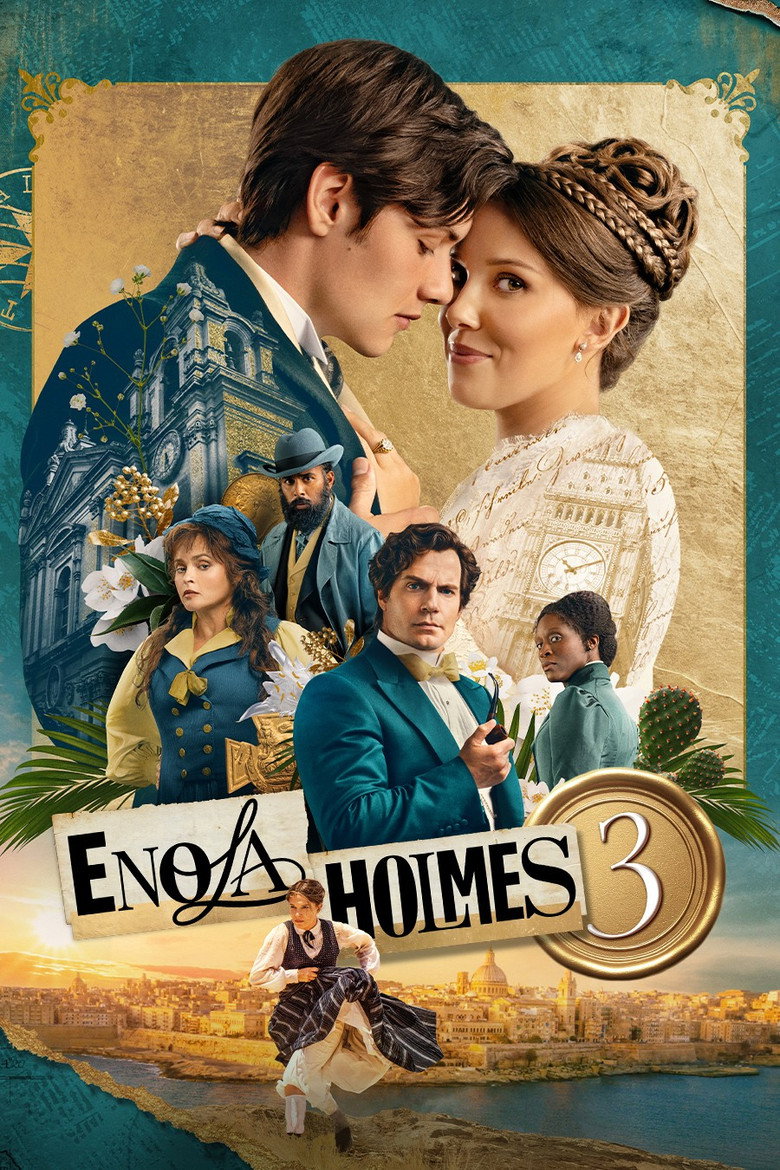
Enola Holmes and Lord Tewkesbury travel to British-controlled Malta for their wedding. Enola worries about becoming a lady, losing the Holmes name, and giving up her detective work. Sherlock goes missing and pulls her into a case with escaped mastermind Moriarty, Dr. Watson, stolen Afghan gold from a British war cover-up, and Maltese resistance. The story ends with a choice to return the treasure instead of leaving it with Britain. Tewkesbury gives up his title, and Enola keeps her surname and marries on her own terms.
The film pairs that marriage story with clear lessons about British colonial guilt. Famous Holmes roles are cast with race and gender changes, including a black woman as Moriarty and a race-swapped Dr. Watson. Reviews quote blunt lines about the British empire refusing to admit guilt and British names stained by empire pain. The mystery centers on colonial looting, exposing British officers, returning treasure as moral repair, and independence energy in Malta. Enola also refuses to lose her name and freedom in marriage, while traditional wife rules and empire honor are shown as problems she and Tewkesbury must reject.
Community feedback
Was our 92% Woke rating accurate?
Breakdown
These are the editorial factors and ratings behind our score for Enola Holmes 3.
Woke representation / casting
A black actress plays Moriarty as a gender and race swap from the classic white male professor. Himesh Patel plays Dr. Watson as a race swap from the usual white portrayal. These choices put identity-forward casting in two famous supporting roles. A female lead detective and mentor Edith also keep the ensemble more representation-heavy than a typical period story.
62%
Woke political dialogue
Reviews quote blunt empire lines about Britain refusing to admit guilt and British names stained by empire pain. Period race notes show a character of color treated as servant-class and not walking beside Enola in public. British superiority talk toward Maltese locals is also clear. The progressive messaging is spoken out loud for the audience, not only hinted at.
68%
Identity-driven story themes
The mystery is built around colonial looting of Afghan gold and exposing British officers. Returning the treasure is framed as moral repair, with Maltese independence energy in the mix. Enola refuses to lose her name and agency in marriage, and Tewkesbury renounces aristocracy after learning of his father’s imperial crimes. Identity and social justice shape how the plot is structured.
72%
Western institutional / cultural critique
The British Empire, military honor, and aristocratic inheritance are framed as guilt-stained and corrupt. Traditional wife and lady expectations are obstacles Enola must redefine. The ending renounces title and empire spoils. This is modern institutional critique set in period costume, not a neutral history adventure.
70%
Woke character or canon changes
Doyle’s Moriarty is recast as black woman Mira Troy, also called Professor Adeline Rathe. Watson is race-swapped from established Holmes canon. These identity-driven changes are centered rather than softened. The screenplay is an original Thorne story, not a Springer novel, but it continues the franchise’s progressive rewrite of the Holmes world.
75%
Anti-woke backlash and complaints
Viewers and social media complain about DEI casting and race-gender swaps for Watson and black female Moriarty. Others attack what they call anti-British colonial lectures and woke framing on Reddit, X, Facebook, and some review comments. The complaints are real and tied to the film’s content. They are moderate rather than a dominant mainstream media firestorm.
48%
Creator track record context
Jack Thorne is linked to inclusion activism and the trilogy’s reform and colonial lesson design. Millie Bobby Brown acts as producer and a girls-empowerment face of the franchise. Shaheen Baig is known for inclusive casting, and Nancy Springer built the books around feminist agency. Philip Barantini and most producers score lower, so overall context is moderately progressive.
52%
Production
Movie · 2016
Industrious high school senior Vee Delmonico has had it with living life on the sidelines. When pressured by friends to join the popular online game Nerve, Vee decides to sign up…
Movie · 2017
Ren Amari is the driven inventor of a revolutionary new drug. OtherLife expands the brain's sense of time and creates virtual reality directly in the user's mind.
Movie · 2025
A treasure-hunting mastermind assembles a team for a life-changing adventure. But to outwit and outrun threats at every turn, he'll need someone even smarter than he is: his…
Movie · 2017
A private investigator helps a former flame solve the murder of her wealthy grandfather, who lived in a sprawling estate surrounded by his idiosyncratic family.
Movie · 2023
A gruesome serial killer is terrorizing London while brilliant but disgraced detective John Luther sits behind bars.

Movie · 2023
After starting their own detective agency, Nick and Audrey Spitz land a career-making case when their billionaire pal is kidnapped from his wedding.

Movie · 2016
Beatrice Prior and Tobias Eaton venture into the world outside of the fence and are taken into protective custody by a mysterious agency known as the Bureau of Genetic Welfare.
Movie · 2018
A former American G.I. joins a yakuza family after his release from prison in post-World War II Osaka.
