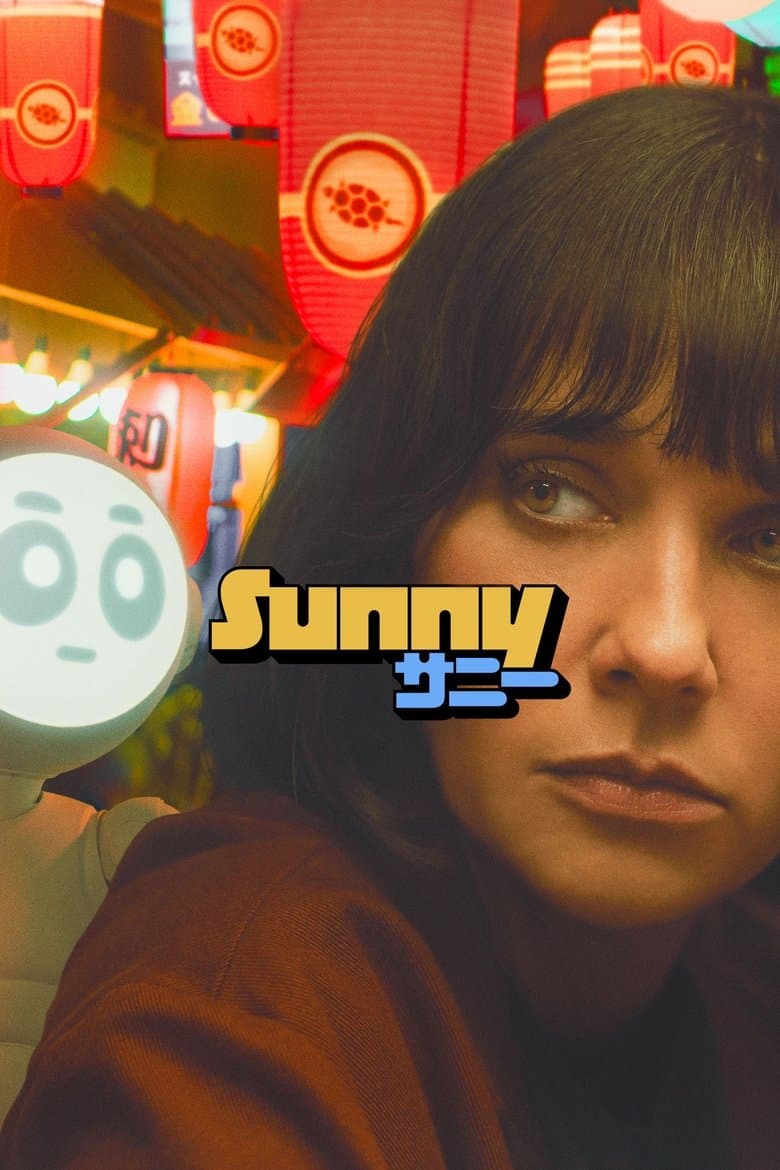
Started July 9, 2024 · Canceled · Based on 1 season, 10 episodes through September 3, 2024 · TV-MA
Sunny follows Suzie Sakamoto, an American woman living in near-future Kyoto. Her husband, Masa, and young son, Zen, vanish after a plane crash, so the company gives her a cheerful home robot named Sunny. Suzie thought Masa only made refrigerators, but she learns that he built advanced robots and hid a dangerous past. Suzie, Sunny, and bartender Mixxy follow clues through hackers, a Japanese crime group, family secrets, and a hidden robot code. The tone mixes grief, dry comedy, crime mystery, and strange science fiction.
The show puts a woman, a lesbian bartender, and a robot treated as female at the center of its main friendships and danger. Mixxy's former girlfriend is mentioned, but her sexuality is not the season's main subject. Suzie and Mixxy repeatedly help each other, while Hime and Noriko make major moves in the crime plot. The season mostly focuses on loneliness, grief, human connection, and the dangers of artificial intelligence. Its identity-focused elements are visible, but they usually sit beside the mystery instead of driving a political message.
Community feedback
Was our 26% Woke rating accurate?
Breakdown
These are the editorial factors and ratings behind our score for Sunny.
Woke representation / casting
Suzie is an American woman played by mixed-race black actor Rashida Jones, and she leads the mystery. Mixxy is a lesbian bartender, and women fill most central roles. Hime and Noriko also hold power in the crime story. These choices make gender and sexuality visible, but the show does not frame the cast as a diversity campaign.
22%
Woke political dialogue
Not present. The dialogue centers on AI, grief, family secrets, organized crime, and human nature. The show does not use recurring speeches about current identity politics, DEI, or left-wing politics.
0%
Identity-driven story themes
Sunny makes the friendship between Suzie, Mixxy, and Sunny a continuing part of the season. Mixxy talks about a former girlfriend, and the show treats her lesbian identity as normal. Women drive the investigation, the rescue plans, and much of the organized crime struggle. These elements are visible, but the main story remains about grief, loneliness, family, and AI.
28%
Western institutional / cultural critique
Not present. The show criticizes secret companies, organized crime, and harmful robot experiments, but it does not make a recurring modern activist attack on Western family life, religion, men, or traditional culture.
0%
Woke character or canon changes
Not relevant. The TV version changes the robot from male-voiced Sonny in the novel to female-voiced Sunny, but coverage presents that as a story and character choice. No identity-driven change to a known real person or legacy character is shown.
0%
Anti-woke backlash and complaints
Not present. The supplied X research found no anti-woke posts, boycott, or review-bomb effort. One scattered Reddit comment called the show “too woke” but gave no clear example, so it does not show a real backlash.
0%
Creator track record context
Katie Robbins has a moderate record from immigration-focused work on Party of Five and female-focused work on Sunny. Kimi Howl Lee and Julissa Castillo have stronger past work about identity, race, and representation. Rashida Jones and Ravi Nandan also have representation-focused production histories. Most other listed writers and directors have little such public history, so the overall context is mixed rather than strongly activist.
31%
Production

TV Show · 2026
The mayor of a New England town resolves to turn it into the next tourist hot spot, despite local warnings that it's cursed.

TV Show · 2023
A disgraced cop in debt is forced to return to his home state of Florida for a shady mission only to get swept up in a wild — and deadly — treasure hunt.

TV Show · 2026
The dynamic between the two contrasting personalities, a seasoned cop who prefers old-school methods and a tech-savvy cop who relies on modern technology for investigations, as…

TV Show · 2022
An anniversary trip puts a marriage to the test when a couple finds themselves embroiled in one of Yucatan's most bizarre unsolved mysteries.
TV Show · 2022
When a man wakes up in the Australian outback with no memory, he must use the few clues he has to discover his identity before his past catches up with him.
TV Show · 2022
When one of a group of friends downloads the mysterious Red Rose app, plans change. What starts innocently as a game of admiration rapidly descends into something much darker.
TV Show · 2020
In an isolated and inaccessible Antarctic research station in which winter has fallen on the South Pole and the sun will soon disappear for the next six months, a small team…

TV Show · 2021
Three strangers share an obsession with true crime and suddenly find themselves wrapped up in one.
