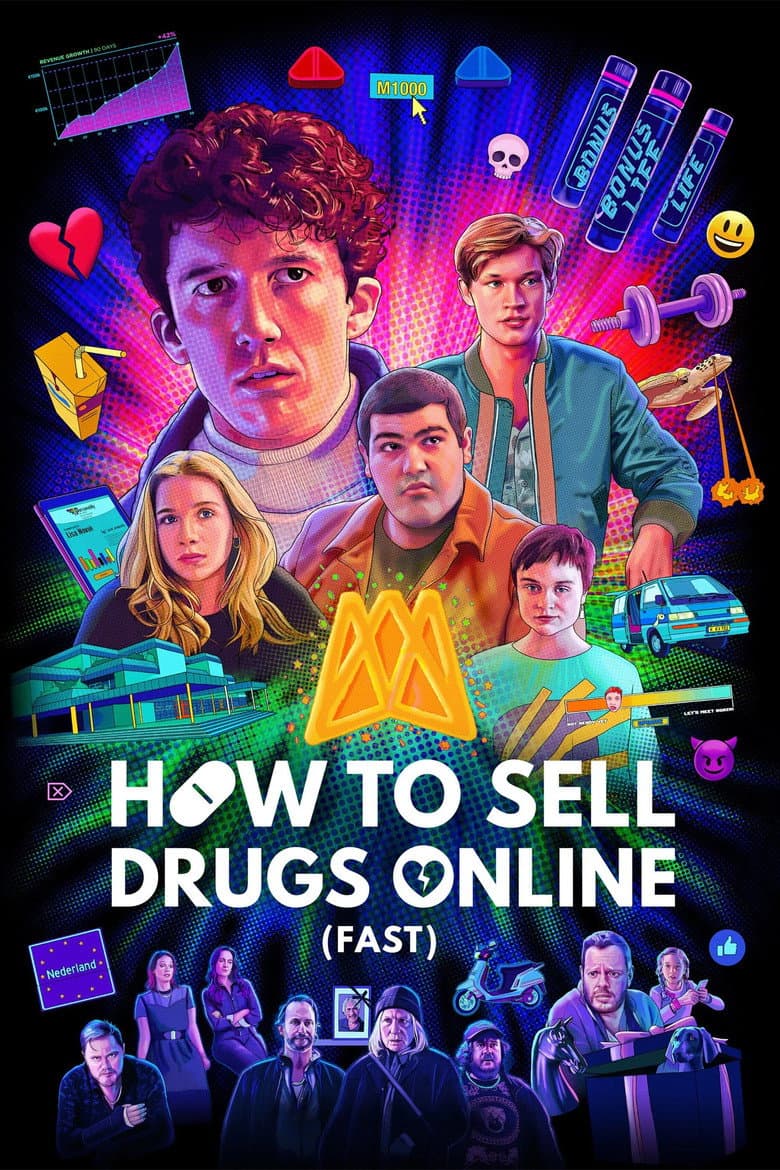
Started May 31, 2019 · Ended · Based on 4 seasons, 24 episodes through April 8, 2025 · TV-MA · German
Moritz Zimmermann is a shy high school student in the small German town of Rinseln. After his girlfriend Lisa returns from a year abroad and ends their relationship, Moritz uses a school project to build an online ecstasy store with his best friend Lenny and later Dan. The store grows into a large drug business, while Dutch dealers, police, sickness, lies, and broken friendships close in. The show uses fast jokes, web graphics, direct talk to the audience, and a dark but playful tone.
The main woke elements are limited and sit beside the crime story. A classroom scene says adults pressure teenagers, questions drug bans, and compares zoos with prisons for animals. The show includes a wheelchair-using friend and bisexual side characters, but it does not make identity politics its main subject. The story mainly follows Moritz's hunger for power, the damage caused by online fame and drug money, and the slow loss of his friends.
Community feedback
Was our 26% Woke rating accurate?
Breakdown
These are the editorial factors and ratings behind our score for How to Sell Drugs Online (Fast).
Woke representation / casting
Lenny is a major wheelchair user because of bone cancer, so disability is visible in the main group. The story explains his condition through his health and keeps him central as a coder and friend, rather than presenting it as a diversity campaign. The other main roles fit a modern German teen setting, and the cast does not show a repeated identity-first pattern.
14%
Woke political dialogue
A classroom scene has Lisa say that adults act as if sex and drugs are too shocking to discuss. Moritz says that banning drugs is not a solution and questions why zoos are accepted. The show does not return to these ideas often, so the dialogue is a brief social critique inside a crime story.
24%
Identity-driven story themes
Fritzi and Gerda are bisexual side characters in the school group. Lisa becomes a journalist and Kira is a strong hacker, but their skills do not become a repeated message about female power. The main story stays focused on Moritz's ego, drugs, friendship, and online life.
15%
Western institutional / cultural critique
Lisa and Moritz question adult control of teenagers and accepted social rules. A school display briefly invokes Fridays for Future, and Lisa calls zoos prisons for animals. These moments are short and do not become a continuing attack on men, Christianity, family life, or Western institutions.
14%
Woke character or canon changes
Not relevant. The series is an original story inspired by a real drug case. It does not change an established character, canon, or historical figure.
0%
Anti-woke backlash and complaints
Not present. The X pass found no anti-woke complaints. Web and viewer coverage discusses drug themes, story quality, and the ending instead of woke or DEI messaging.
0%
Creator track record context
Käßbohrer has a moderate record of socially aware satire, while Murmann has no strong activist profile. Spengler, Colley, Furrer, Thomas, and Stutzky have representation-focused work or public comments in the supplied context. Feldhusen, Montag, Titze, and several producers have little such record, and the show itself is not framed as an activist project.
34%
Production

TV Show · 2021
A seemingly ordinary British couple become the focus of an extraordinary investigation when two dead bodies are discovered in the back garden of a house in Nottingham.
TV Show · 2024
When aristocratic Eddie inherits the family estate, he discovers that it's home to an enormous weed empire — and its proprietors aren't going anywhere.
TV Show · 2018
A hit man from the Midwest moves to Los Angeles and gets caught up in the city's theatre arts scene.
TV Show · 2019
Following an emotional breakup, tough but tender FBI super-agent Will Chase (codename: “Whiskey Cavalier”) is assigned to work with badass CIA operative Frankie Trowbridge…

TV Show · 2026
The dynamic between the two contrasting personalities, a seasoned cop who prefers old-school methods and a tech-savvy cop who relies on modern technology for investigations, as…
TV Show · 2019
A group of working-class friends finding unconventional ways to win at life in suburban northern England. These lads have dealt, scammed, bribed and conned their way through…
TV Show · 2017
The origin story of younger, hungrier, former Green Beret Bryan Mills as he deals with a personal tragedy that shakes his world.
