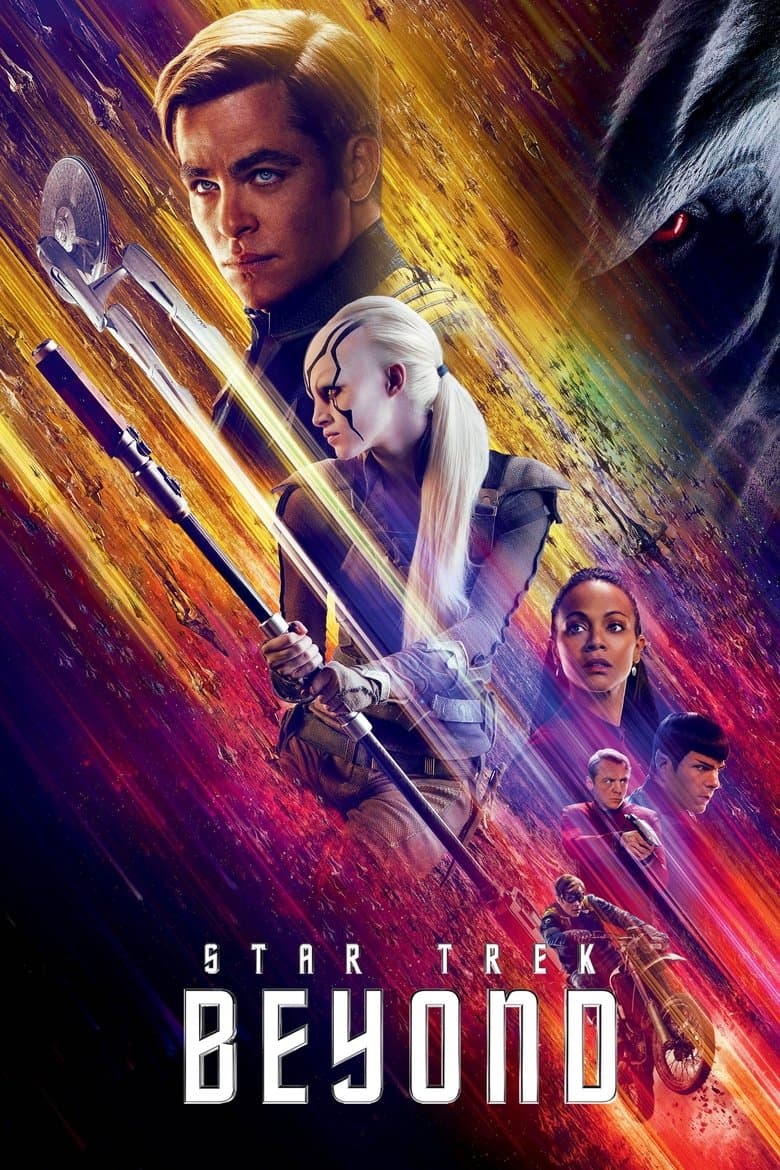
Midway through a five-year mission, Captain Kirk feels restless and the Enterprise mission starts to feel routine. A rescue call turns out to be a trap, and a swarm led by Krall destroys the ship. The crew is scattered on the planet Altamid. With help from the scavenger warrior Jaylah, they learn that Krall is really Balthazar Edison, an old soldier who rejects Federation peace and multi-species unity. They stop him from using a bioweapon against the Yorktown station. The main conflict is about crew loyalty and found family against isolation and endless struggle.
The film also shows Hikaru Sulu with a husband and a daughter, which is the franchise’s first clear on-screen gay lead relationship in a major movie. That beat is short but deliberate, and it was framed as tribute and inclusion under Trek’s infinite diversity idea. Marketing and cast comments also stressed diversity and women of color in strong roles. The core story still centers classic Federation ideals rather than modern identity lectures. The gay family scene and the choice to reframe Sulu still stand out as the main audience-visible progressive elements.
Community feedback
Was our 63% Woke rating accurate?
Breakdown
These are the editorial factors and ratings behind our score for Star Trek Beyond.
Woke representation / casting
Future multi-species Federation makes mixed ethnic bridge crews feel normal for this setting. The score rises because Sulu appears with a husband and daughter in a clear, intentional LGBTQ casting choice. Marketing and cast talk also framed the film as advancing Hollywood diversity. Press also highlighted women of color in authority and combat roles such as Uhura and Jaylah.
46%
Woke political dialogue
On-screen talk is mainly about unity versus struggle, crew loyalty, and Federation ideals in classic Roddenberry style. It is not packed with modern identity slogans. Mild lift comes from public framing that links Krall’s anti-collectivism to Brexit-era walls and isolationism. That framing stays allegorical rather than lecture-heavy.
30%
Identity-driven story themes
The main plot is action survival, crew as family, and Federation openness against a war-hardened man who rejects peace. It is not a race or gender grievance story. A clear but secondary identity signal comes from the gay family beat and open inclusion framing. The brief LGBTQ presence still adds elevated weight under the scoring rules.
40%
Western institutional / cultural critique
Soft anti-isolationist and pro-cooperation themes can read as mild pushback against hard borders when paired with Pegg’s comments. There is no long arc against toxic masculinity, Christianity, or the West as a whole. The villain mainly attacks Federation peace, not traditional family or faith.
24%
Woke character or canon changes
Established helmsman Sulu is reframed as gay with a husband and child as a deliberate representation tribute. That is not an ordinary adaptation cut. It was announced and defended as progressive representation. Takei’s objection underscores that the change was driven by ideology rather than story need.
60%
Anti-woke backlash and complaints
There were real but moderate complaints about forced or agenda-driven gay Sulu, virtue signaling, and some deliberate avoidance. Residual agenda talk remains online. This title did not face a dominant multi-year culture-war pile-on like later Trek TV. Takei’s critique is only partly anti-woke and mostly about not rewriting Roddenberry’s Sulu.
32%
Creator track record context
Cached context is mostly low to moderate across Lin, Jung, Pegg, and Roddenberry, with some casting and producer figures higher. Overall it reads as light progressive franchise DNA. It does not look like an activist writers’ room project. Supporting progressive history is present but not dominant.
25%
Production
Movie · 2016
Following the events of Age of Ultron, the collective governments of the world pass an act designed to regulate all superhuman activity.
Movie · 2010
Cobb, a skilled thief who commits corporate espionage by infiltrating the subconscious of his targets is offered a chance to regain his old life as payment for a task considered…

Movie · 2016
16-year-old Cassie Sullivan tries to survive in a world devastated by the waves of an alien invasion that has already decimated the population and knocked mankind back to the…
Movie · 2024
Following their explosive showdown, Godzilla and Kong must reunite against a colossal undiscovered threat hidden within our world, challenging their very existence – and our own.

Movie · 2023
When his attempt to save his family inadvertently alters the future, Barry Allen becomes trapped in a reality in which General Zod has returned and there are no Super Heroes to…
Movie · 2020
After he and his wife are murdered, marine Ray Garrison is resurrected by a team of scientists. Enhanced with nanotechnology, he becomes a superhuman, biotech killing…
Movie · 2019
When Alita awakens with no memory of who she is in a future world she does not recognize, she is taken in by Ido, a compassionate doctor who realizes that somewhere in this…
Movie · 2016
Through a technology that unlocks the genetic memories of his ancestor in 15th century Spain, Callum Lynch discovers he is a descendant of an ancient line of Assassins and amasses…
