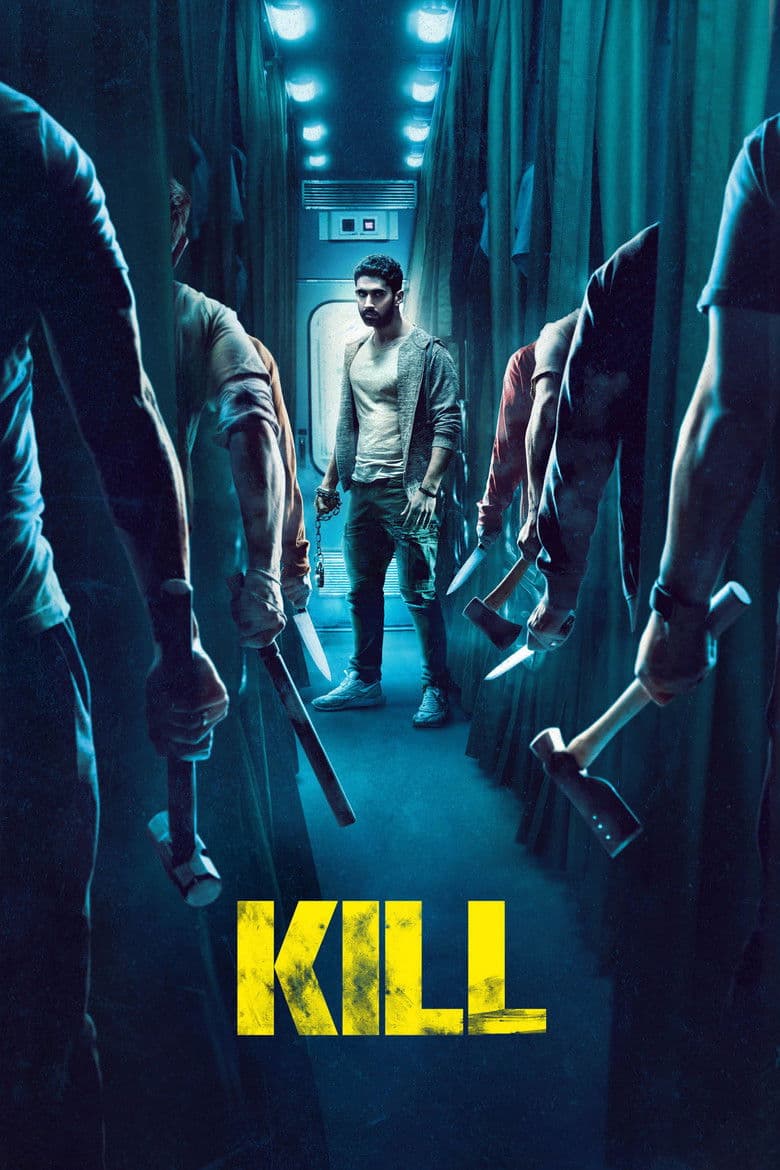
Kill follows Amrit Rathod, a special forces commando who secretly loves Tulika Singh. Tulika’s father sends her by train toward New Delhi for an arranged marriage to another man. Amrit and his fellow commando Viresh board the train to reach her, but a large bandit gang takes control of the coaches. The film turns from a nervous love story into a savage fight for survival, with knives, broken bodies, grief, and revenge filling most of the running time.
The film’s clearest social idea is that Tulika does not control the marriage chosen for her, even though she wants to build a life with Amrit. Her father’s power makes family duty feel like a threat to personal choice, but the movie uses this conflict mainly to start the rescue plot. Fani also treats women as objects and attacks Tulika when she resists him, so his cruelty is tied to control and misogyny. These points are visible, yet they stay below the main story about military skill, criminal violence, love, loss, and whether Amrit becomes as monstrous as the men he kills.
Community feedback
Was our 22% Woke rating accurate?
Breakdown
These are the editorial factors and ratings behind our score for Kill.
Woke representation / casting
Not present. The film uses Indian actors in an Indian setting, and it does not frame its casting as a diversity or identity statement.
0%
Woke political dialogue
Not present. The dialogue focuses on love, family pressure, soldiers, robbery, and revenge, not modern identity or activist claims.
0%
Identity-driven story themes
The film makes Tulika’s unwanted arranged marriage an obstacle to her relationship. Her father controls her choice of husband, and the story treats that pressure as harmful. The plot soon shifts to the train attack and Amrit’s revenge, so this theme is clear at the start but not the main focus.
18%
Western institutional / cultural critique
Fani sexually harasses Tulika and kills her after she resists him. Tulika’s father also tries to control whom she will marry. The film presents these acts as cruel, but it does not build a wider critique of patriarchy, religion, Western culture, or social institutions.
17%
Woke character or canon changes
Not relevant. The film is an original story about a commando, a train robbery, and a revenge fight, so it does not change an established character or known canon.
0%
Anti-woke backlash and complaints
Not present. The supplied X pass found no anti-woke complaints. Other coverage focuses on violence, action, and plot, with no sustained claim that the film pushes DEI or identity politics.
0%
Creator track record context
Nikhil Nagesh Bhat has a cached score of 55 because his wider work often centers on women’s safety, vulnerability, and gendered violence. Karan Johar has 68 and Guneet Monga has 65 because their wider work often supports gender, queer, or representation themes. Achin Jain has 50, while Apoorva Mehta, Hiroo Johar, and Prasanna R Coondapur have 0. Kill itself is framed in interviews as a personal train story about love, survival, and brutal action.
45%
Production
Movie · 2023
Ex-con Russell Gaines is attempting to rebuild his life with the help of his father, Mitchell. However, the arrival of Maben sends his new life into chaos, leading the pair to go…
Movie · 2025
Newly released from prison and marked for death by unrelenting enemies, Nate must now protect his estranged 9-year-old daughter, Polly, at all costs.
Movie · 2017
Quan is a humble London businessman whose long-buried past erupts in a revenge-fueled vendetta when the only person left for him to love – his teenage daughter – dies in an Irish…
Movie · 2025
Big Nick is back on the hunt in Europe and closing in on Donnie, who is embroiled in the treacherous and unpredictable world of diamond thieves and the infamous Panther mafia, as…
Movie · 2024
A Chicago detective travels to Scotland after an emerging serial killer’s crimes match those that he investigated five years earlier, one of which was the crime scene of his…
Movie · 2024
A contract killer, after being diagnosed with a fast-moving form of dementia, is presented with the opportunity to redeem himself by saving the life of his estranged adult son.
Movie · 2016
In the aftermath of an unspeakable act of terror, Police Sergeant Tommy Saunders joins courageous survivors, first responders and investigators in a race against the clock to hunt…
Movie · 2015
An idealistic FBI agent is enlisted by a government task force to aid in the escalating war against drugs at the border area between the U.S. and Mexico.
