Movie review
January 31, 2016 · 130 min · 0
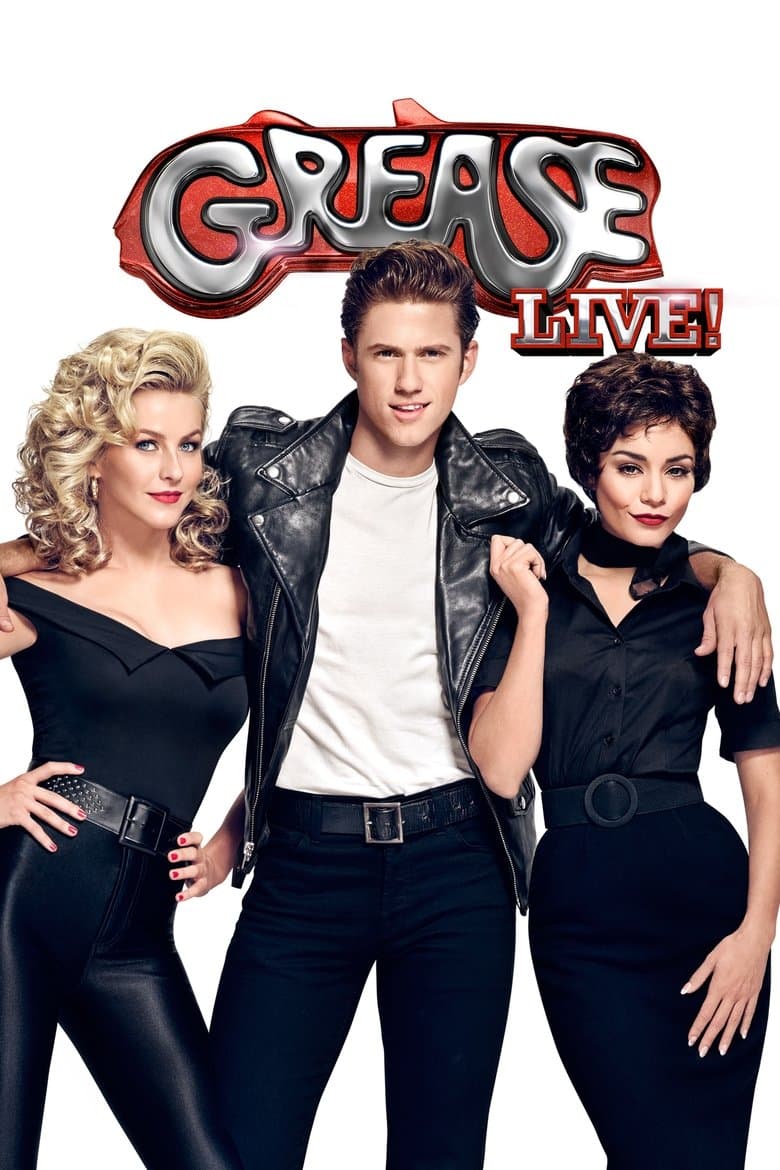
Grease Live follows Sandy Young and Danny Zuko, two high school students who fall for each other during a summer romance. They meet again when Sandy arrives at Rydell High in 1959, but Danny hides their relationship from his friends. Sandy joins the Pink Ladies while Danny stays with the T-Birds, and both groups pull them into dances, fights, gossip, and a car race. The story is a bright, fast musical comedy with singing, dancing, teen sex jokes, and old-fashioned romance.
The production makes race and diversity easy to see because several main students and adults are played by Black, Latino, and other minority performers in a school shown as fully mixed. The Pink Ladies also say that girls should be their own people, and Sandy defends Rizzo when Patty mocks her pregnancy scare. Rizzo's song argues that a girl should not be judged only by her sexual choices, but the story still ends with Sandy changing her clothes and behavior to get Danny. These parts add a clear modern representation layer and some ideas about girls being independent, yet they remain side features around the central romance and big musical show.
Community feedback
Was our 60% Woke rating accurate?
Breakdown
These are the editorial factors and ratings behind our score for Grease Live.
Woke representation / casting
The live version puts Black, Latino, and other minority performers in many visible student and adult roles. Keke Palmer plays Pink Lady Marty, Jordan Fisher plays Doody, and Wendell Pierce plays Coach Calhoun. Bernard Telsey said the team wanted diversity and would not worry about the 1950s time frame. The pattern is clear across the cast, but it does not control the whole story.
52%
Woke political dialogue
Frenchy tells Sandy that life does not revolve around men and that the girls should be their own people. A separate school joke mentions politics and an unpopular vote without naming a current cause. These moments are brief and do not drive the romance or the musical numbers.
23%
Identity-driven story themes
The Pink Ladies repeatedly talk about fitting in, boys, sex, and the pressure placed on girls. Frenchy says girls should be their own people, and Sandy chooses kindness when Patty attacks Rizzo. Rizzo's solo rejects the idea that a girl is bad because she has sex, but the ending still has Sandy change her look to win Danny. These ideas recur around the romance, but the show remains mainly a conventional teen love story.
34%
Western institutional / cultural critique
The story shows Danny and the other boys using sexist jokes and pressuring girls about sex. The school treats cheerleading and girls' looks as part of their social value. The Pink Ladies push back by saying girls should be their own people, but the show does not attack a modern Western institution or a political system. This is a mild gender-role critique inside a comic high school story.
18%
Woke character or canon changes
The live version gives several known Grease roles to Black and Latino performers, including Marty, Doody, Kenickie, Coach Calhoun, Blanche, and Cha-Cha. The 1950s school is shown with a mixed cast even though the original movie's school was almost entirely white. The story does not build a new race-based plot around these changes. The changes are still easy to see because they affect recurring students and adults.
44%
Anti-woke backlash and complaints
Small Reddit and X accounts said the racially mixed 1950s school was historically wrong and seemed designed to promote diversity. Playbill coverage and actor Wendell Pierce treated the accuracy issue as a real talking point and defended color-blind casting. The reaction had little reach, and no clear boycott, review-bombing, or large right-leaning campaign appeared. The backlash is real but fringe.
24%
Creator track record context
The creative team has a mixed track record. Jonathan Tolins and Robert Cary have strong LGBTQ-related work histories, and Bernard Telsey's casting office openly supports diversity and work against racism. Thomas Kail has a mild record in the supplied research, while Alex Rudzinski and most producers have no clear activist profile. This context supports a moderate score, but it is not a shared activist message from the whole team.
34%
Production
