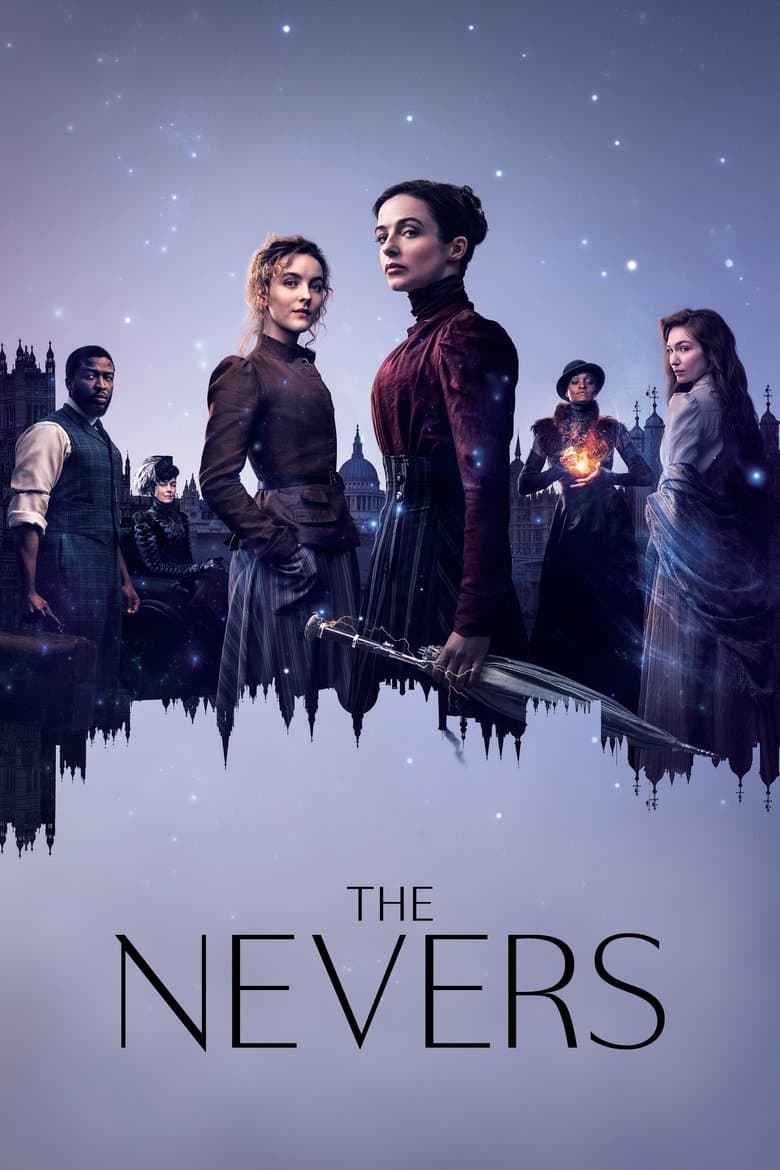
Started April 11, 2021 · Canceled · Based on 1 season, 6 episodes through May 16, 2021 · TV-MA
Set in Victorian London, this science fiction drama follows a group of people, mostly women, who suddenly gain strange, supernatural abilities. Known as the Touched, they are protected by Amalia True, a tough and quick-fisted widow, and Penance Adair, a brilliant young inventor. Together, they run an orphanage to shield their friends from a hostile society, corrupt government officials, and dangerous killers. The show uses these superpowers as a clear metaphor for modern identity struggles and social oppression. The main villains are rich, traditional white men in power who want to destroy the independent women. Viewers will easily notice how the story highlights highly capable female fighters who outfight and outsmart the men around them. The series also pushes progressive themes by including diverse casting that does not fit the history of the setting, alongside several prominent queer and trans-coded characters.
Community feedback
Was our 86% Woke rating accurate?
Breakdown
These are the editorial factors and ratings behind our score for The Nevers.
Woke representation / casting
The casting emphasizes modern representation priorities in a historical setting. Main leads are super-capable women, like Amalia True and Penance Adair, who routinely outfight and outsmart men. The show casts several diverse actors in prominent roles, including Zackary Momoh as Dr. Horatio Cousens. Most notably, the series features several prominent queer and trans-coded characters, such as the pansexual Hugo Swann, the gay detective Frank Mundi, and Nimble Jack (played by non-binary actor Vinnie Heaven). These LGBTQ+ elements heavily elevate the visible identity signaling, which clearly stands out in Victorian London.
68%
Woke political dialogue
While the show is set in the 1890s, much of the dialogue features modern feminist and activist phrasing. Characters frequently talk about institutional exclusion, female subjugation, and the threat that empowered marginalized people pose to the established male elite. High-society villains explicitly discuss their fear of sharing a world with people who no longer need them, directly echoing modern critiques of male entitlement and privilege. These dialogue choices feel less like historical Victorian speech and more like present-day social-justice critiques aimed at modern power dynamics.
54%
Identity-driven story themes
The main plot acts as a direct metaphor for modern marginalized groups fighting systemic oppression. The "Touched" are mostly women, minorities, and queer individuals who are treated as outcasts and "deviants" by society. The core conflict is a battle between these marginalized heroes and an oppressive, institutional patriarchy. Identity struggles are front and center, with characters constantly defending their right to exist in a world that fears their differences. The inclusion of clear queer and gender-identity subplots further anchors the narrative in modern identity-driven themes.
72%
Western institutional / cultural critique
The series heavily critiques traditional Western and Victorian institutions, framing them as inherently corrupt, patriarchal, and bigoted. The British government, conservative high society, scientific establishments, and traditional religious institutions are depicted as the ultimate enemies. Traditional masculinity and gender roles are systematically dismantled, with traditional white male authority figures presented as villains trying to maintain an unfair status quo. Conversely, the "Touched" orphanage serves as a model of a progressive, found-family community that successfully rejects traditional societal norms.
65%
Woke character or canon changes
Not present in this title.
0%
Anti-woke backlash and complaints
The show faced notable backlash from viewers who criticized its heavy-handed feminist themes and "girlboss" tropes. Many online discussions complained that the series was a "woke" and cliché lecture that degraded traditional white male characters while pushing unrealistic female dominance. Critics and audience members on platforms like Reddit and Metacritic pointed out the forced inclusion of modern diversity and LGBTQ+ representation in Victorian England. While some progressive critics complained the show used metaphors rather than direct representation, anti-woke complaints about its left-leaning, feminist, and identity-driven messaging were prominent.
58%
Creator track record context
The creative team has a moderate to strong history of progressive and feminist themes. Creator Joss Whedon (65) is famous for championing strong female characters and progressive narratives, though his legacy has faced immense scrutiny. Writers like Jane Espenson (46) and Kevin Lau (45) have solid histories of incorporating social commentary and identity elements in genre fiction. Director Zetna Fuentes (52) has worked on DGA diversity task forces, and executive producer Ilene Landress (35) has worked on other feminist-themed shows. Together, they bring a clear history of progressive-aligned creative work.
48%
Production
TV Show · 2024
Rick and Michonne are thrown into another world, built on a war against the dead... And ultimately, a war against the living.
TV Show · 2023
Aster Calyx and Halan Kai Nielsen are inextricably drawn to Beacon 23. Navigating one threat after another, they unravel the beacon’s mysteries, just in time to face their most…
TV Show · 2023
At the brink of going to hell, Yee-jae must cycle through twelve separate lives and twelve separate deaths in this reincarnation drama.
TV Show · 2018
Two strangers are drawn to a mysterious pharmaceutical trial that will, they're assured, with no complications or side-effects whatsoever, solve all of their problems…
TV Show · 2022
Gary is an emotional wreck and struggles to provide for his daughter since the death of his wife. Mary has a secret she can't bring herself to share with anyone.
TV Show · 2021
A single mother enters a world of twisted mind games when she begins an affair with her psychiatrist boss while secretly befriending his mysterious wife.
TV Show · 2021
A year after a subglacial volcano erupts, mysterious elements from prehistoric times emerge from the melting ice, bringing unforeseen consequences.
TV Show · 2024
When a fatal accident occurs on board the International Space Station, a lone astronaut makes the heroic journey back to Earth, only to discover key pieces of her life—including…
