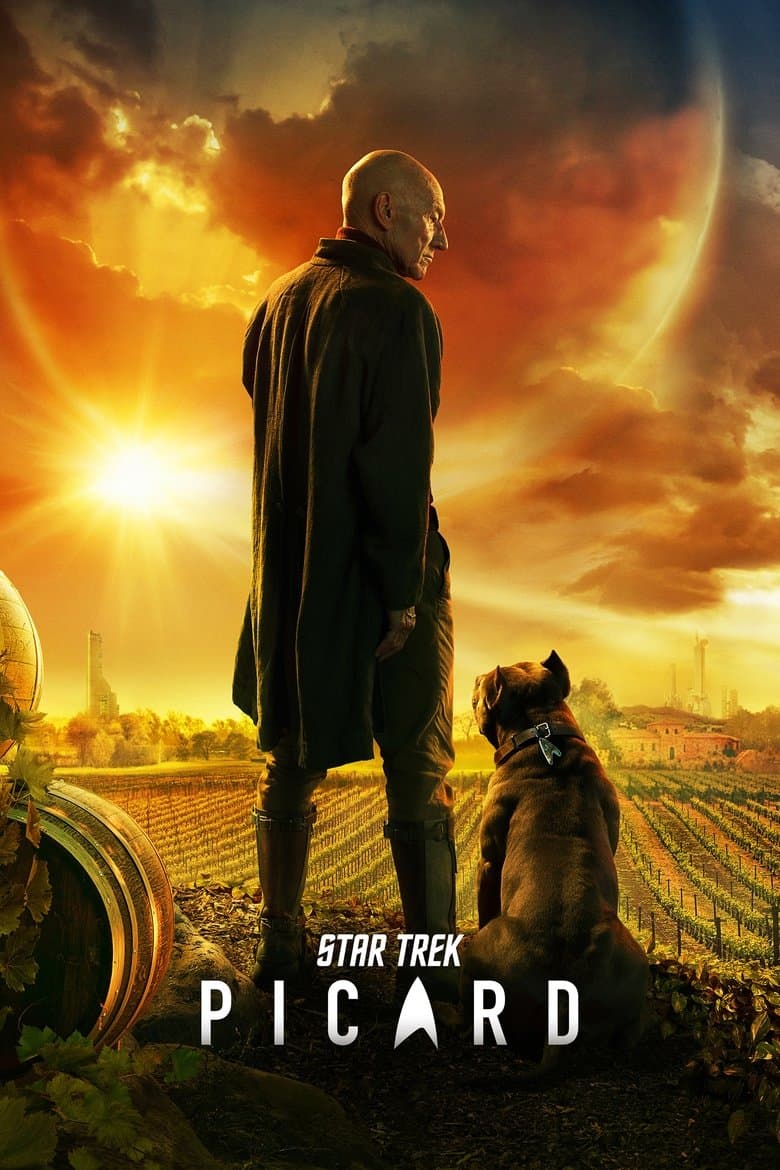
Started January 23, 2020 · Ended · Based on 3 seasons, 30 episodes through April 20, 2023 · TV-MA
Star Trek: Picard follows retired Starfleet admiral Jean-Luc Picard long after his time on the Enterprise. Across three seasons he faces new dangers, old allies, and a Federation that has changed in ways he cannot ignore. The series blends action, drama, and science fiction while asking who counts as a person and who deserves help. Season three brings many Next Generation characters back for a large adventure about family, the Borg, and a final send-off for the crew.
The show also puts progressive social themes in plain view for the audience. Season one opens with Picard defending aid for Romulan refugees and condemning a closed, fearful Federation. Season two turns hard toward modern immigration politics, with raids, detention, and a path to the border. Across the run, Seven of Nine and Raffi share a clear bisexual romance that franchise media called radical and linked to real LGBTQ stakes. Stories about synthetic personhood and Federation failure toward outsiders keep identity and othering in view. Season three eases heavy lectures for nostalgia and adventure, yet the queer couple and diverse command posts remain visible.
Community feedback
Was our 87% Woke rating accurate?
Breakdown
These are the editorial factors and ratings behind our score for Star Trek: Picard.
Woke representation / casting
Future Federation casting is multiethnic by franchise design, so race mix alone is not a mismatch. The new-era core still centers identity-prominent roles such as Raffi, Soji, Rios, and the Seven and Raffi pairing. Season 3 ends with Seven as captain and Sidney La Forge on the Enterprise-G bridge. That pattern is above neutral ensemble choice without becoming a full quota free-for-all.
48%
Woke political dialogue
Season 1 opens with Picard defending Romulan refugee aid and condemning a fearful, closed Federation. Season 2 is blunt about ICE raids, detention, sanctuary travel, and borders, with Rios as the detained outsider. Season 3 largely drops lecture scenes for adventure and nostalgia. A viewer of the whole run still hears progressive immigration and anti-xenophobia lines as written dialogue.
55%
Identity-driven story themes
Core arcs cover synth personhood, Federation abandonment of Romulan refugees, and a sustained Seven and Raffi romance. Official franchise media framed that couple as radical and tied it to real anti-LGBTQ politics. Season 2’s Confederation and immigration plot make othering themes hard to miss. Season 3 re-centers legacy adventure, but queer content and refugee and synth allegories remain major.
64%
Western institutional / cultural critique
Starfleet and the Federation are shown as isolationist, prejudiced through the synth ban, and morally compromised. Season 2 paints contemporary U.S. immigration enforcement as cruel and dystopian. That is progressive critique of Western state power and border policy, not only classic anti-tyranny. Toxic masculinity, anti-Christian mockery, and family as oppression are not central themes here.
50%
Woke character or canon changes
Seven of Nine is re-established as bisexual and paired with Raffi despite earlier on-screen male romance. Jeri Ryan and franchise media endorsed a canonically bi framing for her. That is an identity-driven legacy rewrite rather than ordinary sequel compression. Picard’s synthetic body, Jack Crusher, and Data and Lore plots are not scored as DEI rewrites of core TNG heroes.
50%
Anti-woke backlash and complaints
Right-leaning and anti-woke critics attacked the Season 1 interview, diversity casting, Seven’s queerness, and Season 2 immigration politics. Season 3’s female command ending also drew girlboss-style complaints. Sites and figures such as Ethan Van Sciver and Worth it or Woke kept the criticism going even when praising Season 3 as less woke. The backlash was repeated and real, though not Discovery-level culture war.
58%
Creator track record context
Cached creative scores flag progressive franchise politics around Kurtzman, Matalas, Frakes, Chabon, Waldman, and Roddenberry-style humanism. Patrick Stewart framed the revival as a response to Brexit, Trump-era politics, and xenophobia. That stack supports progressive on-screen politics more than neutral craft alone. It matches the series content without requiring every writer to be an activist.
55%
Production
TV Show · 2020
Daimon and Ana Helstrom are the son and daughter of a mysterious and powerful serial killer. The siblings have a complicated dynamic as they track down the terrorizing worst of…
TV Show · 2020
As humans turn into savage monsters and the world plunges into terror, a handful of survivors fight for their lives — and to hold on to their humanity.

TV Show · 2017
Located in the center of a remote island, the Abyss is the last unexplored region, a huge and treacherous fathomless hole inhabited by strange creatures where only the bravest…
TV Show · 2019
In the dark, early days of a zombie apocalypse, complete strangers band together to find the strength they need to survive and get back to loved ones.

TV Show · 2022
A powerful sorceress in a blind woman's body encounters a man from a prestigious family, who wants her help to change his destiny.
TV Show · 2023
Maggie and Negan travel to post-apocalyptic Manhattan - long ago cut off from the mainland. The crumbling city is filled with the dead and denizens who have made it a world full…
TV Show · 2022
An episodic anthology series focused on both new and established characters set in the world of "The Walking Dead."
TV Show · 2017
Asta and Yuno are two orphans who want the same thing: to become the Wizard King. Locked in a friendly rivalry, they work hard towards their goal.
