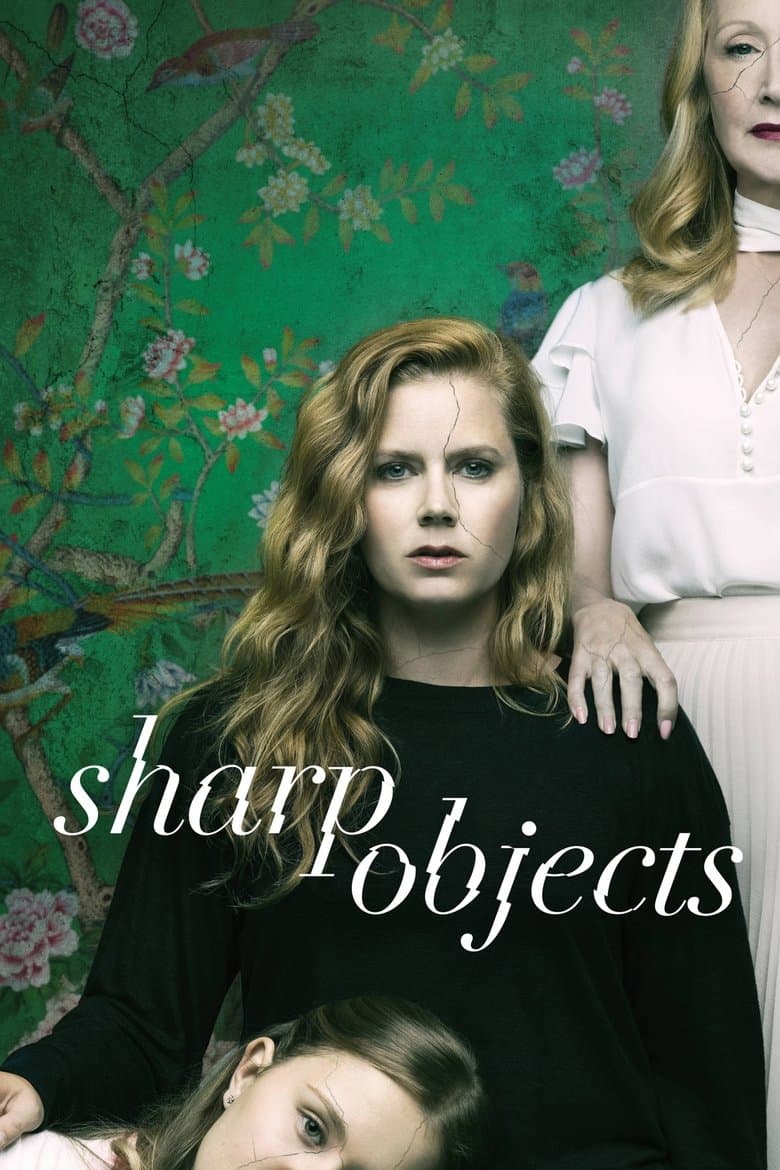
Started July 8, 2018 · Ended · Based on 1 season, 8 episodes through August 26, 2018 · TV-MA
Reporter Camille Preaker leaves psychiatric care still deep in alcohol and self-harm. Her paper sends her back to Wind Gap, Missouri to cover the murders of two young girls. She lives again under her controlling mother Adora and near her half-sister Amma. Family poison, small-town secrets, and a past that will not stay buried pull her into the case. The series is Southern Gothic psychological crime drama, not a modern identity-politics showcase.
Audience-visible themes center on generational mother-daughter abuse, female rage, self-harm, sexual trauma, and the trap of Southern-style femininity. Adora plays the perfect mother, old friends push compulsory motherhood talk, and Amma lives a double life. Calhoun Day frames the town Confederate founding myth as unsaid racism and valorizes a girl silent endurance of wartime sexual assault. Police and townsfolk casually assume the killer must be a man. Local police, social hierarchy, and hog-money elites look corrupt or willfully blind. That gender focus is sustained psychological gothic about damaged women, not race, queer identity, or representation-first politics.
Community feedback
Was our 41% Woke rating accurate?
Breakdown
These are the editorial factors and ratings behind our score for Sharp Objects.
Woke representation / casting
The lead and core Wind Gap cast fit a white small-town Missouri story. Supporting roles include a Latino St. Louis editor and a black household staffer. Neither is framed as a diversity statement or minority savior pattern. The women-centered cast follows the novel family and crime plot rather than quota casting.
10%
Woke political dialogue
Most talk is personal and about the investigation. The clear political beat is Calhoun Day, where Camille and Detective Richard treat the town Confederate founding myth as quiet racism and the town play praises a girl silent endurance of wartime assault. Police and townsfolk also casually assume the killer must be a man. There are no sustained DEI slogans, modern race lectures, or activist monologues.
24%
Identity-driven story themes
The story stays on mother-daughter abuse, female rage, self-harm, sexual trauma, and the trap of Southern-style femininity. Critics widely read it as a feminist dead-girl inversion that lets women be as monstrous as men. That gender focus is clear and sustained for viewers. It is still psychological gothic about damaged women, not race, queer identity, or representation-first politics.
36%
Western institutional / cultural critique
Calhoun Day mocks Confederate nostalgia and a culture that mythologizes female silence after assault. Traditional motherhood and proper Southern womanhood are shown as cover for abuse, including Adora Munchausen by proxy. Local police, social rank, and hog-money elites look corrupt or willfully blind. The critique targets Southern tradition and gender norms more than a generic attack on rich people.
42%
Woke character or canon changes
Not relevant. The miniseries tracks Gillian Flynn novel closely on the central family crimes and twist, with structural differences only, not race or gender swaps or identity rewrites.
0%
Anti-woke backlash and complaints
Not present. No meaningful anti-woke campaign. Reception was critical acclaim. Isolated later jokes naming the show do not amount to sustained complaints that it pushed DEI or identity propaganda.
0%
Creator track record context
Vallée sits low. Flynn and Noxon sit higher for dark women-centered work and some progressive and MeToo-era commentary. Casting director David Rubin has talked inclusion industry-wide. Promo sold female antiheroes and women telling women stories more than hard activist ideology, while the series stays trauma mystery, not manifesto.
28%
Production
TV Show · 2026
Ben Reilly, an aging and down on his luck private investigator in 1930s New York, is forced to grapple with his past life as the city's one and only superhero.
TV Show · 2020
Grace and Jonathan Fraser are living the only lives they ever wanted. Overnight a chasm opens in their lives: a violent death and a chain of terrible revelations.
TV Show · 2025
A brash but brilliant cop becomes head of a new police department, where he leads an unlikely team of misfits in solving Edinburgh's cold cases.
TV Show · 2022
Lucy wakes every night at exactly 3:33am. Nothing in her life has made sense for a long time. But the answers are out there, somewhere, at the end of a trail of brutal murders.
TV Show · 2024
A young boy growing up in the suburbs of 1980s Brisbane faces the harsh realities of life — and the looming dangers that threaten his family.
TV Show · 2021
A detective in a small Pennsylvania town investigates a local murder while trying to keep her life from falling apart.

TV Show · 2020
Zoe Walker leaves her quiet life behind to investigate her brother's disappearance in Ibiza, where she quickly heads down a decadent and dangerous path.
TV Show · 2018
A troubled war veteran is assigned to protect a controversial politician who may be the target of a terror plot.
