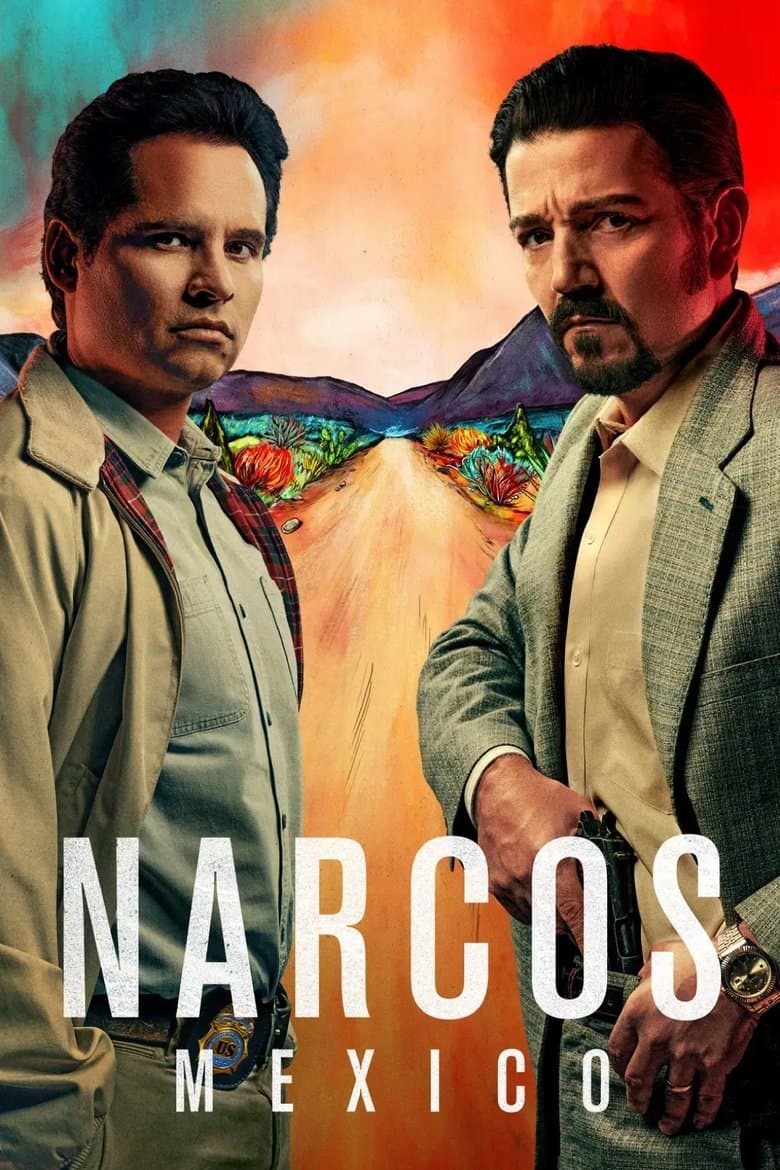
Started November 16, 2018 · Ended · Based on 3 seasons, 30 episodes through November 5, 2021 · TV-MA
Narcos Mexico is a three-season Netflix crime drama about the rise of the Guadalajara Cartel under Miguel Ángel Félix Gallardo. It covers the murder of DEA agent Kiki Camarena, the cartel wars that followed, and the growth of figures like Amado Carrillo Fuentes, the Arellanos, and El Chapo. Across seasons it stays a male-dominated drug-war story about corruption, violence, and the failed U.S. and Mexico war on drugs. Later seasons add stronger female storylines and a Juárez femicides subplot.
Identity politics stay secondary to crime history and critique of the drug war. The show expands prominent women such as Isabella Bautista, Enedina Arellano Félix, and journalist Andrea Nuñez after the original series was faulted for thin female roles. Secondary threads frame female cartel ambition through patriarchy and survival, and the Juárez factory femicides add gender-focused social messaging some viewers will notice late on. Dialogue and plot still center on cartels, bribes, DEA work, and the drug trade more than constant activist speech.
Community feedback
Was our 43% Woke rating accurate?
Breakdown
These are the editorial factors and ratings behind our score for Narcos: Mexico.
Woke representation / casting
The cast is largely Mexican and Latin American and fits the 1980s–90s Mexico setting. The main change is a deliberate push for more important women such as Isabella, Enedina, and season three narrator Andrea Nuñez. That push followed criticism that the original Narcos had thin female roles. The showrunner and cast described it as fixing a narrow male view and as female empowerment, not only as pure history.
30%
Woke political dialogue
Most talk is about cartels, bribes, DEA work, and the drug trade. A few lines blame the system, share fault between the U.S. and Mexico, or note women’s survival in a men’s business. That speech is light. It is not constant activist dialogue.
18%
Identity-driven story themes
The main story is empire, revenge, and the drug war, not race or gender ideology. Later seasons add side plots about women in the cartels and the Juárez factory killings of women. Those threads bring gender-focused social messaging some viewers will notice. They do not redefine the whole series.
28%
Western institutional / cultural critique
The show keeps a strong critique of the War on Drugs, PRI-era Mexican corruption, U.S. demand, and failed institutions. It often frames many people as victims of the system. That is classic progressive institutional critique more than identity culture war. Gender-violence impunity in Juárez is a secondary beat that audiences can still see.
42%
Woke character or canon changes
Isabella is a fictional composite loosely based on Sandra Ávila Beltrán. Enedina is real, but her on-screen power is boosted for drama. That is ordinary compression and invention, not race or gender swaps of iconic figures. The mild ideological edge is the clear creative goal of putting more women front and center.
14%
Anti-woke backlash and complaints
There was almost no mainstream anti-woke campaign. A few people called later seasons woke for exaggerated female masterminds. Most criticism was about quality, accents, or history. Some left-leaning takes said women were still poorly shown, and those do not count here.
10%
Creator track record context
Cached scores for the main crime-drama craftspeople sit mostly in the low single digits to low twenties. Mild lifts come from Latinx diversity advocacy, a Latinx equity letter, a Lovecraft Country credit, and left-leaning humanitarian politics. That is supporting context. It is not a hard identity slate.
18%
Production
TV Show · 2019
Loosely based on infamous crime boss Bumpy Johnson, who in the early 1960s returned from ten years in prison to find the neighborhood he once ruled in shambles.
TV Show · 2023
Candy and Pat Montgomery and Betty and Allan Gore — two churchgoing couples — enjoy their small town Texas life... until an extramarital affair leads somebody to pick up an axe.
TV Show · 2019
Gypsy Blanchard struggles to deal with the toxic relationship with her overprotective mother, but her attempts to free herself lead to murder.

TV Show · 2016
Once a powerful lawyer, Billy McBride is now burned out and washed up, spending more time in a bar than a courtroom.
TV Show · 2025
In the working-class suburbs of Philadelphia, an FBI agent heads a task force assembled to put an end to a string of violent robberies led by an unsuspecting family man.
TV Show · 2021
The remarkable story of how murderer Charles Sobhraj was captured. As the chief suspect in unsolved murders of young Western travellers across India, Thailand and Nepal’s ‘Hippie…
TV Show · 2024
When aristocratic Eddie inherits the family estate, he discovers that it's home to an enormous weed empire — and its proprietors aren't going anywhere.

TV Show · 2024
Through the eyes of various Irish Republican Army (IRA) members, explore the extremes some people will go to in the name of their beliefs, the way a deeply divided society can…
