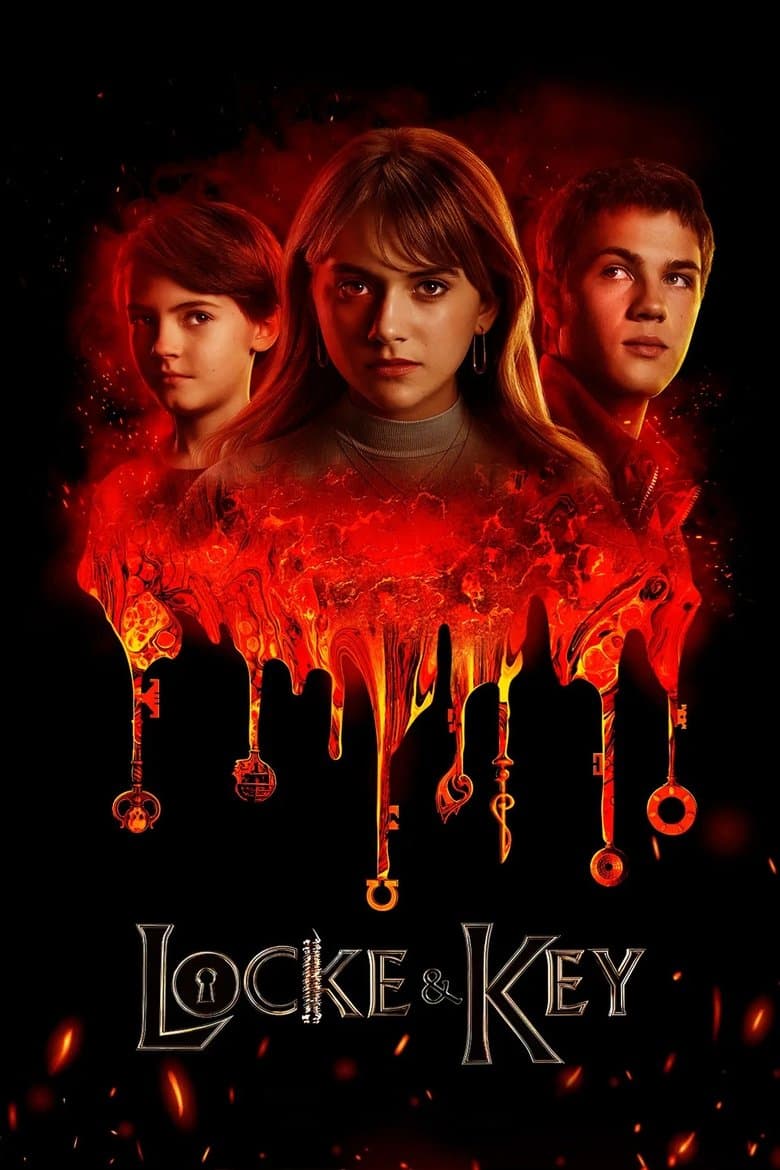
Started February 7, 2020 · Ended · Based on 3 seasons, 28 episodes through August 10, 2022 · TV-14
Locke and Key follows the Locke family after they move into an old house filled with magical keys. The kids find keys that unlock strange powers and hidden doors. They must guard family secrets while facing dangerous enemies. The main story is about grief, family bonds, and fighting dark forces such as Dodge and later Gideon. The series runs three seasons and stays closer to young adult fantasy than pure horror.
The show includes a multiethnic supporting cast and disability casting that progressive coverage treated as inclusion wins. Uncle Duncan has a gay relationship that develops on screen and includes a wedding in season three. A few comic characters were race swapped for television, and two comic keys were merged into the Identity Key. There is almost no activist dialogue about race, gender systems, or modern identity politics. Anti-woke complaints about casting and diversity appeared online but stayed sparse and never became a major news cycle.
Community feedback
Was our 38% Woke rating accurate?
Breakdown
These are the editorial factors and ratings behind our score for Locke & Key.
Woke representation / casting
The show is set in a modern school town with a clear multiethnic supporting cast and real disability casting. Progressive coverage treated those choices as inclusion wins. The core Locke family stays white, matching the comics. Several friend and adult roles matter more than simple background extras.
34%
Woke political dialogue
Not present. No recurring activist dialogue about race, gender systems, DEI, capitalism, or present-day identity politics.
0%
Identity-driven story themes
The main arc is family trauma, magical keys, and fighting Dodge and Gideon, not identity ideology. Uncle Duncan’s gay relationship is source-faithful and becomes a visible supporting subplot with a wedding in season three. Kinsey’s Head Key moment is about personal trauma growth, not feminist messaging. The series is not built around queer-centered politics.
30%
Western institutional / cultural critique
Not present. S3’s possessed Revolutionary War British officer is supernatural historical evil, not modern activist critique of the West, capitalism, whiteness, patriarchy, or Christianity.
0%
Woke character or canon changes
Established comic characters Scot and Ellie Whedon are race-swapped for television. The comics Gender Key and Skin Key are merged into the Identity Key. Duncan’s sexuality matches the comics. Tone softening from horror to YA is adaptation style, not scored as an identity change.
28%
Anti-woke backlash and complaints
There was no major mainstream news cycle calling the show too woke. Sparse social posts complain about DEI casting, a token gay guy in season two, and claims the show went full woke. The reaction is real but low volume.
18%
Creator track record context
Cached scores for key creatives are mostly low, including Cuse, Averill, Hill, and Rodriguez. Most directors land in the mid teens to high twenties. Outlier writer Kimi Howl Lee scores higher at 47. Overall the room looks mild rather than activist-led.
17%
Production
TV Show · 2016
In the near future a family must make difficult decisions as they balance staying together with trying to survive.
TV Show · 2021
Two federal agents from two different continents, and two different mindsets, must work together to investigate when wreckage from a destroyed alien spacecraft has mysterious…
TV Show · 2018
After landing from a turbulent but routine flight, the crew and passengers of Montego Air Flight 828 discover five years have passed in what seemed like a few hours.
TV Show · 2017
Holden wakes up from a coma after 12 years and discovers new abilities that propel him into the middle of a dangerous conspiracy.
TV Show · 2020
Korean emperor Lee Gon tries to close the doors to a parallel world which was opened by demons; a detective tries to protect the people and the one she loves.
TV Show · 2019
A police chief takes in a young child she finds near the site of a mysterious accident who has no memory of what has happened.
TV Show · 2022
An archivist takes a job restoring damaged videotapes and gets pulled into the vortex of a mystery involving the missing director and a demonic cult.
TV Show · 2021
Interconnected phone conversations chronicle the mysterious story of a group of strangers whose lives are thrown into disarray in the lead-up to an apocalyptic event.
