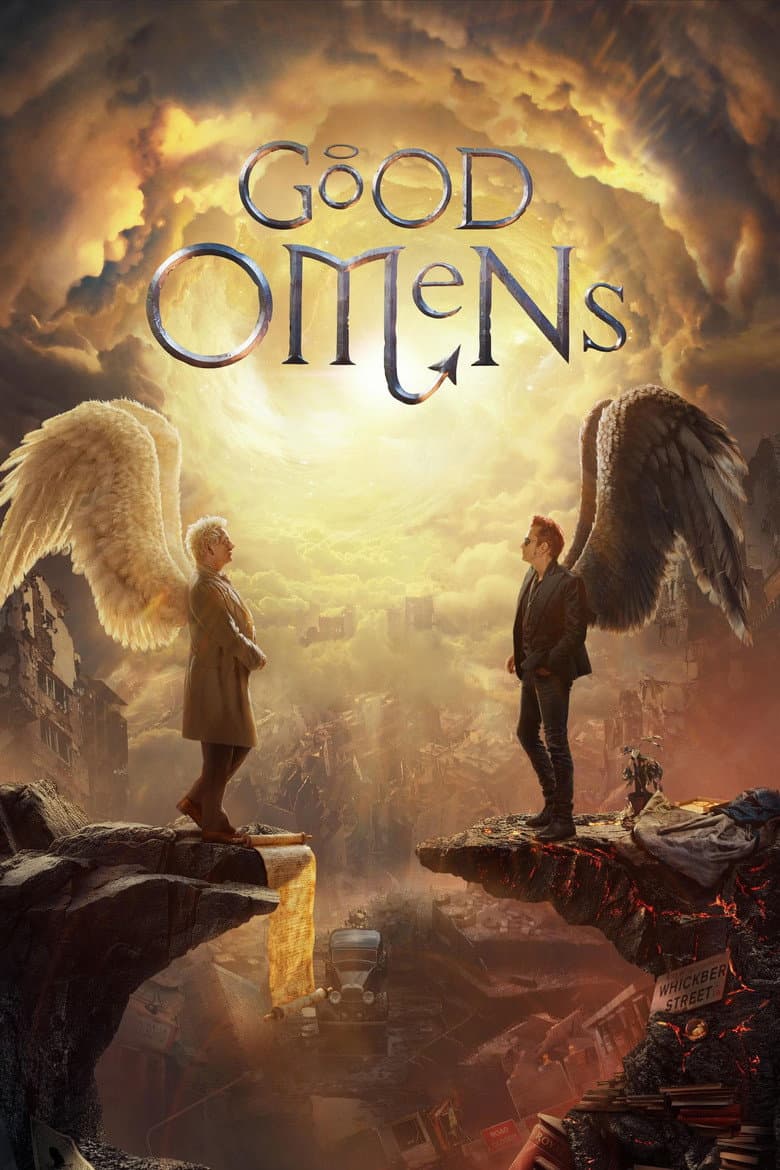
Started May 31, 2019 · Ended · Based on 3 seasons, 13 episodes through May 13, 2026 · TV-MA
Good Omens follows Aziraphale, a careful angel who runs a rare bookshop, and Crowley, a fast-talking demon who drives a Bentley. They have lived on Earth for thousands of years and have grown to love its messy human life. In the first season, they search for the missing Antichrist and try to stop Armageddon, while Heaven and Hell prepare for war. The later seasons move to London, where the pair face a memory-lost angel, a planned Second Coming, and their own split, all in a silly and warm fantasy comedy.
The show makes their bond an open queer romance as the story continues. Season two adds a kiss, a painful breakup, and a smaller romance between Nina and Maggie, two women. Angels and demons are treated as beings without fixed human gender, and several use gender-neutral language or female forms. Season three ends with Aziraphale and Crowley giving up their immortal lives so humans can have free will, then meeting again as married men in new human lives. The show repeatedly treats love, personal choice, and human messiness as better than strict orders from Heaven or Hell.
Community feedback
Was our 90% Woke rating accurate?
Breakdown
These are the editorial factors and ratings behind our score for Good Omens.
Woke representation / casting
Many angels and demons are played by men and women even though the story says these beings have no fixed human gender. The show presents a female-voiced God and genderless or gender-fluid angels, demons, and Horsemen. The human cast also includes visible black and minority actors in roles such as Anathema and Nina. The two lead actors are white men who present as male, so the strongest casting signal comes from the repeated gender choices around the supernatural cast.
35%
Woke political dialogue
Not present in this title.
0%
Identity-driven story themes
The show’s main emotional story becomes Aziraphale and Crowley’s queer love. Season one builds their close romantic bond, and season two confirms it with a confession and a kiss. Season two also gives Nina and Maggie a lesbian romance and treats angels and demons as nonbinary or gender-fluid beings. Season three centers the pair’s sacrifice and reunion as a married human couple.
92%
Western institutional / cultural critique
The show makes Heaven and Hell look like petty offices filled with rigid rules, bad managers, and blind obedience. The story repeatedly mocks divine plans, religious authority, and the idea that people should be punished for how they were made. The finale removes God, Satan, angels, and demons so humans can live with free will. This is a strong attack on religious order, but it stays inside fantasy satire and does not become a modern campaign against capitalism, patriarchy, or current politics.
44%
Woke character or canon changes
The original novel treats Aziraphale and Crowley mainly as an unusual friendship with romantic hints. The TV show makes their bond an open love story with a confession and a kiss. Season two adds Nina and Maggie’s lesbian romance, which is not part of the novel. Season three adds new human lives and a marriage for the pair, making the identity change part of the ending.
88%
Anti-woke backlash and complaints
A conservative review of season two called its alternative to religion “woke cringe” and objected to its identity and relationship themes. Some online posts also described the same-sex romance as forced or agenda-driven. The 2019 petition with more than 20,000 names attacked Satanism, blasphemy, and the female voice of God instead of focusing mainly on DEI. The anti-woke reaction is real but small beside the much larger fan response.
23%
Creator track record context
Neil Gaiman’s creator record shows a strong pattern of queer and diverse characters, and his comments about this show support its nonbinary angels and demons. Rachel Talalay’s record shows feminist and justice themes. Cat Clarke’s writing adds a clear trans and queer focus. Terry Pratchett, John Finnemore, and most other listed creators have milder or unclear activist records, so the context is mixed but leans progressive.
62%
Production
TV Show · 2022
Gary is an emotional wreck and struggles to provide for his daughter since the death of his wife. Mary has a secret she can't bring herself to share with anyone.
TV Show · 2016
A comedic thriller that follows the bizarre adventures of eccentric “holistic” detective Dirk Gently and his reluctant assistant Todd.
TV Show · 2018
Two strangers are drawn to a mysterious pharmaceutical trial that will, they're assured, with no complications or side-effects whatsoever, solve all of their problems…
TV Show · 2022
The intricate and magical love story of Clare and Henry, and a marriage with a problem… time travel.

TV Show · 2016
In his quest for a bride to break his immortal curse, a 939-year-old guardian of souls meets a grim reaper and a sprightly student with a tragic past.
TV Show · 2016
Hundreds of years from now, the last surviving humans discover the means of sending consciousness back through time, directly into people in the 21st century.

TV Show · 2023
At the brink of going to hell, Yee-jae must cycle through twelve separate lives and twelve separate deaths in this reincarnation drama.
TV Show · 2026
After accidentally creating a new multiverse, comic book store owner Stuart Bloom must locate a quantum-interference device to restore reality.
