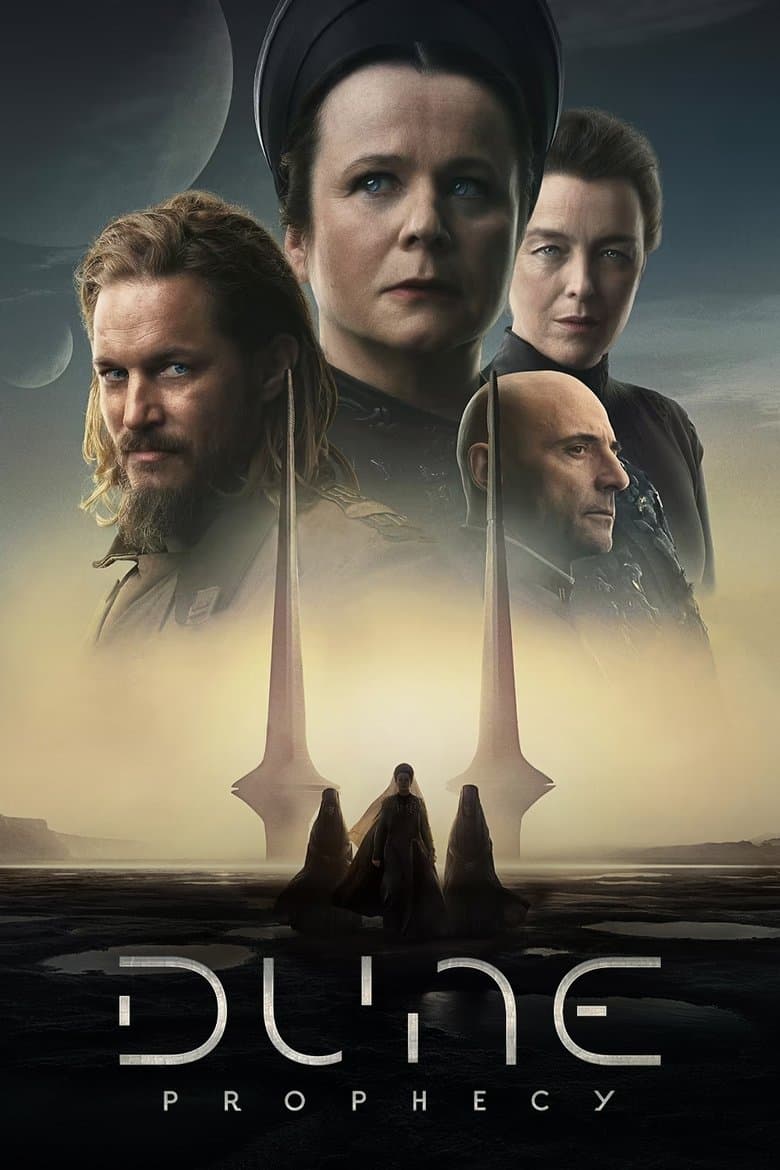
Started November 17, 2024 · Returning Series · Based on 1 season, 6 episodes through December 22, 2024 · TV-MA
Dune: Prophecy follows sisters Valya and Tula Harkonnen, who rise from a disgraced family to lead a school of women with unusual mental and physical skills. Ten thousand years before Paul Atreides, the sisters use truth tests, secret plans, and arranged marriages to build power in the young Imperium. Valya wants one of their own on the throne, while Tula struggles with the cost of their choices and with the son she had with an Atreides. A returning soldier named Desmond Hart brings a deadly power and a warning about a coming disaster, which turns the family fight into a threat to the whole empire.
The show makes female power its clearest audience-visible identity element. The Sisterhood is an all-female group that trains women to control their bodies, read lies, guide rulers, and shape future bloodlines. Several women lead armies, courts, rebellions, and schools, while many male leaders are shown as violent, weak, or easy to influence. The story does not present these women as simple heroes because Valya and her allies lie, kill, use people, and defend a harsh breeding plan. Its main message stays focused on power, family loyalty, prophecy, and the danger of letting any group control the future.
Community feedback
Was our 44% Woke rating accurate?
Breakdown
These are the editorial factors and ratings behind our score for Dune: Prophecy.
Woke representation / casting
The show places a visibly mixed group of women in important Sisterhood roles, including Black, South Asian, and East Asian performers. The main Harkonnen sisters are played by white British actresses, while several supporting women hold senior roles. The showrunner said the Imperium should feel like a global world and the cast should reflect that diversity. The far-future setting makes the mix plausible, but the repeated identity framing makes this a noticeable, not dominant, signal.
35%
Woke political dialogue
Valya's opening speech calls her new female family unafraid of its power. The Sisters say rulers are driven by violence and greed, and they plan to put one of their own women on the throne. The show places these lines inside a fictional fight over power and prophecy, so it does not use modern activist language or direct present-day politics.
18%
Identity-driven story themes
The show makes an all-female order the main force shaping the Imperium. Women train other women, protect a chosen family, control rulers, and decide which bloodlines should continue. The story presents these women as strong and capable while many male leaders are weak, violent, or easy to control. The story also shows Valya and her allies as liars and killers, so the female-power message is mixed rather than a simple hero story.
42%
Western institutional / cultural critique
The show presents many male rulers as violent, weak, or easy to manipulate. The Sisterhood grows by working around male control and by placing women near every major ruler. The arranged marriage of a princess to a nine-year-old and the empire's wars are shown as abuses of power. The story still treats the Sisterhood as cruel and corrupt, and it does not attack Christianity or capitalism.
30%
Woke character or canon changes
Not relevant. Direct expansion of the established prequel novel Sisterhood of Dune with no identity-driven alterations to canon, characters, or historical figures.
0%
Anti-woke backlash and complaints
Small X accounts called the show a girlboss or Mary Sue series and complained about forced diversity, weak men, and a Dune: GirlBoss framing. A few anti-woke-adjacent YouTube posts treated it as woke-adjacent, but their main complaints were quality and the use of Mark Strong. No clear boycott, review-bomb campaign, or large right-leaning news fight appeared. The evidence is fringe and low volume.
15%
Creator track record context
Most available profiles for the listed directors, casting directors, and Herbert family writers show little activist history. Diane Ademu-John and Kevin Lau are the clearest exceptions because their past work includes representation and social themes. Monica Owusu-Breen adds a smaller signal, while the wider team remains mostly neutral. This gives the show a low-to-moderate creator track record signal.
25%
Production
TV Show · 2023
After washing ashore in France, Daryl struggles to piece together how he got there and why, as he navigates a fractured, walker-infested landscape to find his way home.
TV Show · 2019
A grim drama that unfolds against the backdrop of a global catastrophe. An unknown new virus turns Moscow into a city of the dead.
TV Show · 2026
A century before the events of Game of Thrones, two unlikely heroes wandered Westeros: a young, naive but courageous knight, Ser Duncan the Tall, and his diminutive squire, Egg.
TV Show · 2022
A high school becomes ground zero for a zombie virus outbreak. Trapped students must fight their way out — or turn into one of the rabid infected.
TV Show · 2017
Located in the center of a remote island, the Abyss is the last unexplored region, a huge and treacherous fathomless hole inhabited by strange creatures where only the bravest…
TV Show · 2020
Daimon and Ana Helstrom are the son and daughter of a mysterious and powerful serial killer. The siblings have a complicated dynamic as they track down the terrorizing worst of…
TV Show · 2017
Daredevil, Jessica Jones, Luke Cage and Iron Fist join forces to take on common enemies as a sinister conspiracy threatens New York City.
TV Show · 2021
After encounters with a dragon and a princess on her own mission, a Dragon Knight becomes embroiled in events larger than he could have ever imagined.
