Started January 4, 2018 · Ended · Based on 3 seasons, 19 episodes through May 18, 2022 · TV-MA · 23 min
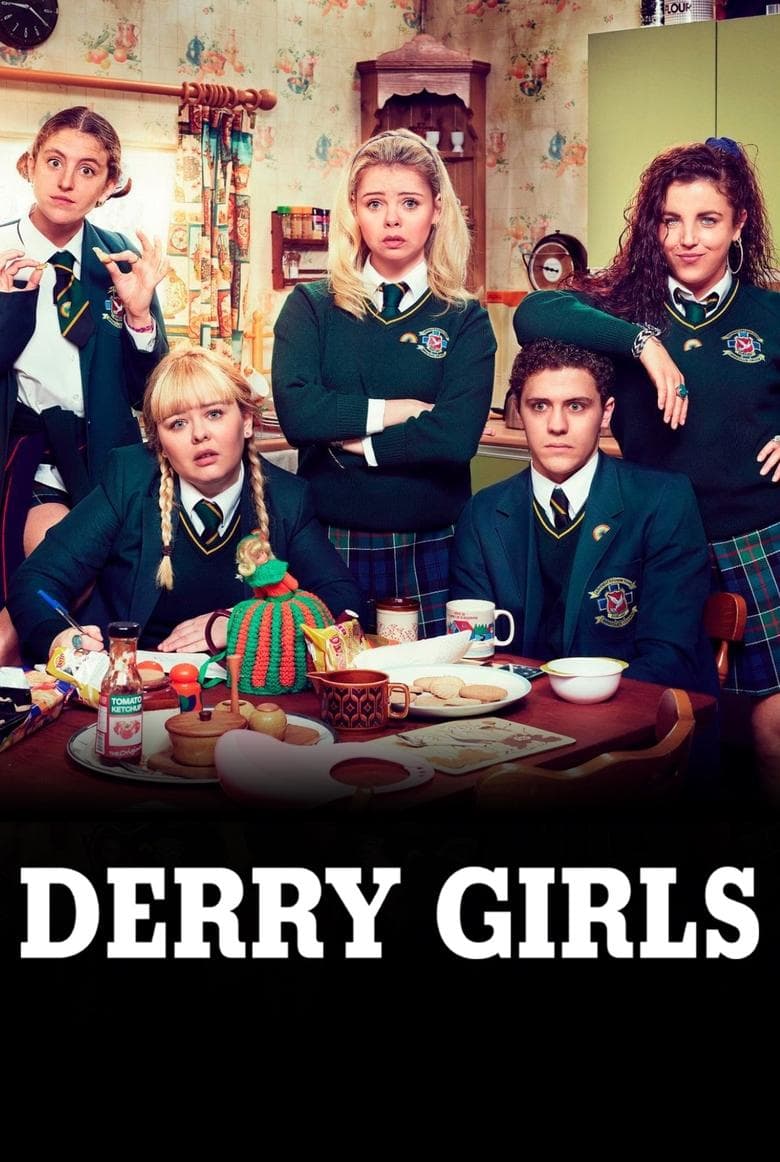
Derry Girls follows Erin Quinn, a loud and hopeful teenager who wants to be a writer and thinks she understands the world. She lives with her family and cousin Orla in Derry, where she attends a Catholic girls' school with Clare, Michelle, and James, Michelle's English cousin. The friends deal with homework, crushes, family fights, school rules, and the danger of the Troubles in 1990s Northern Ireland. The show uses fast jokes, rude teen talk, warm family scenes, and sudden sad moments.
The clearest woke element is Clare's lesbian coming-out story, which begins in the first season and leads to rainbow support and a kiss with another girl in the final season. The show also puts four girls at the center and presents itself as a female-led story about young women, while James is welcomed as a “Derry Girl.” The group calls a school ban on a lesbian story a gay rights issue, but the joke comes from the girls' confusion and boldness. The Troubles, the Good Friday Agreement, Catholic authority, and police behavior appear as local history, not as long modern activist speeches. The show makes the identity material visible, but it keeps friendship, family trouble, and teenage embarrassment as the main focus.
Community feedback
Was our 41% Woke rating accurate?
Breakdown
These are the editorial factors and ratings behind our score for Derry Girls.
Woke representation / casting
The lead group has four local Irish girls and one English boy in a Catholic girls' school. The show and its cast call it a female-led story about young women, and interviews stress that the girls are not sexualized. Clare's lesbian identity adds a clear queer representation signal, but the cast has no race-based mismatch or one-of-each diversity pattern. The setting and story explain most of the casting choice.
30%
Woke political dialogue
The school magazine plot calls a ban on a lesbian story a gay rights issue. The friends also discuss Catholic and Protestant divisions, British soldiers, police, and the Good Friday Agreement. The historical talk belongs mostly to the setting and the comedy. The show does not turn these subjects into long modern activist speeches.
16%
Identity-driven story themes
Clare's coming-out story is a clear part of the first-season finale. Clare's friends wear rainbow pins and keep her sexuality visible without making it her only trait. Clare later kisses Laurie, another girl, during the final season. The show also centers female friendship and lets the girls be loud, messy, and independent. The identity material is important, but family, friendship, and teenage life remain the main story.
50%
Western institutional / cultural critique
The girls and women often control the home, school, and group decisions. The show makes male authority look foolish through the fathers, the young priest, soldiers, and police. The Catholic school and church figures are mocked, but faith remains part of the community rather than an enemy. The show does not build a modern attack on men, family, Christianity, or Western society.
20%
Woke character or canon changes
Not present in this title.
0%
Anti-woke backlash and complaints
Not present in this title.
0%
Creator track record context
Lisa McGee's supplied creator score is 26/100, and Michael Lennox's is 16/100. McGee's interviews frame the show around strong Derry women, local voices, and a young female view of the Troubles. Neither creator has a documented pattern of political activism or identity-focused advocacy. This gives mild supporting context.
21%
Production
TV Show · 2019
Tony had a perfect life. But after his wife Lisa suddenly dies, Tony changes. After contemplating taking his own life, he decides instead to live long enough to punish the world…

TV Show · 2020
After being bullied and discriminated because of her ugly looks, a high school girl transforms herself into a gorgeous "goddess" and quickly rises to fame after mastering the art…
TV Show · 2024
When aristocratic Eddie inherits the family estate, he discovers that it's home to an enormous weed empire — and its proprietors aren't going anywhere.

TV Show · 2016
In his funky California beach enclave, Chip's the go-to guy for personal insights. But he isn't quite as enlightened when it comes to his own baggage.

TV Show · 2019
To win back his ex-girlfriend, a nerdy teen starts selling ecstasy online out of his bedroom -- and becomes one of Europe's biggest dealers.

TV Show · 2024
The life of an American woman living in Kyoto, Japan, is upended when her husband and son disappear in a mysterious plane crash.
TV Show · 2020
New passions. New fashions. New Emily? A plucky American marketing whiz spreads her wings in life and love after landing her dream job in Paris.
TV Show · 2021
A seemingly ordinary British couple become the focus of an extraordinary investigation when two dead bodies are discovered in the back garden of a house in Nottingham.
