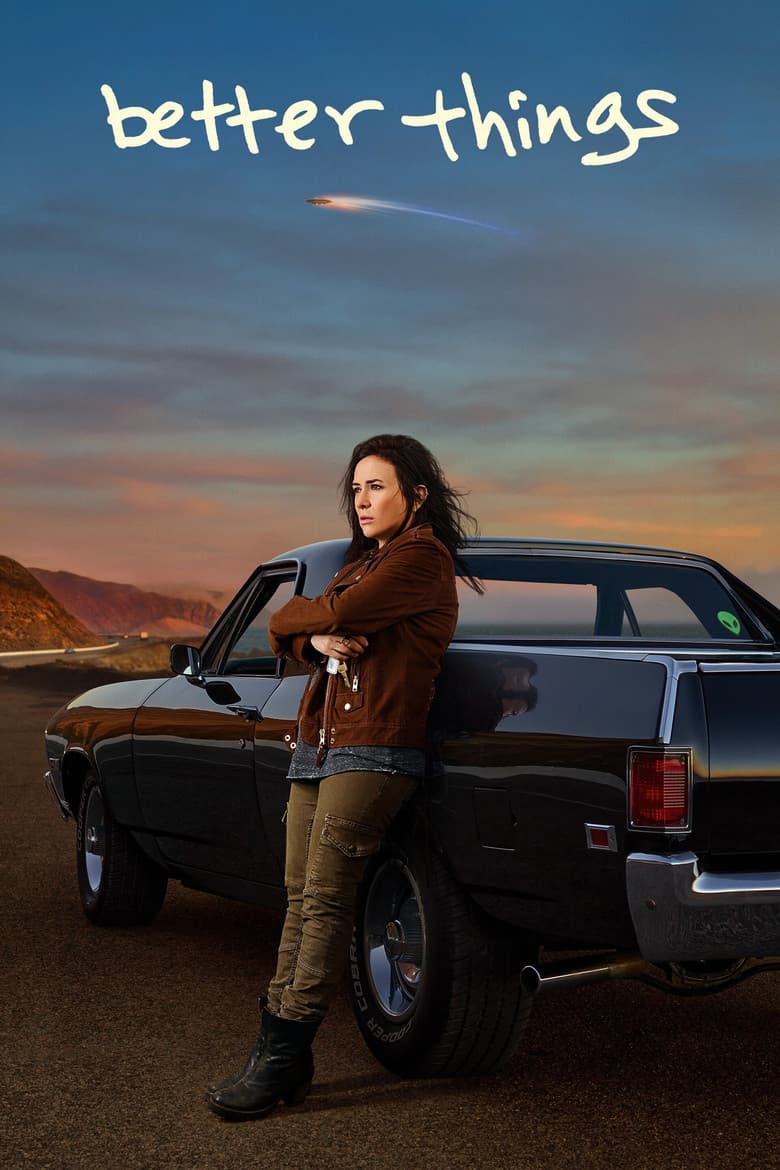
Started September 8, 2016 · Based on 5 seasons, 52 episodes · TV-MA · 23 min
Better Things follows Sam Fox, a divorced working actress who raises three daughters in Los Angeles. The series is a semi-autobiographical comedy-drama that ran for five seasons and fifty-two episodes. Its core stories focus on messy motherhood, aging, the Hollywood hustle, and friction across generations in one family. The show stays rooted in daily chaos and personal struggle rather than acting like a pure identity lecture. Gender, sexuality, and women-centered social themes still run through all seasons and grow clearer later.
Viewers will notice progressive casting and recurring queer roles around the Fox family and their circle. Middle child Frankie has a multi-season arc about gender nonconformity, fluid presentation, and later talk about pronouns and nonbinary identity. The series also features a gay best friend, a lesbian romantic interest for Sam, and same-sex romance for Jason in the final season. Themes of feminism, Hollywood sexism and ageism, and divorce as agency sit alongside those identity arcs. The queer and gender material stays on screen for many seasons, so it carries real weight even though motherhood remains the main spine.
Community feedback
Was our 57% Woke rating accurate?
Breakdown
These are the editorial factors and ratings behind our score for Better Things.
Woke representation / casting
The main Fox household is a modern Los Angeles family led by a white working actress and fits the autobiographical premise rather than a diversity quota cast. Recurring and guest roles still show progressive signaling, including gay best friend Rich, black lesbian manager Mer, and a growing circle of women of color. Middle child Frankie is written as gender-nonconforming across seasons and stands out as a clear identity role among the three daughters. Queer and diversity-forward casting is visible beyond pure story need, but the show is not a one-of-each hero team.
34%
Woke political dialogue
Most talk stays personal and observational rather than full of slogans. Progressive beats still return, such as a feminist school event with Frankie, pushback at Phil’s racism after Sam dates a black man, and talk about Hollywood sexism and ageism. Season 5 has Sam learning proper pronoun use around Frankie, who resists a fixed label. Men are often framed in blunt terms as useless, sleazy, or absent, so the progressive tone is clear if you listen for it.
30%
Identity-driven story themes
Motherhood and daily chaos stay at the center, but identity arcs run across seasons and are hard to miss. Frankie’s path covers early gender nonconformity, fluid presentation, same- and opposite-sex intimacy, and later nonbinary and pronoun talk while refusing a hard label. The show also keeps a gay best friend, Sam’s flirtation with lesbian Mer, and Jason’s same-sex romance in the final season. Women-centered feminism, menopause as visibility, and divorce as agency layer on top, so queer and gender material carries high weight even though the show is not only a queer project.
64%
Western institutional / cultural critique
The strongest targets are Hollywood ageism and sexism plus traditional family and gender scripts. Men often look worthless or predatory, divorce looks like power, and a matriarchy looks like the stable unit while midlife women feel erased. Phil’s racism is called out inside the family. This is modern cultural pushback more than a full anti-West or anti-capitalist tract, but it clearly challenges conservative norms about gender roles, marriage, and who gets to lead on screen.
44%
Woke character or canon changes
Not relevant. This is an original series with no legacy characters or historical figures rewritten for identity reasons.
0%
Anti-woke backlash and complaints
Not present. No meaningful right-leaning or anti-woke campaign against the show as woke propaganda showed up in news or social search. Coverage stayed critic-darling motherhood dramedy. Louis C.K.’s exit was about sexual misconduct, not content ideology.
0%
Creator track record context
Showrunner star and primary author Pamela Adlon scores 25 for personal family storytelling and resists activist framing of her work. Co-creator Louis C.K. scores 25 for early seasons only with boundary-pushing comedy rather than social justice activism. Most listed producers and editors sit low between 8 and 22, while Nisha Ganatra at 58 directed several Season 1 episodes and has a clearer diversity filmography but is not the long-term center. Weighted toward Adlon as the dominant voice, the record is moderate rather than activist-forward.
28%
Production
TV Show · 2019
Burned out on life, Miles undergoes a strange procedure at a strip mall spa -- and wakes to find he's been replaced by a better version of himself.

TV Show · 2019
Tony had a perfect life. But after his wife Lisa suddenly dies, Tony changes. After contemplating taking his own life, he decides instead to live long enough to punish the world…

TV Show · 2024
The life of an American woman living in Kyoto, Japan, is upended when her husband and son disappear in a mysterious plane crash.

TV Show · 2016
Rebellious Mickey and good-natured Gus navigate the thrills and agonies of modern relationships.

TV Show · 2023
The lives of a realtor, a plumber and a former tennis star unexpectedly collide, exposing America’s obsession with true crime, murder and the slow-close toilet seat.

TV Show · 2022
In disguise as her friend, Ha-ri shows up to a blind date to scare him away. But plans go awry when he turns out to be her CEO — and makes a proposal.

TV Show · 2023
A disgraced cop in debt is forced to return to his home state of Florida for a shady mission only to get swept up in a wild — and deadly — treasure hunt.

TV Show · 2026
The mayor of a New England town resolves to turn it into the next tourist hot spot, despite local warnings that it's cursed.
