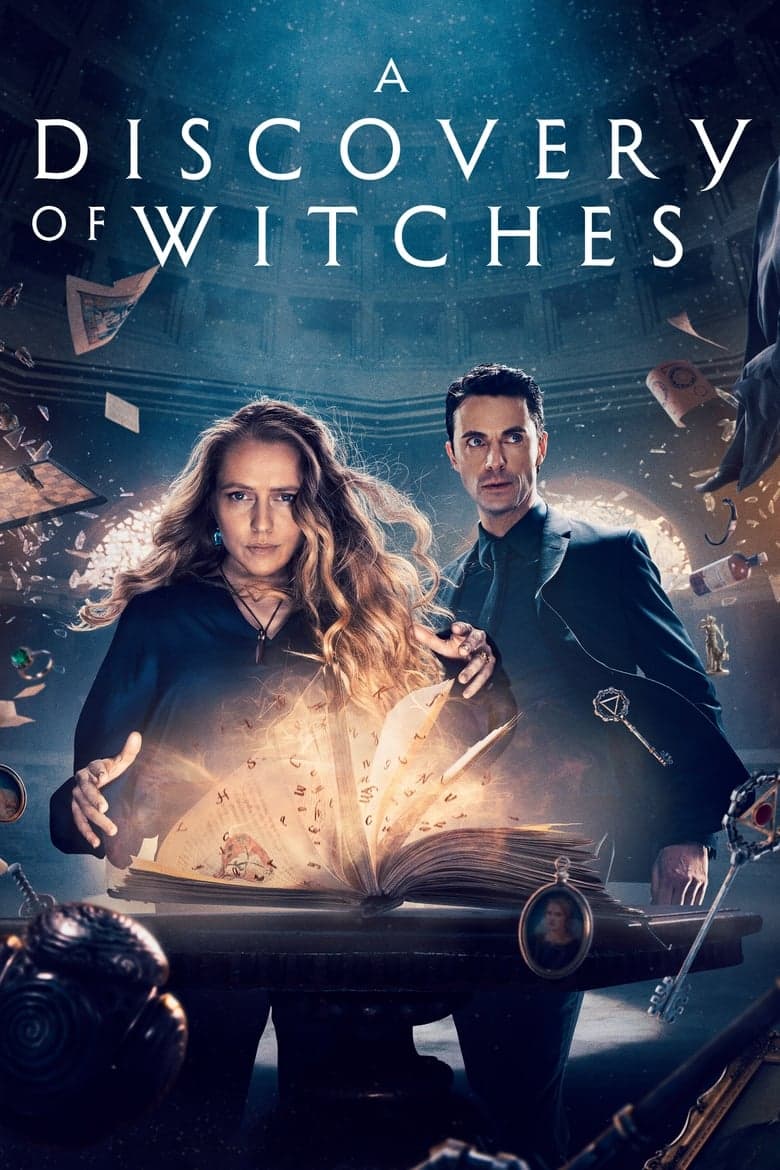
Started September 14, 2018 · Ended · Based on 3 seasons, 25 episodes through February 18, 2022 · TV-MA · 45 min
A Discovery of Witches follows Diana Bishop, an Oxford historian who has spent years refusing to use her witch powers. She finds a missing book that draws witches, vampires, and daemons into a fight over the future of their hidden world. Diana joins Matthew Clairmont, an old vampire and scientist, and their forbidden love becomes the center of the danger. The three seasons move from modern Oxford and France to Elizabethan London and back, with romance, family drama, mystery, and dark fantasy.
The series has clear woke elements, especially in its final season, but they do not take over the story. Diana grows into a powerful female lead and challenges leaders who try to control her. The final episodes call the old separation of witches, vampires, and daemons unfair and favor mixed families, while Diana’s lesbian aunts provide confirmed queer representation. A brief display of pink Women’s March hats adds a modern women’s rights signal, but the show still spends most of its time on romance, magic, murder, bloodlines, time travel, and the Book of Life.
Community feedback
Was our 51% Woke rating accurate?
Breakdown
These are the editorial factors and ratings behind our score for A Discovery of Witches.
Woke representation / casting
The show gives several important supporting roles to black actors, including Emily Mather, Agatha Wilson, and Nathaniel Wilson. Diana and Matthew remain the white leads, while the wider cast is more diverse than the book descriptions. Sarah and Emily are an openly lesbian couple who help raise Diana. The pattern is noticeable, but identity casting is not the main story.
34%
Woke political dialogue
Season 3 uses direct political language when Diana calls the Covenant a law of prejudice and exclusion. The Congregation debates whether all groups benefited equally from the old order. The dialogue links the fantasy conflict to segregation, equal treatment, and bloodline purity. The message appears mainly in the final season and remains tied to the creature plot.
27%
Identity-driven story themes
Diana’s story presents a gifted woman who claims her power and challenges leaders who treat her as a tool. The show makes the romance between a witch and vampire a test of rules that keep species apart. The final season says mixed bloodlines and families are needed for survival and calls the old separation unfair. Sarah and Emily are an openly lesbian couple who raise Diana, adding a confirmed queer identity element.
48%
Western institutional / cultural critique
The Congregation is a ruling council that keeps witches, vampires, and daemons apart. Diana says its law protected old power, harmed groups unequally, and valued bloodline purity over survival. The final debate asks the council to overturn that system and share power more fairly. The show keeps this critique inside its fantasy world and does not attack real Western institutions, Christianity, or capitalism.
35%
Woke character or canon changes
The TV adaptation keeps Diana, Matthew, their romance, and the main creature conflict from the books. The screen version uses a more racially diverse supporting cast than the book descriptions, including a Black Emily Mather and other important creature roles. Sarah and Emily’s same-sex relationship already exists in the source story, so the show did not add that element. The other large changes mainly cut, reorder, or expand plot material for television.
18%
Anti-woke backlash and complaints
One isolated MovieChat thread asks whether the series is woke or the usual woke material. I found no large review campaign, news controversy, or organized boycott over that issue. Most fan discussion focused on romance, pacing, book changes, and confusing plot points. The evidence for anti-woke backlash is weak and fringe.
10%
Creator track record context
Most listed directors, producers, casting directors, and writers have low or modest woke scores and no strong activist record. Michelle Gayle, Charlene James, and Debs Paterson have some work about women or minority communities. Title interviews openly discuss acceptance across race, gender, and sexuality and highlight strong women. This gives the show a mild creator-context signal.
24%
Production
TV Show · 2022
The intricate and magical love story of Clare and Henry, and a marriage with a problem… time travel.
TV Show · 2022
Irene and Franklin York, a retired couple, have a secret: a Chamber buried in their backyard that miraculously leads to a strange, deserted planet.
TV Show · 2016
Hundreds of years from now, the last surviving humans discover the means of sending consciousness back through time, directly into people in the 21st century.
TV Show · 2024
Jason Dessen is abducted into an alternate version of his life. To get back to his true family, he embarks on a harrowing journey to save them from the most terrifying foe…
TV Show · 2021
A single mother enters a world of twisted mind games when she begins an affair with her psychiatrist boss while secretly befriending his mysterious wife.
TV Show · 2024
Rick and Michonne are thrown into another world, built on a war against the dead... And ultimately, a war against the living.
TV Show · 2018
After 250 years on ice, a prisoner returns to life in a new body with one chance to win his freedom: by solving a mind-bending murder.
TV Show · 2020
A unique story told over two distinct halves, "Summer" follows Sam, a man drawn to a mysterious island off the British coast where he encounters a group of islanders set on…
