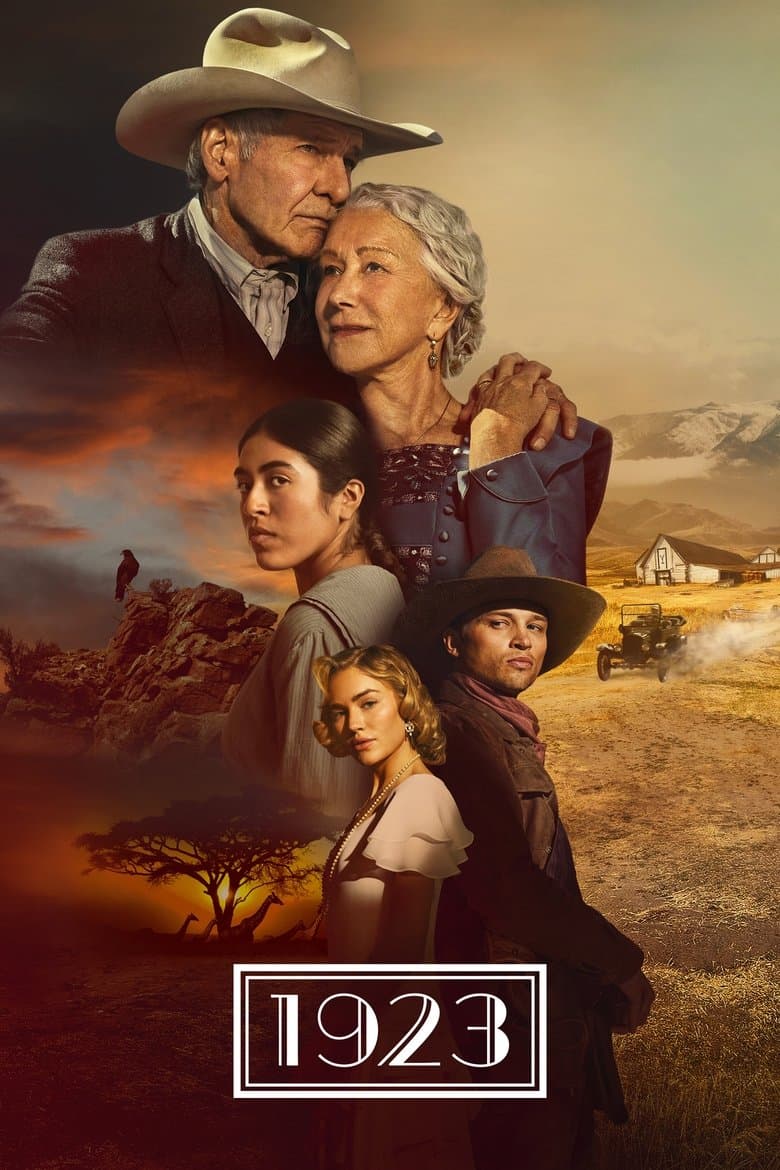
Started December 18, 2022 · Ended · Based on 2 seasons, 15 episodes through April 6, 2025 · TV-MA
1923 is a Paramount Plus neo-Western prequel in the Yellowstone franchise. It runs for two seasons and sixteen episodes. The story follows the Montana Dutton family as they face drought, Prohibition pressure, a sheep and cattle range war, and a dangerous mining tycoon. Helen Mirren and Harrison Ford play Cara and Jacob Dutton. Spencer returns from Africa with his British wife Alexandra while the family fights to hold their land.
A major parallel story follows Crow girl Teonna Rainwater through abusive federal and Catholic Indian boarding schools, her escape, and a manhunt across both seasons. The show stresses forced assimilation, racial abuse, and cruelty by clergy. A female U.S. marshal answers sexist doubt with harsh language about bigotry. There is also a secret interracial marriage under anti-miscegenation pressure. These identity threads are hard to miss even though the ranch war and Spencer and Alexandra romance stay central.
Community feedback
Was our 53% Woke rating accurate?
Breakdown
These are the editorial factors and ratings behind our score for 1923.
Woke representation / casting
The main Dutton cast fits 1920s Montana ranch demographics. Crow and other native roles are cast as Native, not race-swapped. The score reflects a series-long Indigenous co-lead, a trailblazing female U.S. marshal, and framing of strong women and native storytelling as priorities. It is not an engineered modern one-of-each ensemble.
20%
Woke political dialogue
Most ranch and Africa dialogue is period Western melodrama. Clear spikes include Season 2 marshal Mamie Fossett answering sexist doubt with “Because you’re a bigot… living in the wrong century.” Boarding-school scenes hammer forced assimilation, racial abuse, and clerical cruelty in plain, on-the-nose terms. These moments are present and noticeable in those threads, not constant sloganeering across the whole show.
30%
Identity-driven story themes
The Teonna Rainwater arc is a major multi-season A-plot about forced removal, cultural and language erasure, abuse in church-run Indian boarding schools, a sadistic priest, and survival that costs family and home. Secondary beats include a secret interracial marriage under anti-miscegenation pressure and Alexandra rejecting aristocratic arranged life. The core Dutton land war and Spencer and Alex romance remain central, so this is strong and hard to miss but not the sole premise.
55%
Western institutional / cultural critique
Across two seasons the Catholic Church and federal boarding-school system appear as tools of cultural destruction, with clergy as serial abusers and almost no counterbalancing faithful Christian figures. The show also pushes against traditional gender limits through Cara running ranch politics, capable frontier women, and the marshal’s bigot and wrong-century beat. Whitfield is a classic predatory capitalist villain in period melodrama form more than a full anti-capitalist manifesto.
50%
Woke character or canon changes
Not relevant. This is an original Sheridan series with no identity-driven rewrite of established literary or film canon. Fossett draws on a lightly documented historical deputy rather than flipping a known character’s identity.
0%
Anti-woke backlash and complaints
A minority of right-leaning viewers and posts call 1923 Sheridan’s most woke entry, a Trojan horse, or the exception to his otherwise non-PC brand, mainly over the Indigenous boarding-school emphasis. There is no large organized boycott. Many of the same audiences still recommend the show as non-woke relative to modern prestige TV.
20%
Creator track record context
Cached key creatives score very low, with Sheridan at 9 and directors, casting, and producers roughly 7 to 11. Sheridan’s public persona and output lean anti-woke and traditional storytelling even while he repeatedly dramatizes hard native history. Supporting crew shows no activist pattern.
10%
Production
TV Show · 2021
Follow the Dutton family as they embark on a journey west through the Great Plains toward the last bastion of untamed America.
TV Show · 2022
New York mafia capo Dwight "The General" Manfredi is released from prison after 25 years and exiled by his boss to set up shop in Tulsa, Oklahoma.

TV Show · 2026
The Clyburns uproot their comfortable New York City lives to the wild, untamed beauty of Montana's Madison River Valley on a search for connection.
TV Show · 2023
The story of Bass Reeves, the legendary lawman of the wild West, is brought to life. Reeves worked in the post-Reconstruction era as a federal peace officer in the Indian…
TV Show · 2024
The true story of one Jewish family separated at the start of World War II, determined to survive—and to reunite.
TV Show · 2021
Inspired by the true story of Marty and the therapist who turned his life around...then took it over. When he first meets Dr. Ike, Marty just wants to get better at boundaries.

TV Show · 2022
This sweeping saga chronicles the hopes and dreams of a Korean immigrant family across four generations as they leave their homeland in an indomitable quest to survive and thrive.
TV Show · 2026
Rip Wheeler and Beth Dutton gamble everything on a new life in South Texas, but the promise of building a future far from the ghosts of Yellowstone quickly collides with brutal…
