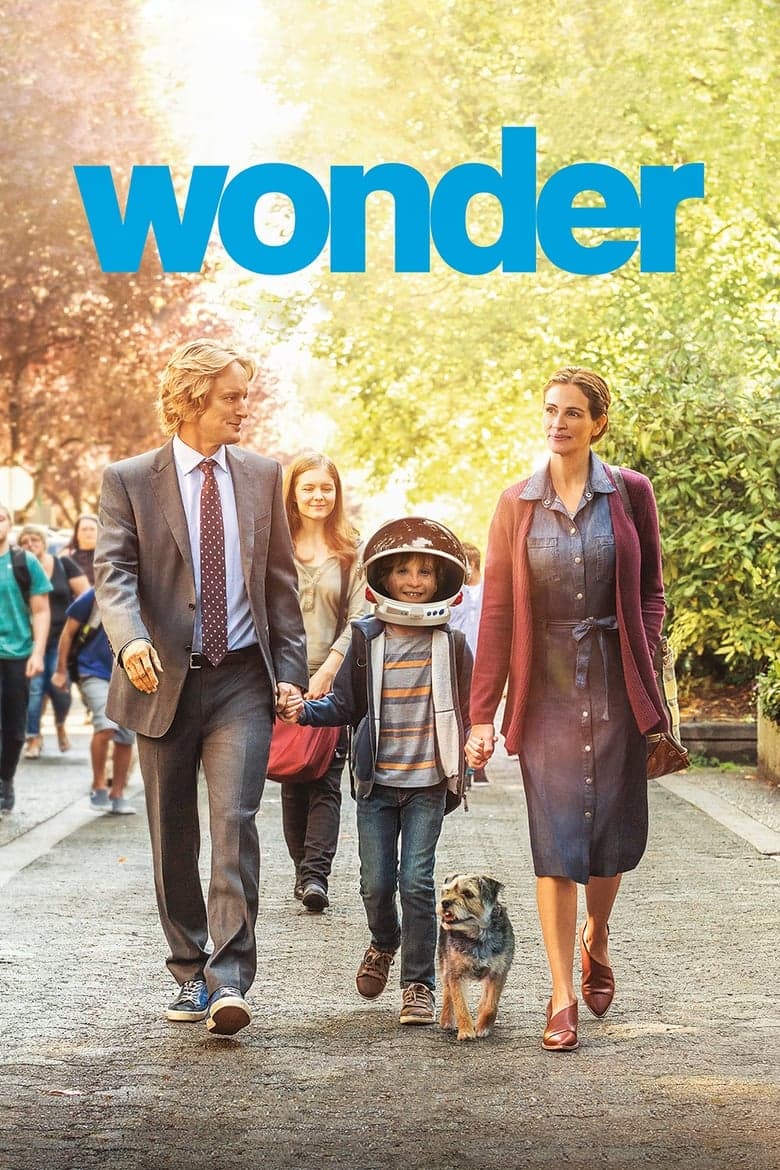
August Auggie Pullman is born with a craniofacial condition and leaves homeschooling for fifth grade at a private Brooklyn school. The story follows bullying from Julian, friendships with Jack Will and Summer, and family strain as his sister Via feels sidelined. School life centers on Mr. Browne kindness precepts. The film adapts R.J. Palacio novel and stays focused on empathy and standing out rather than race, gender ideology, or party politics.
Audience-visible woke elements are light and mostly about disability acceptance. The moral arc is visible-difference inclusion, anti-bullying, and institutional kindness under Choose Kind language. Supporting cast diversity appears in secondary roles while leads stay mostly white. Talk stays at universal kindness rather than identity slogans. Mild critique falls on entitled wealthy parents at a private school, not on Western institutions as a whole.
Community feedback
Was our 26% Woke rating accurate?
Breakdown
These are the editorial factors and ratings behind our score for Wonder.
Woke representation / casting
Modern NYC private-school setting with mostly white leads and real but secondary supporting diversity, a light modern-diversity pattern not quota-forward leads
15%
Woke political dialogue
Precept-level kindness and bullying talk, not identity slogans, oppression lectures, or partisan lines
5%
Identity-driven story themes
Premise and moral arc are visible-difference acceptance, anti-bullying, and Choose Kind inclusion without race, gender, or queer activist framing
23%
Western institutional / cultural critique
Mild elite-parent and private-school entitlement villains, not a sustained attack on Christianity, family, masculinity, or Western institutions
10%
Woke character or canon changes
Close to the novel with notable Black casting of Summer and Justin, not a major race or gender rewrite, and non-disabled Auggie casting runs opposite own-voice pressure
10%
Anti-woke backlash and complaints
Not present. No durable anti-woke campaign, existing controversy was pro-representation disability casting criticism
0%
Creator track record context
Soft progressive inclusion and disability empathy from Chbosky, Thorne, Palacio, and Participant more than identity-politics crusading
36%
Production
Movie · 2024
When David Smallbone's successful music company collapses, he moves his family from Australia to the United States in search of a brighter future.
Movie · 2016
When Christy discovers her 10-year-old daughter Anna has a rare, incurable disease, she becomes a ferocious advocate for her daughter’s healing as she searches for a solution.
Movie · 2017
In 1843, despite the fact that Dickens is a successful writer, the failure of his latest book puts his career at a crossroads, until the moment when, struggling with inspiration…

Movie · 2017
The film follows a man with an unwanted gift for healing who meets a teenager with cancer who helps him to find himself.
Movie · 2017
The behind the scenes story of the life of A.A. Milne and the creation of the Winnie the Pooh stories inspired by his son Christopher Robin.

Movie · 2019
A dog finds the meaning of his own existence through the lives of the humans he meets.
Movie · 2016
The incredible true story of the greatest walk-on in the history of college football.
Movie · 2024
The Herdman kids are undeniably the worst kids in the history of the world. They lie, steal, cheat, bully and overall terrorize their small community.
