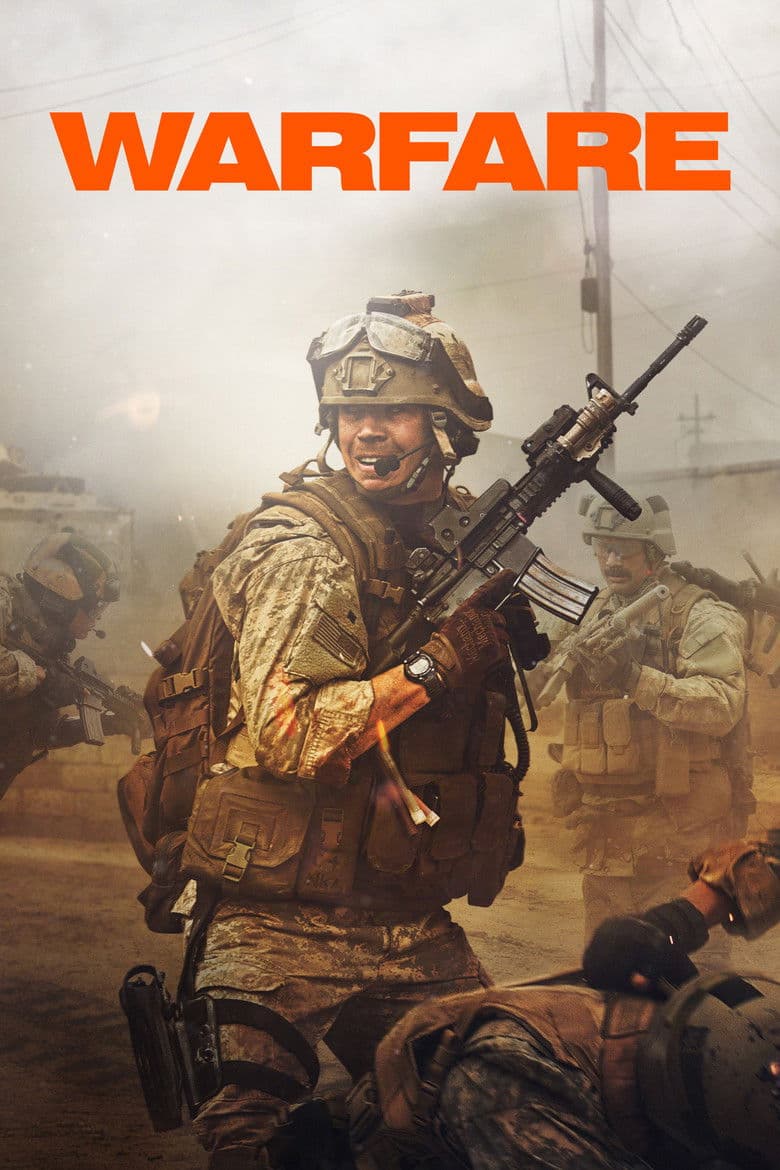
Warfare follows Ray Mendoza, a Navy SEAL communications worker, during a 2006 mission in Ramadi, Iraq. His platoon enters an Iraqi family’s home to watch nearby streets, but an attack traps the men and badly wounds two soldiers. Ray and the others must hold the building, call for help, and move the injured men while enemy fire closes in. The film stays close to their memories and uses real-time action, long quiet waits, loud gunfire, and graphic injuries to create a harsh, tense tone.
The film’s only clear representation question comes from casting Indigenous Canadian actor D’Pharaoh Woon-A-Tai as the real Hispanic veteran Ray Mendoza. The choice is visible because Ray is the main role, but interviews tie it to the actor’s similar upbringing and his fit for the part, not to a diversity message. The other soldiers are mostly male, and the story does not build plots around race, gender, sexuality, or identity. The main themes are unit loyalty, fear, physical pain, memory, and the damage that war leaves behind, while the Iraqi family remains a small but important reminder of civilian cost.
Community feedback
Was our 11% Woke rating accurate?
Breakdown
These are the editorial factors and ratings behind our score for Warfare.
Woke representation / casting
The film puts Indigenous Canadian actor D’Pharaoh Woon-A-Tai in the lead role of real Hispanic SEAL Ray Mendoza. The actor said he and Mendoza had similar upbringings. Mendoza said he wanted young actors with the right attitude and work ethic. The platoon also includes a Black Marine and actors from several backgrounds, but no character talks about identity. The casting creates a mild visible mismatch with the real man's background, but it does not drive the story.
16%
Woke political dialogue
Not present. No political, activist, identity-related, or social-justice dialogue appears; all conversation stays tactical, procedural, and focused on immediate survival and coordination.
0%
Identity-driven story themes
Not present. Narrative centers on combat chaos, memory, injury, evacuation, and soldier brotherhood in one specific historical event; no identity politics, representation arcs, gender themes, or modern social issues drive the story.
0%
Western institutional / cultural critique
Not present in this title.
0%
Woke character or canon changes
Not relevant. Story comes from direct participant memories of real 2006 events with no adaptation of existing characters, canon, or historical figures altered for ideological reasons.
0%
Anti-woke backlash and complaints
Not present in this title.
0%
Creator track record context
Ray Mendoza’s public work centers on truthful military accounts and has no known activist or identity-focused record. Alex Garland has made political films and discusses extremism, but his work is usually presented as uncertain rather than activist. Casting director Kharmel Cochrane publicly promotes fresh and diverse talent. That background adds only mild context because Warfare itself does not use a strong identity message.
17%
Production
Movie · 2025
Returning to the house where his family was brutally murdered during the war, "the man who refuses to die" dismantles it, loads it on a truck, and is determined to rebuild it…

Movie · 2021
After a blood- soaked jujitsu match in Dubai, fighting legend Mickey Kelley falls to superstar Blaine. But years later, an online video proves that Blaine cheated, and the world…
Movie · 2020
A small unit of U.S. soldiers, alone at the remote Combat Outpost Keating, located deep in the valley of three mountains in Afghanistan, battles to defend against an overwhelming…
Movie · 2026
A man takes justice into his own hands, hunting down criminals. His vigilante crusade makes him a social media star but puts him at odds with the local police chief.
Movie · 2025
The Demon Slayer Corps are drawn into the Infinity Castle, where Tanjiro, Nezuko, and the Hashira face terrifying Upper Rank demons in a desperate fight as the final battle…
Movie · 2019
In 1897, an army of 21 Sikhs battles 10,000 Afghans to prevent the Saragarhi Fort from being taken down.
Movie · 2022
The vicious, power-mad Kano is determined to take over Earthrealm, one soul at a time. Assisted by a trio of cold Black Dragon mercenaries, he embarks on a brutal assault from…
Movie · 2017
The story of the miraculous evacuation of Allied soldiers from Belgium, Britain, Canada and France, who were cut off and surrounded by the German army from the beaches and harbour…
